Kenya Dental Association Warns Against Unaccredited Healthcare Courses, Cites Risks to Patient Safety
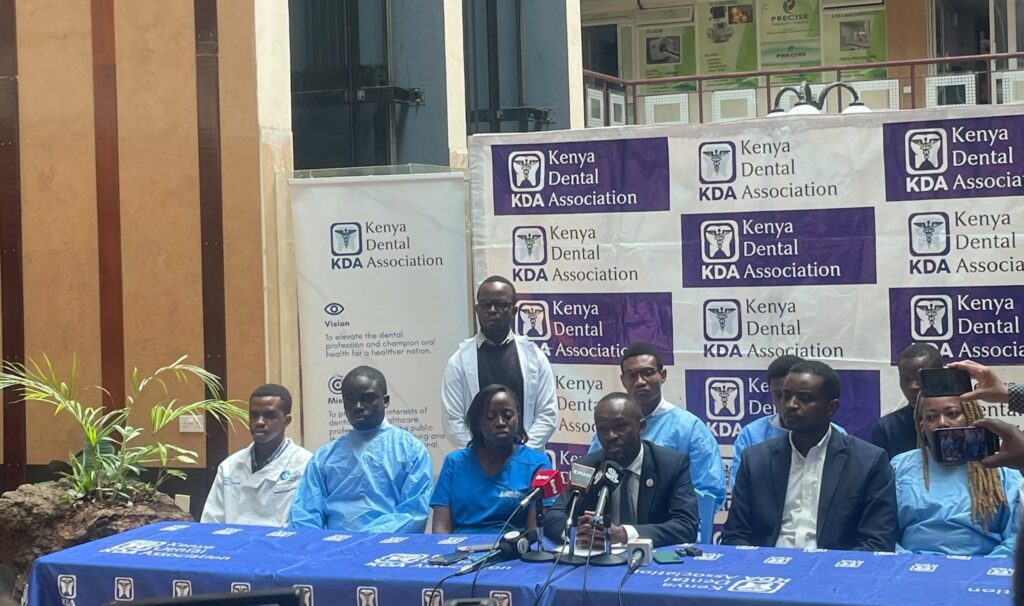
Kenya Dental Association Warns Against Unaccredited Healthcare Courses, Cites Risks to Patient Safety. Photo/Courtesy
By Ruth Sang
Kenya Dental Association has come out pretty worried about this whole growing thing with unaccredited and kind of low quality healthcare training courses being pushed out by some universities or colleges. They say it could leave people graduating without the right formation, and then yeah patient safety gets put at risk too.
While talking during a press briefing in Nairobi on Tuesday, KDA President **Dr Kahura Mundia** said basically every healthcare training place needs to line up their programmes with the kind of standards set by the Ministries of Health and Education. Otherwise, graduates will not really have the skills expected for professional work.
Dr Mundia explained that the Ministry of Health has already directed that all healthcare-related courses including dentistry medicine pharmacy and nursing must follow both national and international professional standards.
“The Ministry of Education and the Ministry of Health must work together because healthcare training cannot operate independently without consultation,” said Dr Mundia.
He pointed out that in Kenya, oral health teaching has mainly been through the Bachelor of Dental Surgery route, which has stayed the recognised baseline for decades. In his view, bringing in other degree pathways without the right backbone approvals and resources, just weakens the training part.
“We have a degree that has been in practice for the last 50 years , where students undergo rigorous training, internships and competency assessments before they are licensed. Universities cannot establish programmes without hospitals, equipment qualified trainers and patients for clinical exposure,” he said.
Dr Mundia added that people who join courses that are not approved may end up unable to obtain professional licences after finishing. That means money issues, and also years lost, because the qualification might not open the needed doors.
“These persons now risk non-licensure because they cannot see patients if they have not been trained in the right way,” he stated.
The KDA president also raised concern about new health training programmes in a number of institutions, saying some courses do not match the competency benchmarks that are recognised internationally for healthcare training.
He stressed that healthcare practitioners must finish supervised clinical practice, keep proper training logbooks, and complete internships before being allowed to practise on their own.
“You cannot go out and see patients without logbooks, internship records and proper supervision. Healthcare is not a place where you just stand near a doctor and watch,” he said.
He also said the Ministry of Health had earlier called meetings with universities, professional regulators, and other key stakeholders. During those meetings, institutions apparently committed to aligning their programmes with ministry instructions by September this year.
“To go back and claim there was no consultation is mischievous because the universities attended the meetings and committed themselves to standardisation,” he said.
He further urged private universities to pour in enough into healthcare training facilities and infrastructure so they can meet global benchmarks.
“We need enough doctors in the country, but they must be properly trained to provide quality healthcare services,” he added.
When addressing a recent court ruling connected to the issue, Dr Mundia said the court told the Ministry of Education to give guidance, but he insisted that any moves should include consultation with the Ministry of Health.
“The Ministry of Health has already consulted the Ministry of Education, so there is nothing to celebrate about continuing with illegal programmes,” he said.
The KDA president urged parents and prospective students to check whether healthcare programmes are accredited before enrolling.
“Parents should be careful not to take their children to schools offering programmes that do not meet professional standards,” he warned.
He added that some students who were affected by accreditation concerns have already been advised to go through refresher and retraining programmes, to ensure their qualifications meet the required national competencies.
Other KDA officials attending the briefing said the association’s stance is meant to protect public health and keep professional standards strong across the healthcare industry.
Dr Muiridi Kaari, a prosthodontist and lecturer, described the rise of these programmes as a type of “quackery in training,” saying it threatens the dental profession’s credibility.
Meanwhile, Dr Laura Izaya, a lecturer at the University of Nairobi School of Dental Sciences, acknowledged that Kenya faces a shortage of healthcare workers, but warned that it should not be used to justify lowering training standards.
“A shortage does not mean we expose people to substandard care. It means we must increase efforts to train qualified personnel who can provide quality healthcare,” she said.
The association also said it is concerned about the quick expansion of medical colleges and healthcare programmes that operate without proper accreditation. They warned that graduates from such setups may struggle to get professional recognition.
About Author