Court Jails Man Behind Sh151 Million Fake Mineral Deal, Orders Compensation to Chinese Investor
Officials said the outcome sends a strong warning to criminal networks involved in elaborate investment scams and fraudulent export schemes.

Suspect. Photo/Courtesy.
By Robert Mutasi
A court in Nairobi has sentenced the architect of a multimillion-shilling fake mineral scheme to three years in prison or a fine of Sh10 million after finding him guilty of defrauding a foreign investor in a bogus tantalum export deal.
In a judgment delivered at the Milimani Law Courts on Wednesday, the court convicted Ulundu Patrick Lumumba, who is also known by the aliases Gabriel Kulonda and Lumumba Patrick Byarufu, of obtaining money by false pretences.
The court further directed that Sh151 million lost by a Chinese businessman in the fraudulent transaction be refunded.
The conviction brings to an end a high-profile investigation into a sophisticated scam that exploited the lucrative international market for tantalum, a valuable mineral used in the manufacture of electronic components.
According to investigators, Lumumba masterminded a scheme that convinced a Chinese investor to purchase what was presented as a shipment of tantalum destined for export. However, the consignment allegedly contained sand rather than the precious mineral.
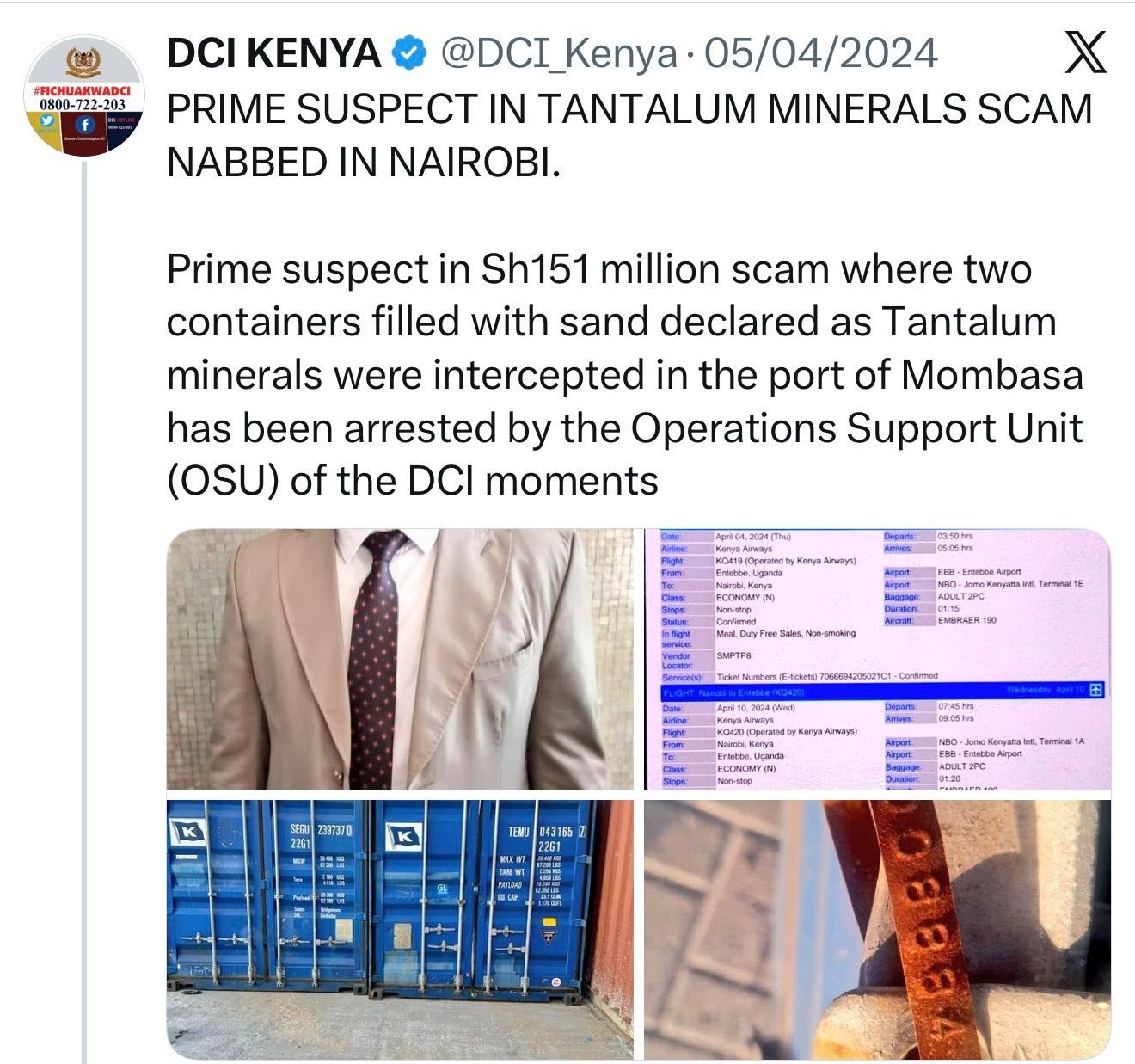
Detectives from the Directorate of Criminal Investigations (DCI) arrested the suspect on April 5, 2024, shortly after he arrived in Nairobi from Entebbe, Uganda.
Investigators revealed that authorities had earlier placed restrictions on one of his travel documents. Despite this, he allegedly attempted to enter the country using alternative identification papers and different names.
The case unfolded after one of the exported containers was opened abroad and discovered to contain drums filled with sand instead of tantalum. The discovery prompted an extensive investigation that uncovered what detectives described as a carefully planned transnational fraud operation.
Further inquiries at the Port of Mombasa led investigators to additional containers that had allegedly been prepared using the same method. Authorities found that the consignments were falsely documented as mineral exports despite containing ordinary sand.
The findings exposed what investigators believe was a wider criminal network operating across several countries and targeting investors seeking to participate in the international minerals trade.
During the trial, prosecutors presented evidence linking Lumumba to the fraudulent transactions and demonstrated how the scheme resulted in substantial financial losses for the foreign investor.
The court ultimately found the evidence sufficient to sustain a conviction under Section 313 of the Penal Code, which deals with obtaining money through false representations.
The Directorate of Criminal Investigations welcomed the ruling, describing it as a significant victory in the fight against organised economic crimes and cross-border fraud.
Officials said the outcome sends a strong warning to criminal networks involved in elaborate investment scams and fraudulent export schemes.
The conviction is expected to strengthen efforts by law enforcement agencies to protect investors and preserve confidence in Kenya’s trade and investment environment.
With the sentence now handed down and compensation ordered, the case stands as one of the most significant prosecutions involving fraudulent mineral exports in recent years, highlighting the growing determination by authorities to pursue those behind complex international scams.
About Author