US Official Defends Kenya as Preferred Location for Ebola Quarantine Facility
The proposal has sparked legal battles and public protests, even as Kenyan authorities intensify preparedness measures in high-risk counties.
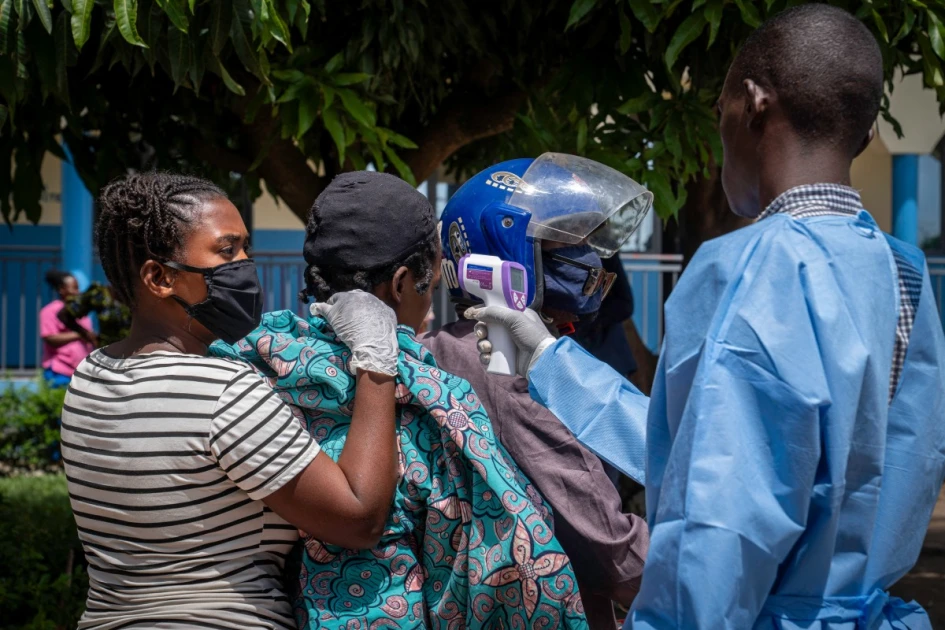
A health worker (R) measures the temperature of a patient (2nd L) suspected of having Ebola as she is transported by motorcycle taxi to Rwampara Hospital in Ituri, in the eastern Democratic Republic of Congo. Photo/Courtesy
By Ruth Sang
A senior United States health official has defended the decision to consider Kenya as a location for an Ebola quarantine facility, citing the country’s geographical proximity to the Democratic Republic of Congo (DRC), where a fresh outbreak of the virus has been reported.
Speaking during a White House briefing on Tuesday, Dr. Mehmet Oz, who heads the Centers for Medicare & Medicaid Services (CMS), said Kenya’s location makes it a practical option for handling Americans who may have been exposed to the disease.
“As a doctor, I want to take the patient to the operating room next to where they are sick, not to the building next to them or two blocks away because that time is precious,” Dr. Oz said.
He noted that while there are several locations that could host such a facility, transporting potentially infected individuals over long distances would not be the most effective approach.
“There are many places we can send folks, but sending them across the world, especially when we are not sure about what’s going on with them, is not the wisest move,” he added.
The remarks come amid concerns over a recent Ebola outbreak in the northeastern part of the Democratic Republic of the Congo. Authorities in the DRC reported on May 15 that the outbreak in the conflict-affected Ituri Province had resulted in 48 deaths from 321 confirmed cases. Neighboring Uganda has also reported nine infections and one fatality linked to the disease.
According to reports, President William Ruto approved plans allowing the United States to establish a quarantine centre at the Laikipia Air Base in Nanyuki for its citizens who may require isolation and monitoring.
Dr. Oz revealed that discussions between Kenyan and U.S. authorities are ongoing following a court decision that halted construction of the proposed facility.
“The State Department is confident that they will work something out with Kenya. There has already been a fair amount of communication around this issue,” he said.
The legal dispute continued on Tuesday when the High Court extended orders suspending the project. The court directed the government to provide details of any agreements, memoranda, arrangements or negotiations relating to the proposed quarantine centre.
In addition, the court ordered the disclosure of all public health, environmental, biosafety and security assessments conducted in relation to the facility. It also sought information on approvals obtained from Parliament, relevant regulatory agencies and county governments.
Meanwhile, the Ministry of Health has intensified preparedness efforts by identifying 25 counties as being at elevated risk in the event of an Ebola outbreak.
Counties classified as “very high risk” include Nairobi, Mombasa, Uasin Gishu, Busia, Kisumu, Bungoma, Trans Nzoia, Siaya, West Pokot, Turkana, Homa Bay and Migori. Many of these counties are located along Kenya’s international borders and major transit routes.
Those listed as “high risk” include Vihiga, Kakamega, Nakuru, Kericho, Nandi, Kiambu, Machakos, Kilifi, Makueni, Taita Taveta, Isiolo, Elgeyo Marakwet and Garissa.
The proposed quarantine facility has generated significant public debate, with residents in Nanyuki staging demonstrations on Monday to oppose its establishment in the area.
Critics argue that Kenya’s healthcare system may face challenges in handling a highly infectious disease outbreak and warn that accommodating Ebola patients could pose risks to public health and national security.
Despite the concerns, President Ruto has maintained that his decision was informed by Kenya’s close partnership with the United States and broader international cooperation efforts in public health preparedness.
About Author