The Women Uasin Gishu Refuses to Forget
The measure of progress will not be how loudly Kenya mourns the next woman who dies. It will be whether more women are protected while they are still alive.

Uasin Gishu County Deputy Governor Evans Kapkea flags off a procession during a campaign to end gender-based violence in Eldoret, Uasin Gishu County, on Saturday, September 12, 2026. The procession brought together women and other stakeholders in a public call for an end to gender-based violence.
By James Gitaka
Women walked through the streets of Eldoret on Saturday carrying a message they wanted the city — and the country — to hear: They were done treating violence against women as an inevitable part of life.
The procession came less than two weeks after Doris Murei, a 45-year-old nurse, was shot dead at a General Service Unit mess near the Eldoret State Lodge.
As they moved through the city on Sept. 12, the women made a public declaration against gender-based violence, calling for greater protection of women and girls and insisting that killings that might once have been treated as private tragedies be confronted as a public crisis.
Their protest was not only about Murei.
It carried the names and memories of women whose deaths have unsettled Uasin Gishu and the wider Rift Valley in recent years — among them medical student Ivy Wangechi, distance runner Agnes Tirop, Bahraini athlete Damaris Muthee Mutua and Ugandan Olympian Rebecca Cheptegei.
And now, Murei.
Her family was burying her on Friday in Tiaty, Baringo County.
Murei’s death has become the latest focal point in a county where women gathered to say that mourning alone is no longer enough.
Police Constable Nathan Kirwa was arrested in connection with Murei’s death and appeared before an Eldoret court, which granted investigators 21 days to continue their inquiries, including recording witness statements and awaiting postmortem and forensic reports. He has not taken a plea. The case is scheduled to be mentioned on Sept. 23.
According to police, the shooting occurred on Aug. 30 at the Naiberi GSU Mess Compound near the State Lodge.
The circumstances surrounding the death remain under investigation, and the allegations against Kirwa have yet to be tested in court.
For the women who marched through Eldoret on Saturday, however, the case has become part of a larger question: How many women must die before violence against women is treated not as a series of individual tragedies, but as a crisis demanding sustained action?
The names behind the statistics
Pastor Bones Biwot, founder of the Women of the Living Waters community organisation, told the gathering that gender-based violence could no longer be treated as a private matter.
“Nobody has been given a mandate to take anybody’s life,” she said.
Her words came against a backdrop of concern over several deaths in Uasin Gishu in recent weeks.
Murei was killed on Aug. 30.
High-school teacher Charity Kitur died on Aug. 12.
And on Aug. 6, the body of 26-year-old Lilian Chepkor was discovered inside a timber yard along Booster Street, a day after she had been reported missing.
The three cases are at different stages of investigation and court proceedings.
A death does not automatically establish femicide, nor does it establish who was responsible or why. Those questions belong to investigators, prosecutors and, ultimately, the courts.
But the accumulation of cases has nevertheless created alarm among women, human-rights advocates and community leaders.
A region where athletic glory has met violence
Uasin Gishu and neighbouring counties are internationally known as a heartland of distance running, producing athletes whose careers have taken them to Olympic stadiums and world championships.
The region has also been the setting for several cases of violence against female athletes that have drawn international attention.
Agnes Tirop, a Kenyan distance runner and former world record holder, was found dead at her home in Iten in October 2021.
Her husband, Ibrahim Rotich, was charged in connection with her death. The case has remained before the courts, with proceedings facing delays and further legal developments.
The following year, the body of Bahraini athlete Damaris Muthee Mutua was found in Iten. Her death added to growing concern over violence against women in Kenya’s high-altitude athletics communities.
Then came Rebecca Cheptegei.
The Ugandan marathon runner competed at the Paris Olympics in 2024. Weeks later, she was attacked and set on fire in Trans Nzoia County. She died at Moi Teaching and Referral Hospital in Eldoret in September 2024.
Her former partner, Dickson Ndiema Marangach, was identified in reports as the attacker. He later died from injuries sustained in the incident.
Cheptegei’s death reverberated far beyond Kenya.
She had competed on the world’s biggest sporting stage only weeks earlier. Her death brought international attention to the vulnerability of women in intimate relationships and the dangers faced by female athletes who live and train far from home.
For residents of the Rift Valley, however, these were never simply international headlines.
They were women who lived, worked and trained in communities not far from their own.
The violence behind the numbers
The statistics help explain why the women gathered in Eldoret are demanding more than condolences.
According to the 2022 Kenya Demographic and Health Survey, 41.9 percent of women aged 15 to 49 in Uasin Gishu reported having experienced physical violence since age 15, compared with 33.9 percent nationally. About 9.9 percent reported having experienced sexual violence.
The same survey found that about 39 percent of women aged 15 to 49 in Uasin Gishu who had ever been married or had an intimate partner had experienced physical, sexual or psychological or emotional violence from their most recent husband or partner.
These figures describe experiences of violence; they do not measure killings alone.
And they cannot capture every woman who remained silent.
They cannot count every threat made behind a closed door, every relationship that became dangerous, every girl who was afraid to tell her family, or every survivor who decided that reporting violence would bring more consequences than protection.
That silence is one of the central challenges confronting the campaign against gender-based violence.
The 2022 survey also found that 43.1 percent of women and 42.2 percent of men in Uasin Gishu agreed that a husband was justified in hitting or beating his wife for at least one specified reason.
For campaigners, such attitudes are part of the environment in which violence can become normalised.
“I refuse gender-based violence”
Grace Akinyi understands what it means to carry violence from childhood into adulthood.
Speaking at Saturday’s gathering, she described herself as a survivor of sexual violence experienced when she was a child.
Then she made a declaration that became one of the clearest statements of the gathering.
“I refuse gender-based violence,” she said.
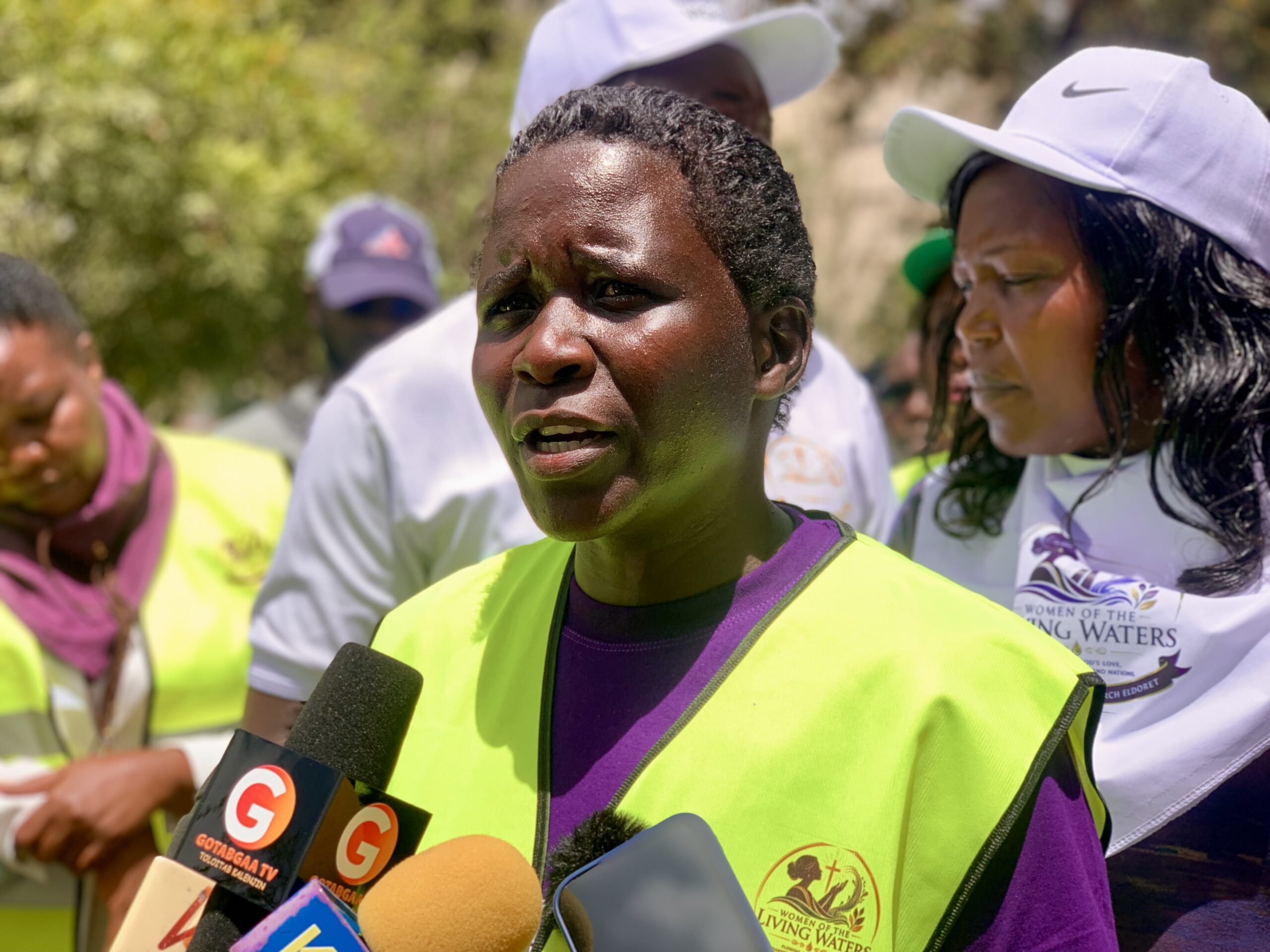
There was no attempt to turn her experience into spectacle.
Instead, Akinyi used her testimony to demand that adults protect children and that survivors be heard when they speak.
Her story illustrates one of the most difficult dimensions of gender-based violence: Survival does not necessarily end when the immediate danger ends.
Survivors may have to rebuild their confidence, relationships, education, economic independence and sense of safety.
For many, the first battle is simply being believed.
The responsibility of men
Cyril, who leads the Boy Child Mentors community organisation, said men must become part of the solution.
Men, he said, should stand with women, challenge abusive behaviour among their peers and support girls rather than blame victims.
“Everybody deserves to live,” he said.
Cyril|Women cannot be expected to solve a crisis in which men are often perpetrators, witnesses or potential interveners.
He called for an end to femicide in Uasin Gishu and warned against reducing victims to statistics.
The numbers, he said, represent human beings — sisters, mothers and people with futures.
His message reflects an increasingly important dimension of Kenya’s response to gender-based violence: Women cannot be expected to solve a crisis in which men are often perpetrators, witnesses or potential interveners.
Prevention requires men to participate.
A national reckoning
The events in Uasin Gishu are unfolding amid a wider national reckoning over killings of women in Kenya.
A presidential working group established in late 2024 was tasked with examining the causes and patterns of femicide and recommending measures to address gaps in law enforcement, legislation and social responses.
A subsequent report based on National Police Service data recorded 1,639 cases involving the killing of women between 2022 and 2024. The report said 578 such cases were recorded in 2024, up from 535 in 2023. It also noted that police data did not previously classify femicide as a distinct category, making the scale and nature of the problem more difficult to track.
The figures have intensified calls for better data, faster investigations and stronger prevention.
But statistics alone cannot answer the question being asked by the women in Eldoret.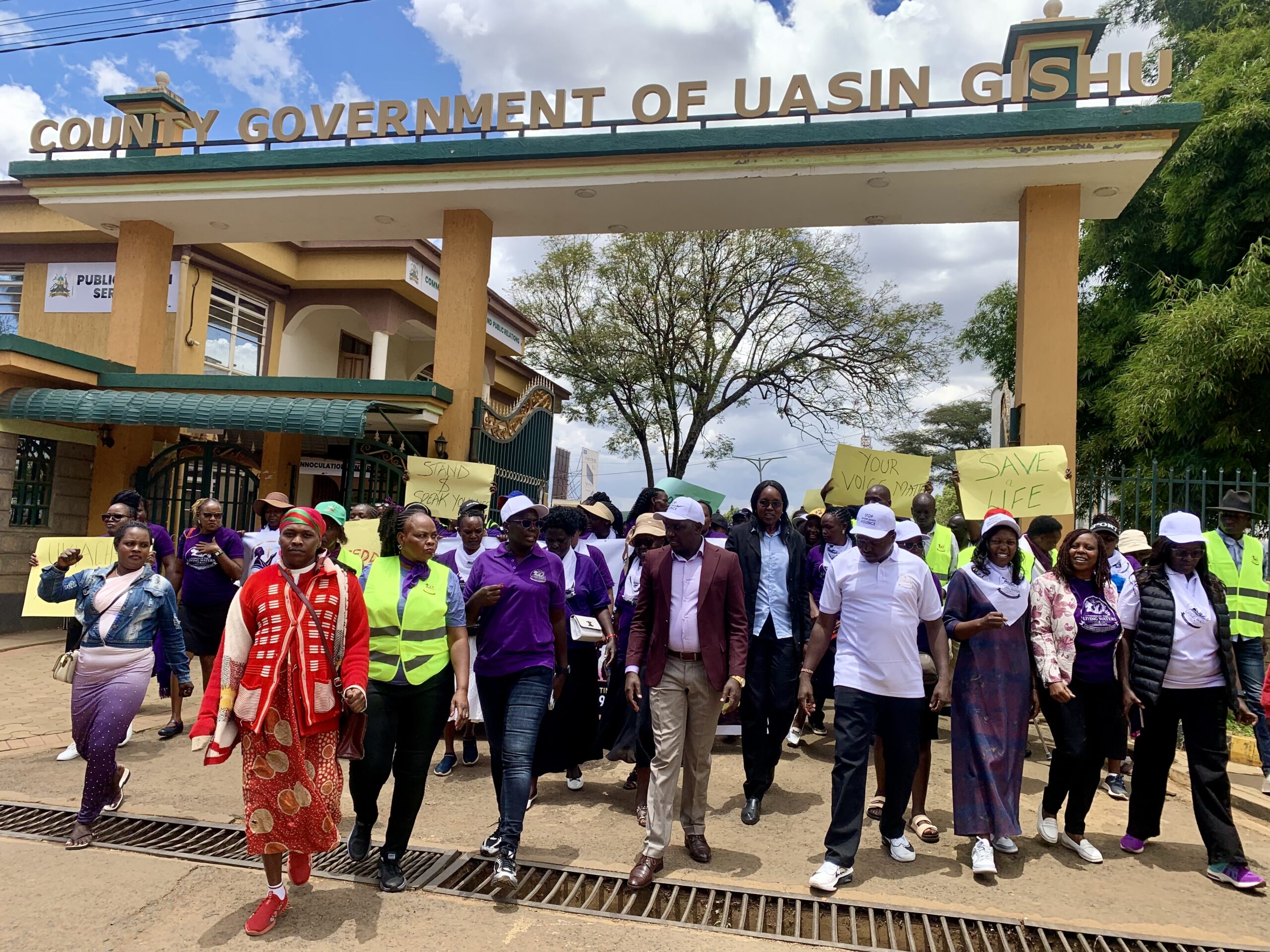
Uasin Gishu Deputy Governor Evans Kapkea and a pastor Biwott lead a GBV awareness procession outside the Uasin Gishu County Headquarters in Eldoret.
They want to know whether institutions can move quickly enough to prevent the next death.
The question is particularly urgent when survivors say they are afraid to speak, when families struggle to respond to women trying to leave abusive relationships, and when communities treat intimate-partner violence as a private dispute rather than a potential threat to life.
Uasin Gishu leaders have called for grassroots campaigns, community dialogue and safe spaces, while urging men to break their silence around gender-based violence.
But the women gathered in Eldoret are asking for something that cannot be delivered by policy documents alone.
They want protection to work before a woman becomes a headline.
A place that remembers
There is something particularly unsettling about the geography of Murei’s death.
The GSU compound near the State Lodge is only a short distance from the area where Ivy Wangechi’s life ended in 2019.
Wangechi was a sixth-year medical student at Moi University when she was attacked outside Moi Teaching and Referral Hospital on April 9, 2019. Naftali Kinuthia was later convicted and sentenced to 40 years in prison for her murder.
Murei was a health worker who had spent years caring for other people.
Tirop was an international champion.
Cheptegei was an Olympian.
Mutua was an athlete building a life in Kenya.
Different women. Different lives. Different circumstances. Different investigations.
Their stories should not be collapsed into a single narrative when the facts of each case are distinct.
Yet their deaths have entered the same national conversation about the safety of women.
That is the tension at the centre of the debate.
The danger in drawing easy connections between individual cases is that every death has its own circumstances, and those circumstances must be established through investigation and due process.
The danger in failing to see the broader pattern is greater still.
Because each case leaves behind families who must continue living after the headlines disappear.
What happens after the headlines?
On Saturday, the women of Uasin Gishu did not ask to be remembered only when another woman is killed.
They asked to be protected while they are alive.
Their procession through Eldoret was therefore more than a demonstration.
It was an appeal to families to listen.
To men to intervene.
To institutions to act.
To survivors to know that speaking out should not cost them their dignity or safety.
And to government authorities to ensure that a woman seeking help encounters protection rather than indifference.
Doris Murei’s family was burying her on Saturday.
The investigation into her death continues. A police officer remains in custody in connection with the case, and the facts surrounding the shooting will have to be established through the legal process.
But her death has already entered a much larger story.
A story that includes Ivy Wangechi, Agnes Tirop, Damaris Mutua and Rebecca Cheptegei — women whose lives have become part of Kenya’s increasingly urgent conversation about violence against women.
Their names should not become a roll call of women Kenya failed to protect.
They should become a reason to act before another family receives the call that changes everything.
And that may be the most important message from the women who walked through Eldoret today:
The measure of progress will not be how loudly Kenya mourns the next woman who dies. It will be whether more women are protected while they are still alive.
About Author