Kagwe Urges Africa to End Raw Commodity Exports, Calls for Fairer Global Trade
He said the practice discourages value addition in producing countries and leaves African farmers trapped in low-income commodity markets.
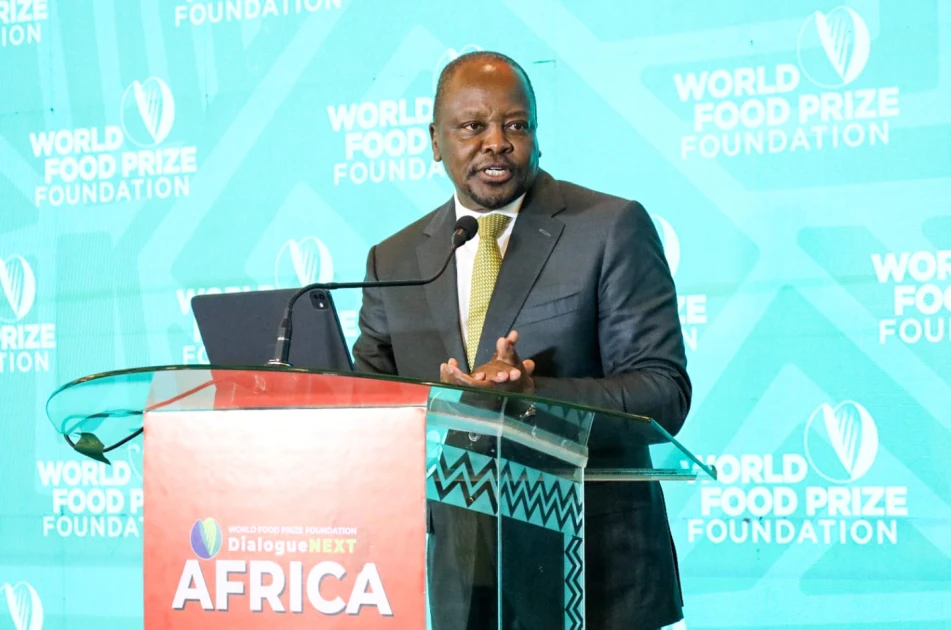
Agriculture Cabinet Secretary Mutahi Kagwe. Photo/Courtesy.
By Robert Mutasi
Agriculture Cabinet Secretary Mutahi Kagwe has called on African countries to push for reforms to global trade rules, arguing that tariff policies imposed by developed economies continue to undermine industrialization and deny the continent the full value of its agricultural exports.
Speaking Monday during the DialogueNEXT Forum convened by the World Food Prize Foundation in Nairobi, Kagwe criticized the practice of tariff escalation, in which developed markets admit raw agricultural commodities at low or zero tariffs while imposing higher duties on processed products.
He said the practice discourages value addition in producing countries and leaves African farmers trapped in low-income commodity markets.
“It is difficult to explain to an African farmer why it is acceptable to export raw coffee but prohibitively expensive to export roasted coffee,” Kagwe said.
The Cabinet secretary said tariff escalation has prevented African economies from moving up the global value chain by encouraging the export of raw commodities while manufacturing, branding and packaging take place elsewhere.
He noted that countries producing coffee, tea, cocoa, macadamia, cotton and hides often export raw materials only to import finished products at significantly higher prices.
Kagwe urged African governments to adopt policies that promote domestic processing before export, saying value addition would create jobs, increase export earnings and strengthen rural economies.
He pointed to Kenya’s ban on the export of raw in-shell macadamia as an example of policies designed to encourage local processing and expand the country’s agro-industrial capacity.
According to Kagwe, similar approaches should increasingly be adopted in the coffee and tea sectors so that roasting, packaging and branding are carried out within Africa before products reach international markets.
“Every stage of processing completed within Africa creates jobs, increases farmers’ incomes and strengthens rural economies,” he said.
“The son and daughter of the farmer should find employment in coffee roasting plants, tea packaging factories, macadamia processing industries, food manufacturing, logistics and agricultural technology, not feel compelled to abandon farming communities in search of jobs elsewhere.”
Kagwe also called for policy reforms to support agricultural industrialization, criticizing taxes imposed on agro-processing machinery and mechanization equipment.
He said such measures contradict government efforts to modernize agriculture and expand manufacturing.
“We cannot claim to support value addition while taxing the machinery needed to establish agro-processing industries. We cannot encourage mechanization while making agricultural equipment prohibitively expensive,” he said.
The Cabinet secretary also urged financial institutions to redesign agricultural lending models to better reflect the realities of farming.
He said commercial banks and development finance institutions should provide flexible financing with repayment schedules aligned to production cycles, alongside affordable long-term credit and weather-indexed insurance products.
According to Kagwe, improving access to finance, promoting local value addition and removing barriers to agro-industrial investment are critical to making agriculture more profitable and attractive to young people.
“If we truly believe in equitable global development, international trade rules must reward value addition, not punish it,” he said.
The DialogueNEXT Forum, held under the theme “Born to Feed the Future,” brought together agriculture ministers, scientists, policymakers, researchers, farmer organizations, development partners and private sector leaders from across Africa and beyond to discuss the future of food systems, agricultural innovation, trade and food security.
Among those attending were Madagascar’s Minister of Livestock Riana Nantenaina Randrianomenjanahary, Senegal’s Minister Delegate in charge of Livestock Ousmane Diagne and 2017 World Food Prize Laureate Dr. Akinwumi Adesina, alongside representatives from international agricultural and development institutions.
About Author