How Vivo Energy Is Helping Eldoret Mechanics Power Kenya’s Food Chain
To most Kenians, mechanics are the backbone of many industries. But to those in Uasin Gishu County, these skilled workers represent food security.

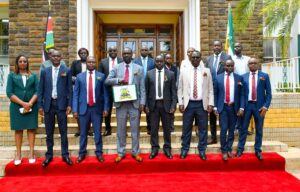
L–R: William Boinnet, Director, Tess Distributors Ltd; Simon Mwangi, Most Valuable Player (MVP) of the football tournament; Kasim Manya, *Golden Boot* winner; and Stephen Gikonyo, Lubricants & LPG Sales and Marketing Manager, Vivo Energy Kenya, during the awards ceremony at the 2nd Mechanic Wellness Day held in Eldoret.
By James Gitaka
While the swish of traffic along Eldoret’s Northern Bypass highway on a Saturday morning is the usual reminder of an active business route for traders and motorists in the city, the rumbles of 16-tonne lorries filled with bags of maize from Turbo, tractors girding to till Moiben’s rich soils, matatus waiting to take Ziwa traders to their markets, and motor-cyclists ferrying spares after dropping them off are all sounds emanating from a single source.
The men and women in oil-stained overalls.
More than a hundred mechanics from the North Rift arrived in Eldoret on Saturday to lay down their spanners and pick up football boots, darts and pool sticks as Vivo Energy Kenya’s 2nd annual Mechanics Wellness Day got underway with the theme ‘Celebrating the people behind Kenya’s mobility ecosystem’.
Held under the banner of health and wellness awareness, the event’s significance reverberated through the town as mechanics in the region get recognition for their role in Kenya’s food production and distribution chain, and industrial activity.
The Invisible Backbone
To most Kenians, mechanics are the backbone of many industries. But to those in Uasin Gishu County, these skilled workers represent food security.
While the county supplies over 40% of the country’s maize as the nucleus of Kenya’s breadbasket, it is the tractors, planters, combines and irrigation pumps that enable farmers to turn this bounty into profits. Similarly, without the trucks that carry the grains to the National Cereals and Produce Board depots, or to Mombasa and across the borders to Uganda and Sudan, much of the produce would languish in the fields. Even the piped water that keeps dairy farmers in Kesses busy is a mechanical marvel that needs regular servicing.
And where better to understand the symbiosis between mechanics, farmers and traders than in Uasin Gishu?
“Behind every safe journey, every successful delivery and every successful harvest is a mechanic whose expertise makes it possible. Behind every mechanic should be a partner that cares,” said Stephen Gikonyo, lubricants and liquefied petroleum gas sales and marketing manager at Vivo Energy Kenya, during award presentations at the event.
This support is a form of value addition that comes in various forms depending on how integrated a mechanic is in a given supply chain.
A mechanic in Soy village who services a 75 horse-power tractor and advises his farmer customer to use Shell lubricants is helping that individual add value to his investment in a number of ways, including increasing the distance covered per litre of fuel, shortening harvest durations and lowering running costs.
Where the Bypass Meets the Breadbasket
Nowhere is this value addition more critical than on the route of the Northern Bypass.
The 32 km road that is meant to divert heavy traffic away from the town and connect the Suam border to the Northern Corridor has attracted commercial activities along the Elgon View, Cheplaskei and Maili Tisa routes.
Warehouses, grain storage facilities, spares dealers, jua kali workshops, fabrication firms and catering outlets have cropped up to serve the needs of the motorists plying along the by-pass.
At one garage, mechanics were seen changing a lorry’s oil while at the next, another team was servicing a commercial vehicle that delivers fertilizer from Mombasa. At the third, a mechanic was repairing a plough for a farmer from Ainabkoi.
All of them are integral parts of the county’s bustling agricultural production system and its commercialization channels.
In fact, the value addition that mechanics provide cuts through everything that makes up the county’s famed agricultural produce.
County agricultural statistics show that Uasin Gishu’s 120,000 plus hectares of maize production is testimony to the significant role the mechanics in the county play in facilitating increased yields through higher mechanization.
As much as 30 % of farms in the county were fully mechanized a decade ago and this figure is fast rising with the county’s tractor hire programme that complements private mechanization efforts.
Without a mechanic within 10 kms to do minor servicing and major repairs on tractors, the “breadbasket” moniker would not have been realized.
Health, Dignity and the Cost of Living
Despite the invaluable services, mechanics often work under very poor working conditions.
This is where the wellness day comes in.

Apart from allowing the mechanics to have a day off their routine to engage in healthy competition, including football, darts and snooker, Vivo Energy Kenya together with Equity Afya offered medical screenings to mechanics and their family members.

Equity Afya representative Ezra Omwancha noted that apart from the general wellness checks such as blood pressure, blood sugar, eye and body scans, the company’s doctors are also on standby to offer treatment and advice to mechanics.
“For instance, mechanics often work in confined spaces, lift heavy engine parts and face other physical challenges on the job. Through this initiative, we will ensure that they have access to healthcare services and are fit to continue serving in this vital sector,” said Mr Omwancha.
The wellness day is part of Vivo’s value addition proposition to its customers across Kenya, Tanzania, Uganda, Rwanda, Ethiopia and Eritrea.
With over 4,200 retail petrol stations in 29 African markets, the company has committed to promoting the mobility ecosystem through technical support to mechanics, advisory services on products such as lubricants, and safety awareness to enhance customer care.
These services have a huge bearing on the wider economy as mechanics are often consultants to ordinary motorists and farmers.
A roadside mechanic I spoke to in Eldoret noted that a casual motorist’s choice of oil often determines how fast his vehicle will deteriorate.
“The same applies to farmers. For instance, a 90 kg bag of maize will cost a farmer about 350 shillings to transport from Eldoret to Nairobi when using standard oil. The amount jumps to almost 500 Shs if the oil used is counterfeit. By implication, every consumer is being charged more due to cheap, substandard spares and oil,” said the mechanic.
A similar argument can be made for the maintenance schedules that mechanics recommend to farmers. With the cost of cultivating a hectare of maize using tractors at 200,000 Shs, farmers will be unable to profit from their investments if they spend significantly higher amounts on maintenance, for instance, due to fake oil.
A thriving mechanic market, therefore, helps lower the costs of farming and by extension, the prices of most goods and services in the country.
The Human Chain
But what stood out in this week’s event was the human chain that makes up these mechanics.
“Am 34 years old and have three apprentice learners with me. Most of them completed Form Four and could not afford to go to college. They start by learning diagnosis before progressing to electrical wiring and later engine servicing. After two years, they will be on their own and take in another two learners,” said 34-year-old Kipkemoi Rono as he showed me around his garage.
This is an informal technical vocational education and training (TVET) system that has produced many of the mechanics in the North Rift.
While many young people go to formal institutions and emerge as engineers, few are able to practice mechanical engineering because of the costs involved.
Mr Rono and his peers have filled this skills gap by producing competent mechanics who can handle both 1998-model Isuzu FH trucks and 2024 John Deere tractors.
It is this human resource that enables farmers to plant and harvest simultaneously as is the case with most commercial farms in the county.
With Kenya’s mobility ecosystem embracing cleaner technologies and more efficient machinery, including electric motorcycles, tractors and buses, the mechanics’ skills will have to be upgraded consistently to keep up with the new demands.
While Saturday’s wellness day will be remembered by many mechanics for the darts and football tournaments, the message by Mr Gikonyo in his opening remarks about investing in Kenya’s mobility manpower holds true.
“As we celebrate the people behind Kenya’s mobility ecosystem, Vivo Energy Kenya wishes to invest in the people who make it all possible,” said Mr. Gikonyo before the tournament.
Indeed, as the music dies down today (Sunday), the mechanics have already resumed their duties along the Northern Bypass as traders, farmers and traders keep the county’s food basket moving.
About Author