Senator Jackson Mandago Highlights Legislative Push Behind Kenya’s Health Sector Reforms

0

Beyond lawmaking, the Senate Health Committee has intensified oversight visits to counties to assess healthcare delivery.

Uasin Gishu Senator and Chairperson of the Senate Standing Committee on Health, Jackson Kiprotich arap Mandago, whose legislative agenda has focused on advancing health sector reforms, strengthening Universal Health Coverage, and enhancing access to quality healthcare through policy, oversight and legislative initiatives.
By James Gitaka

 Uasin Gishu Senator Jackson Kiprotich arap Mandago has outlined the legislative milestones spearheaded by the Senate Standing Committee on Health, showcasing a series of reforms aimed at strengthening Kenya’s healthcare system through improved financing, digital transformation, patient protection and community health.

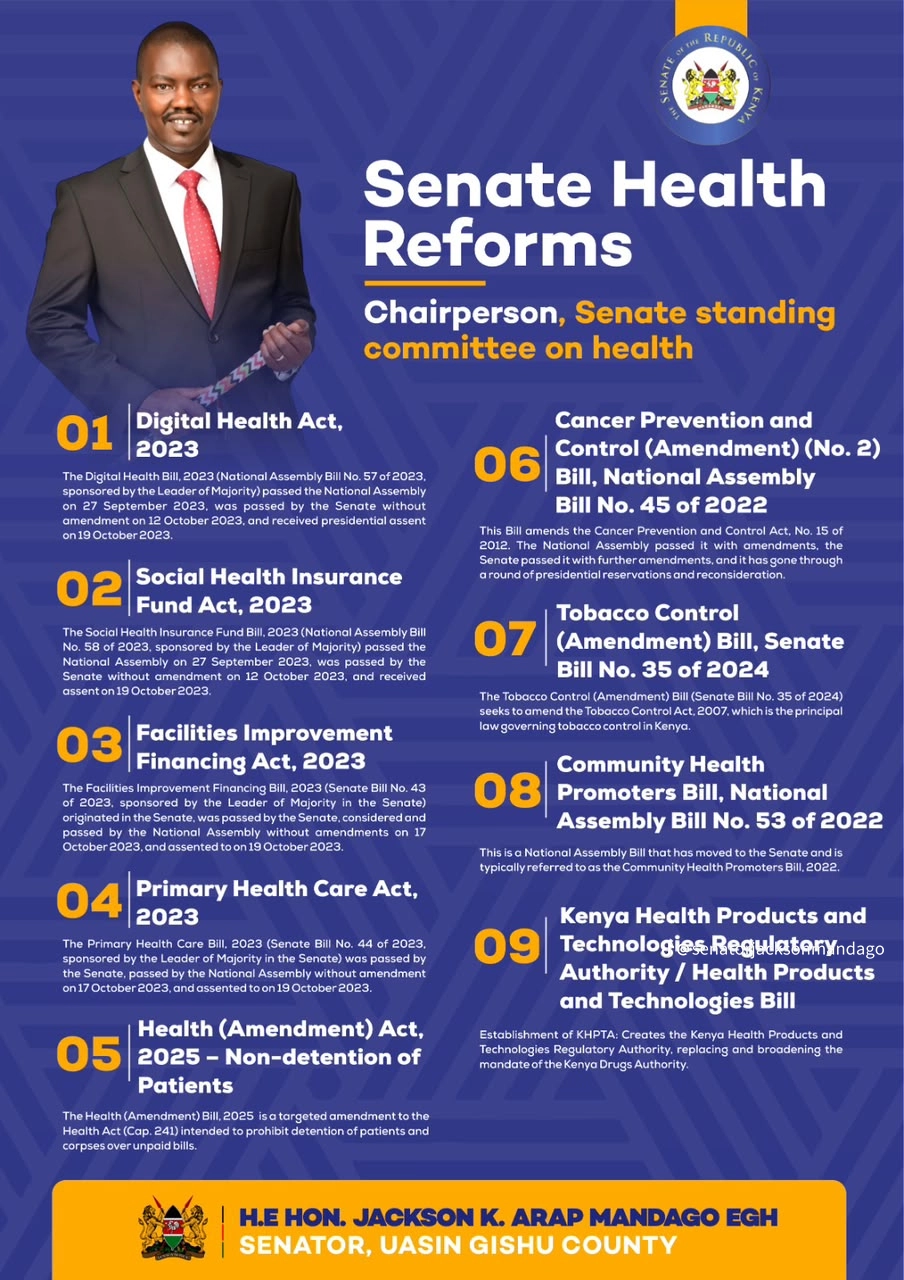
An infographic shared by the senator’s office highlights key health laws and Bills championed or considered under his leadership as Chairperson of the Senate Standing Committee on Health, underscoring the Senate’s role in shaping the country’s health policy agenda.

The legislative package comes as Kenya continues implementing Universal Health Coverage (UHC) reforms anchored on four major health laws enacted in 2023, while Parliament considers additional legislation to modernize regulation, strengthen primary healthcare and improve access to quality health services.

Among the reforms highlighted is the Digital Health Act, 2023, which established the legal framework for digitizing healthcare records and improving the delivery of health services through technology.

The senator also cites the Social Health Insurance Act, 2023, legislation that replaced the former National Health Insurance Fund (NHIF) with the Social Health Authority (SHA) as part of broader efforts to expand affordable healthcare coverage.

Other landmark laws include the Facility Improvement Financing Act, 2023, which allows public health facilities to retain and utilize revenues collected from services to improve operations, and the Primary Health Care Act, 2023, designed to strengthen preventive and community-based healthcare.

The infographic further outlines several Bills that have either passed through Parliament or are under consideration by the Senate.

Among them is the Health (Amendment) Bill, 2025, which seeks to prohibit hospitals from detaining patients or the bodies of deceased persons over unpaid medical bills—a practice that has drawn widespread criticism from human rights groups and healthcare advocates.

According to the Health Committee’s report, the proposed amendment is intended to strengthen patients’ rights while promoting equitable access to healthcare regardless of a person’s financial circumstances.

Other measures include amendments to the Cancer Prevention and Control Act, the Tobacco Control Act, the proposed Community Health Promoters Bill, and legislation establishing the Kenya Health Products and Technologies Regulatory Authority, aimed at strengthening oversight of medicines and medical technologies.

Beyond lawmaking, the Senate Health Committee has intensified oversight visits to counties to assess healthcare delivery.

In recent months, the committee has inspected public health facilities, raising concerns over staffing shortages, inadequate medical equipment, inconsistent drug supplies and infrastructure challenges affecting service delivery.

During one such inspection, Senator Mandago emphasized that achieving Universal Health Coverage requires sustained investment in county hospitals.

“We cannot talk about Universal Health Coverage when facilities at the grassroots are still struggling with basic supplies and adequate personnel,” Mandago said during a Senate Health Committee oversight visit.

He added that the committee’s oversight work is intended to ensure accountability and translate findings into legislative and policy interventions that improve healthcare across the country.

The reforms highlighted by Senator Mandago align with the national government’s ongoing health transformation agenda.

The Ministry of Health has identified the Digital Health Act, Social Health Insurance Act, Primary Health Care Act and Facility Improvement Financing Act as the four cornerstone statutes underpinning Kenya’s Universal Health Coverage programme. The Ministry says these laws provide the legal framework for expanding access to healthcare, improving financing, digitizing health services and enhancing transparency within the sector.

The Senate Standing Committee on Health continues to review additional legislation, including Bills on assisted reproductive technology, community health and regulation of emerging healthcare services, as Parliament seeks to modernize Kenya’s health legal framework.

Since his election to the Senate in 2022 after serving two terms as Governor of Uasin Gishu County, Senator Mandago has chaired the Senate Standing Committee on Health, one of the House’s key oversight committees.

Under his leadership, the committee has focused on strengthening county health systems through legislative reforms, oversight of devolved health services, public participation on health Bills and engagement with national and county health stakeholders.

The senator says the committee remains committed to supporting policies that promote affordable, accessible and quality healthcare for all Kenyans while enhancing accountability in the management of public health resources.

About Author

Leave a Reply

Your email address will not be published. Required fields are marked *