Nurses Demand Concrete Action Before Ending Prolonged Nationwide Strike
The Kenya National Union of Nurses and Midwives (KNUNM) says it remains open to constructive engagement with both the national government and the Council of Governors.
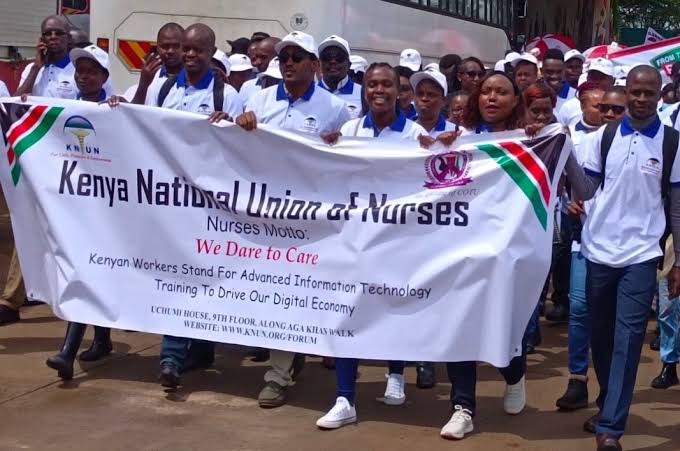
Photo: Courtesy.
By Robert Mutasi
Kenya’s nurses have made it clear they are prepared to call off their nationwide strike, but only after the government and county leaders fully implement long-outstanding agreements on their employment terms.
The industrial action, which began on July 29 and has now entered its fifth week, continues to disrupt public health services across the country. Patients in many counties face delays and restricted access to care as the standoff drags on.
The Kenya National Union of Nurses and Midwives (KNUNM) says it remains open to constructive engagement with both the national government and the Council of Governors. However, Secretary General Seth Panyako stressed that the union will not accept empty promises. Talks must lead to actual implementation before nurses return to work.
Panyako spoke after meeting Mombasa Governor Abdulswamad Nassir, who chairs the CoG Health Committee. The union is intensifying direct engagement with governors in a bid to resolve the dispute.
“We have met Governor Nassir to deliberate and explore solutions to resolving the ongoing nationwide nurses’ strike,” Panyako said. He described the conflict as a national labour issue centred on the welfare of nurses and midwives, not a campaign against patients. The union, he added, is pursuing multi-level diplomacy at both county and national levels to address grievances and restore normal services in health facilities.
Key demands include the full implementation of the 2017 return-to-work agreement, conclusion and enforcement of the nurses’ collective bargaining agreement (CBA), adoption of career progression guidelines, and the permanent absorption of Universal Health Coverage (UHC) workers into pensionable employment. Outstanding county-level agreements and other employment grievances must also be settled.
Some progress has been recorded in recent discussions. On career progression guidelines, the union and governors have tentatively agreed to form a joint committee to review and develop an implementation framework. The union has also welcomed government steps to address the status of UHC workers, though it insists on formal confirmation of their permanent and pensionable positions. A presidential directive has been issued to resolve related human resource and payroll issues.
“The President, when he promises like that, in Kenya, we expect the words of the President to be honoured and implemented,” Panyako said.
The CBA remains the primary obstacle. Panyako said the agreement must be finalised and submitted to the Salaries and Remuneration Commission for a letter of no objection before any return to work. Further meetings are planned this week in the hope of securing that clearance.
Union official Maurice Odhiambo was categorical: “The nurses will not go back to work until we have the CBA, until we have the UHC staff getting their letters of PNP and paid gratuity, until our career progression guidelines are implemented.” He also criticised governors who have begun recruiting new nurses during the strike, questioning why money is suddenly available for hiring while long-standing grievances remain unresolved.
His remarks followed Governor Nassir’s directive for the immediate recruitment of 573 nurses on contractual terms in Mombasa. Nassir has maintained that the county faces no shortage of nurses and that more than 1,000 people would apply if positions were advertised. He has appealed to health workers to end the strike and give dialogue a chance.
The union insists that only its national leadership has the authority to formally end the industrial action. Branch officials cannot unilaterally call it off. Odhiambo urged nurses to remain firm even in counties where they had been told the strike was over.
“We reassure our nurses and the public that the strike is on until the governors and SRC act,” he said.
The union has previously given the Salaries and Remuneration Commission a seven-day ultimatum to issue the necessary no-objection letters. It has also warned that the dispute could widen, with a possible extension of the strike to national referral hospitals if no settlement is reached.
For now, nurses are offering dialogue rather than surrender. Their message is unambiguous: they are ready to negotiate, but any return to the wards must be backed by signed agreements, official approvals and genuine implementation. The 2017 return-to-work formula, signed to end an earlier prolonged strike, still has key provisions that remain unfulfilled.
About Author