Nakuru Records Highest Number of School Closures as Student Unrest Spreads Across Kenya
Nakuru County has recorded the highest number of school closures linked to recent student unrest, with at least 15 schools across several counties affected by strikes, fires and demonstrations.
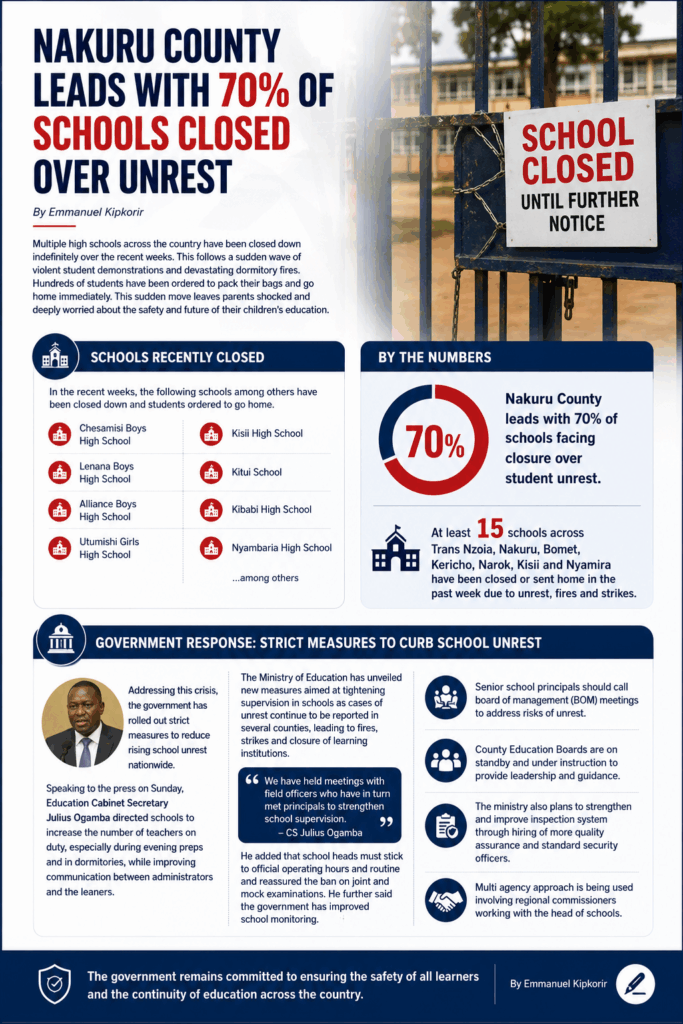
Nakuru leads in school closures as government steps up efforts to curb rising student unrest.Photo/Courtesy
By Emmanuel Kipkorir
Nakuru County has emerged as the most affected region in the ongoing wave of student unrest that has led to the closure of several secondary schools across the country.
In recent weeks, numerous learning institutions have been shut down indefinitely following incidents of student demonstrations, strikes and dormitory fires, disrupting learning and raising concerns among parents and education stakeholders.
Hundreds of students have been sent home as school administrations move to contain the unrest and protect learners and property.
Among the schools affected are Chesamisi Boys High School, Lenana School, Alliance High School, Utumishi Girls High School, Kisii High School, Kitui School, Kibabi High School and Nyambaria High School, among others.
According to recent education sector reports, Nakuru County accounts for approximately 70 percent of the reported school closures linked to student unrest. At least 15 schools across Trans Nzoia, Nakuru, Bomet, Kericho, Narok, Kisii and Nyamira counties have either been closed or temporarily suspended learning activities over the past week due to strikes, fires and related incidents.
In response to the growing crisis, the government has introduced a series of measures aimed at restoring order and preventing further disruptions in schools.
Speaking on Sunday, Education Cabinet Secretary Julius Ogamba directed schools to strengthen supervision by increasing the number of teachers on duty, particularly during evening study sessions and in boarding facilities.
“We have held meetings with field officers who have, in turn, engaged principals to strengthen supervision and improve management within schools,” Ogamba said.
The CS also emphasized the need for stronger communication between school administrators and students to address grievances before they escalate into unrest.
The Ministry of Education has further rolled out measures to tighten oversight and monitoring in schools as authorities seek to curb the rising cases of strikes and property destruction.
Ogamba instructed school heads to adhere to established operating procedures and reiterated the government’s position on the ban of joint and mock examinations.
“Senior school principals should convene Board of Management meetings to address potential risks of unrest. County Education Boards have been directed to provide leadership, guidance and support where necessary,” he said.
The CS noted that the ministry is enhancing its inspection and quality assurance systems through the recruitment of additional education quality assurance and standards officers.
“We are strengthening school monitoring mechanisms to ensure learning institutions remain safe and conducive for education,” he added.
The government is also implementing a multi-agency approach involving regional commissioners, county education officials and school administrators to address the challenges contributing to student unrest.
Education stakeholders continue to call for increased guidance and counselling services, improved student engagement and enhanced safety measures as efforts intensify to restore stability in schools across the country.
About Author