Climate Crisis Hits Kenya’s Food Basket as Farmers Gamble on a Second Planting After Failed Rains Destroy Maize Crops
From Nandi to Uasin Gishu, delayed rainfall and worsening climate extremes are threatening maize production, raising fears of reduced harvests, rising food prices and greater dependence on imports.
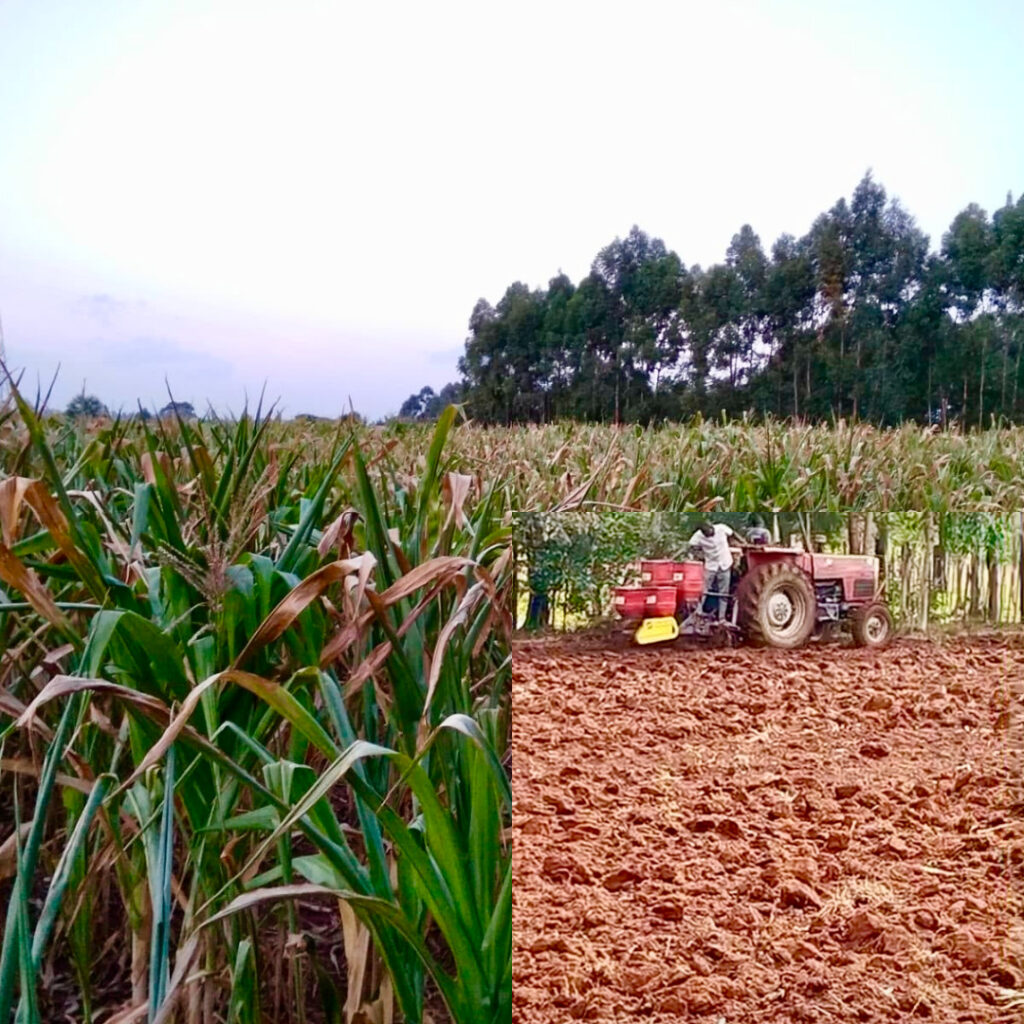
Sections of Dr. Henry Rotich's farm in Mosop, Nandi County, showing maize damaged by prolonged dry spells alongside land being prepared for a second planting as the farmer races against time to salvage part of the growing season. Photos by Henry Rotich.
By James Gitaka
Standing in the middle of what should have been a thriving maize field in Kipkenyo, Uasin Gishu County, Dr. Henry Rotich surveys five acres of withered crops that have become another casualty of Kenya’s increasingly unpredictable climate.
Originally from Nandi County but farming in Uasin Gishu—one of Kenya’s leading maize-producing regions—Rotich has watched months of investment disappear after prolonged dry spells struck during the crop’s most critical growth stages.
The delayed rains destroyed the crop before it reached maturity, forcing the farmer into a painful decision: abandon the failed crop and prepare the land for a second planting in the hope that the anticipated rains will still salvage part of the season.
Unlike many failed maize crops that can still be harvested as livestock silage, Rotich says this season’s crop was beyond recovery.
“The first crop is gone,” he said. “Most of the maize never even reached the flowering and pollination stage, making it unsuitable even for quality silage. What little we managed to salvage has very little value. For us, it is a total loss.”
He explains that the prolonged dry spell interrupted the crop before tasseling and pollination, leaving the plants unable to produce grain.
“Without pollination there is no maize. Once the crop reaches that stage, there is virtually nothing left to harvest. We have prepared the land again because we still hope the rains will come, but this is another costly gamble.”
Rotich is among hundreds of farmers across Kenya’s North Rift—widely regarded as the country’s food basket—who are counting heavy losses after erratic weather disrupted this year’s long-rains planting season.
In Uasin Gishu County alone, agricultural officials estimate that more than 40,000 acres of maize have been severely affected by the drought, translating into a potential loss of nearly 800,000 bags of maize based on average yields.
The crisis extends beyond Uasin Gishu into Nandi, Trans Nzoia and neighbouring counties, where thousands of farmers are uncertain whether to replant, wait for rain or abandon the season altogether.
Kenya relies heavily on these counties for maize production, with annual output typically ranging between 40 and 48 million 90-kilogram bags depending on seasonal rainfall. Any significant reduction in harvests could tighten supplies, increase maize prices and raise the country’s food import bill.
For Rotich, the losses are especially painful because he has spent years championing environmental conservation.
As one of the leaders behind the restoration of 74 hectares of degraded forest in the Nandi Escarpment, Rotich has worked with the Kenya Forest Service, Nandi County Government and conservation partners to restore indigenous forests in Chepkiep Forest. Last month, Governor Stephen Sang, Head of Public Service Felix Koskei and Environment Cabinet Secretary Dr. Deborah Mlongo Barasa joined local communities in planting indigenous trees to rehabilitate the fragile ecosystem.

Photo by James Gitaka
“The changing weather is no longer a theory,” Rotich said. “It is happening in our farms. Climate change is affecting food production, livelihoods and ultimately our national food security. Conserving forests is no longer just about protecting nature—it is about protecting agriculture.”
Scientists have repeatedly warned that climate change is increasing the frequency of delayed rains, prolonged droughts and erratic weather across East Africa, disrupting traditional planting calendars and exposing farmers to repeated crop failures.
The uncertainty comes as global food markets also remain under pressure. Fertilizer prices have risen sharply since early 2026, significantly increasing production costs for farmers already struggling with unpredictable weather. Reduced fertilizer use due to higher costs could further lower yields, even if rainfall improves later in the season.
Weather forecasts indicating a high probability of El Niño developing later this year present another challenge. While the phenomenon could bring much-needed rainfall to some regions, it may also trigger flooding and further disrupt agricultural production if farmers are not adequately prepared.
Kipkorir Menjo, Director of the Kenya Farmers Association, said the current crisis should not have caught the country by surprise.
“The Kenya Meteorological Department has significantly improved the accuracy of its seasonal forecasts,” Menjo said. “The warning signs were there, but unfortunately we continue to react after farmers have already suffered losses instead of planning ahead.”
He said the government must move beyond issuing advisories and urgently roll out practical interventions to help farmers recover.

File photo courtesy of Kipkorir Menjo.
“This is the time for action, not statements,” he said. “Many farmers borrowed money to buy seed, fertilizer and prepare their land. Government should consider restructuring or writing off some of these agricultural loans through institutions such as the Agricultural Finance Corporation and strengthen cooperative societies so farmers can access affordable credit without exploitation by middlemen.”
Menjo urged farmers in affected areas to shift quickly to short-season crops that can still mature if the expected rains arrive.
“If the rains begin now, we could still recover between 40 and 50 percent of this season’s production,” he said. “Farmers should immediately plant certified short-season crops such as wheat, potatoes, cabbages and other suitable varieties. That message needs to be amplified by both national and county governments so there is rapid uptake.”
He also warned that poor local harvests could force Kenya to increase maize imports, putting additional pressure on scarce foreign exchange reserves.
“When local production declines, government has little choice but to import maize,” Menjo said. “That means billions of shillings leave the country instead of supporting Kenyan farmers. Investing in local farmers today is far cheaper than importing food tomorrow.”
He called for emergency subsidies on certified seeds, increased financing through the Agricultural Finance Corporation and stronger extension services to help farmers adapt to changing weather patterns.
“We must support farmers with quality seed, timely information and affordable financing,” he said. “If we fail to act now, the effects will be felt not only in our farms but also in every household through higher food prices.”
For Rotich, however, the crisis is about more than statistics or policy debates.
As tractors prepare his fields for another planting, he knows he is taking another gamble against a climate that has become increasingly unpredictable.
Still, like thousands of farmers across Kenya’s food-producing counties, he remains hopeful.
“Farmers never stop believing,” he said, gazing toward clouds gathering over the Nandi Hills. “We plant because we believe the rains will come. But we cannot fight climate change alone. Farmers need government support, timely information and climate-smart solutions if Kenya is to secure its food future.”
As the planting season enters a critical window, the coming weeks may determine whether Kenya salvages a significant portion of its maize harvest—or faces a year of lower production, higher food prices and increased dependence on imports. The outcome will not depend on rainfall alone, but also on how quickly policymakers respond to one of the country’s most pressing climate and food security challenges.
About Author