Kenya Intensifies Crackdown on Fake Medicines as WHO Warns of Growing Health Threat
The newly established steering committee will coordinate implementation through technical working groups responsible for each strategic pillar.
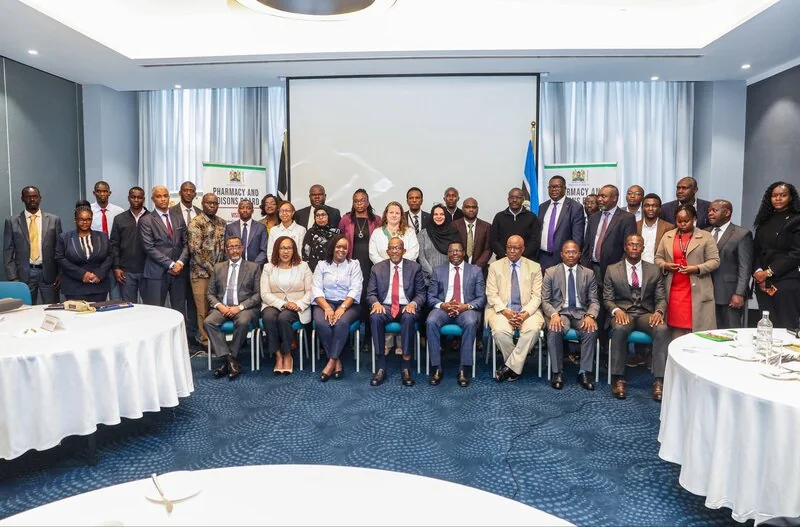
Health Cabinet Secretary Aden Duale launches the Interministerial Steering Committee to coordinate Kenya's fight against substandard and falsified medicines, following WHO warnings that one in 10 medical products in Africa is counterfeit or of poor quality. Photo : Courtesy.
By Robert Mutasi
The Kenyan government has stepped up efforts to combat substandard and falsified medicines following a World Health Organization (WHO) warning that one in every 10 medical products circulating in Africa is either substandard or counterfeit, posing a significant threat to public health.
Health Cabinet Secretary Aden Duale on Monday inaugurated an Interministerial Steering Committee to oversee implementation of Kenya’s National Action Plan on Substandard and Falsified Medical Products, an initiative aimed at strengthening coordination among regulators, law enforcement agencies and border authorities.
The committee will provide strategic oversight in preventing, detecting and responding to counterfeit medicines while addressing weaknesses in regulation, enforcement and supply chains that have allowed illicit products to enter the market.
“Substandard and falsified medical products remain a major threat to patient safety, health security and economic development,” Duale said during the launch.
“They contribute to treatment failure, antimicrobial resistance and preventable deaths while eroding public confidence in our healthcare system and threatening the success of Taifa Care and Universal Health Coverage.”
According to the WHO, counterfeit and poor-quality medicines contribute to more than 267,000 deaths each year in Africa due to ineffective antimalarial drugs and a further 169,271 deaths linked to substandard antibiotics used to treat severe pneumonia in children.
Health experts attribute the growing trade in counterfeit medicines to porous borders, informal markets, cross-border smuggling, weak regulatory enforcement and organized criminal networks.
Duale said tackling the problem requires collaboration across multiple institutions rather than relying on regulators alone.
“Addressing this challenge requires a coordinated whole-of-government and whole-of-society approach involving regulatory agencies, law enforcement, border control authorities, county governments, healthcare professionals, manufacturers, distributors, development partners and the public,” he said.
The launch comes as the Pharmacy and Poisons Board (PPB) reports a significant increase in surveillance and enforcement activities across the pharmaceutical sector.
Since 2021, the regulator has recorded 1,413 product quality complaints, coordinated 99 product recalls, received 32,833 reports of adverse drug reactions and issued 18 public alerts on suspected falsified medical products.
Since January 2025 alone, the PPB has conducted 58 product recalls, issued 14 rapid alerts and closed 200 non-compliant pharmaceutical outlets while arresting and prosecuting offenders.
According to the board, the increase in product recalls reflects stronger surveillance, expanded reporting systems and enhanced post-market monitoring rather than a rise in unsafe medicines alone.
The regulator has also strengthened inspections at Kenya’s designated ports of entry through comprehensive physical inspections, intelligence-led operations, risk-based profiling and rapid screening technologies.
In addition, the PPB has established 15 post-marketing surveillance sentinel sites and 30 pharmacovigilance sentinel sites across the country to improve early detection of poor-quality medicines and adverse drug reactions.
PPB Chairperson Dr. John M. Munyu said Kenya has made significant progress in strengthening pharmaceutical regulation but warned that counterfeit medicines continue to exploit weaknesses across the supply chain.
“While these reforms have strengthened our regulatory system, they are not enough,” Munyu said.
“Substandard and falsified medical products exploit weaknesses across supply chains, border control, law enforcement and criminal networks. No regulator, regardless of its capacity, can address this challenge alone.”
Among the counterfeit products previously detected in Kenya’s regulated market are fake Truvada, counterfeit Viagra, falsified HIV rapid test kits and counterfeit heparin injections.
Health experts warn that falsified HIV medicines can lead to treatment failure and drug-resistant infections, while fake diagnostic kits may produce inaccurate results that delay treatment. Counterfeit heparin injections have also been associated with severe bleeding, organ damage and, in some cases, death.
Kenya’s National Action Plan is built around five strategic pillars: prevention, detection, response, communication and sustainability.
The strategy seeks to strengthen border controls, improve intelligence sharing, enhance investigations and prosecutions, introduce digital medicine traceability systems, increase public awareness and secure the pharmaceutical supply chain.
The newly established steering committee will coordinate implementation through technical working groups responsible for each strategic pillar.
Its immediate priorities include finalizing the National Action Plan, mobilizing financial resources, coordinating implementation and establishing monitoring and evaluation systems to measure progress.
Health officials said the initiative marks a significant step toward safeguarding patients from counterfeit medicines and ensuring that Kenyans have access to safe, effective and quality-assured medical products.
About Author