IMF Signals Need for Strong Fiscal Reforms as Kenya Seeks New Financing Deal
By March 2025, the country had drawn approximately KSh404 billion before exiting the programme, leaving a balance of KSh63.4 billion.
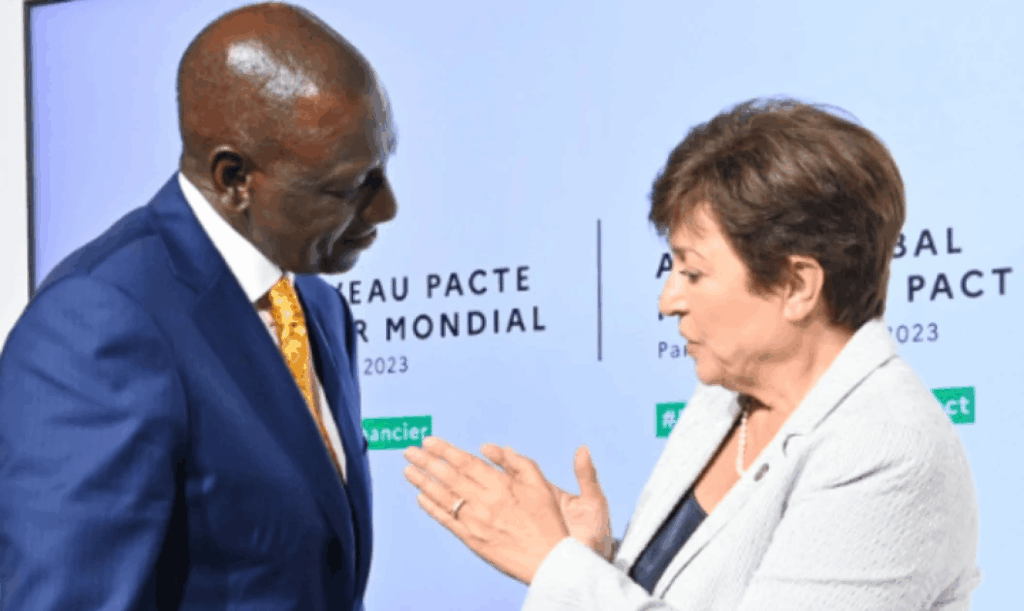
President William Ruto and Kristalina Georgieva, Managing Director of the International Monetary Fund (IMF), at the "New Global Financing Compact" summit in Paris on 22 June 2023. Photo/ Courtesy
By Ruth Sang
The International Monetary Fund (IMF) has indicated that ongoing discussions with the Kenyan government remain inconclusive, stressing that any future programme will depend on Nairobi presenting a credible fiscal consolidation plan to address rising debt pressures.
IMF Africa Department Director Abebe Aemro Selassie said negotiations with President William Ruto’s administration are still underway, noting that Kenya is navigating a complex financing environment shaped by volatile global markets and tightening access to international capital.
“Kenya is, of course, a market access country or shifting towards a market access country. And you know, the market access these days has become very, very volatile. And so, the government is continuously thinking about how to best address its financing needs,” Selassie said.
He added that while IMF support remains an option, Kenya ultimately aims to rely more on market-based financing. “IMF, of course, is an option, but in the long run, of course, it wants to be a market access country,” he noted.
Selassie said Kenya has made progress in strengthening its external buffers but emphasized that the Fund is waiting for a clear fiscal direction before any new programme is agreed. “What we would like to see for programme discussions to advance is a path towards credible fiscal consolidation,” he said.
Fiscal consolidation refers to policy measures aimed at reducing public debt accumulation, including spending cuts and efforts to broaden the tax base. Such reforms are considered key to improving debt sustainability and boosting investor confidence.
The IMF official explained that discussions remain constructive, but Kenya has yet to make a final decision on whether to pursue a new IMF-backed arrangement. He added that the country is currently using a combination of liability management strategies to ease repayment pressures while assessing future financing options.
Selassie also noted that the IMF is not applying a uniform approach across countries, but is instead evaluating financing needs on a case-by-case basis as governments reassess their fiscal positions.
On concerns over so-called “hidden debt” in Kenya, Selassie dismissed the claims, saying there is no evidence of undisclosed borrowing. He clarified that recent discussions only involved the classification of certain government transactions and arrears within official statistics.
“These obligations are already known to the IMF and are only included in official debt figures once they are confirmed, following standard reporting rules,” he said.
Kenya previously entered into a programme with the IMF in April 2021 under the Extended Fund Facility (EFF) and Extended Credit Facility (ECF), which aimed to support economic recovery and address structural fiscal challenges.
Under the arrangement, Kenya was eligible for KSh467.5 billion in financial support. By March 2025, the country had drawn approximately KSh404 billion before exiting the programme, leaving a balance of KSh63.4 billion.
The EFF provides countries up to four years to implement reforms, while the ECF can be extended to five years depending on programme conditions.
About Author