Government Reviews 2013 Environmental Policy to Address Emerging Climate Challenges
The Environment Secretary stated that devolution had just begun at the time when the 2013 policy was implemented
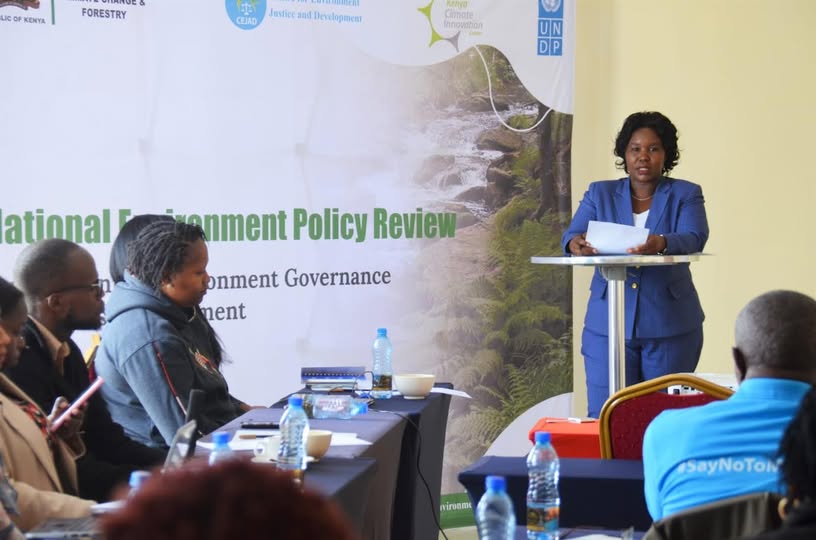
Dr. Selly Kimosop, Environment Secretary. Photo/Courtesy
By Ruth Sang
The Government is conducting a review of the 2013 National Environmental Policy through its State Department for Environment and Climate Change to address the emerging problems in environmental and climate change.
The stakeholders needed to examine the existing policy gaps while they identified the key partners who would help develop new framework update methods during the three-day technical workshop which took place in Machakos.
Dr. Selly Kimosop who works as Environment Secretary in the State Department for Environment and Climate Change said the review provides an opportunity to update the policy according to current climate changes and technological advancements and shifting societal and economic conditions.
The implementation of environmental and technological and social economic changes which have occurred since the policy development needs a policy update to maintain its present status and future operational capabilities.
The policy review will address issues linked to the triple planetary crisis—climate change, biodiversity loss, and pollution—while also promoting a circular economy that supports reuse, repair, and recycling. According to Dr. Kimosop, this approach could create up to 46,000 jobs by 2030.
The implementation of circular economy principles should take place across all sectors which include industry and agriculture and urban development and infrastructure because this approach provides both environmental advantages and economic development potential.
The revised policy will establish systems which enable carbon markets and climate financing and green investments and flood hazard mapping and gender-specific flood relief for affected communities.
Dr. Kimosop emphasized the requirement for immediate policy action through flood hazard mapping and community relocation assistance to handle the escalating lake waters which currently increase during the rainy season.
The national and county governments need stronger coordination to operate effectively because institutional collaboration shows the current policy framework’s main shortcoming according to her explanation.
The Environment Secretary stated that devolution had just begun at the time when the 2013 policy was implemented. She stated that environmental stakeholders at the county and national levels require a formal coordination system to improve their environmental management partnerships.
About Author