Government Releases KSh49.8 Million to Compensate Human-Wildlife Conflict Victims in Kajiado
The compensation package covers verified claims involving deaths, injuries, destruction of crops, livestock losses and damage to property caused by wildlife.
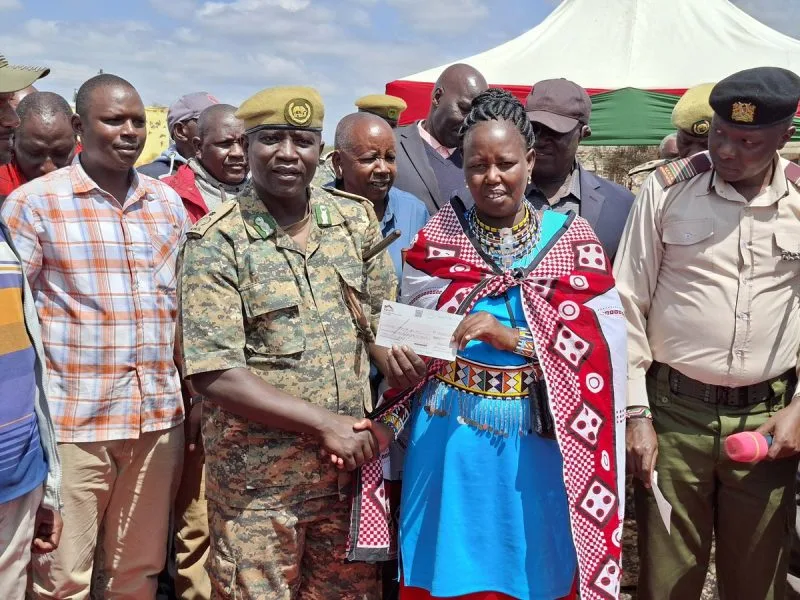
Government officials present compensation cheques to victims of human-wildlife conflict during a ceremony in Kimana, Kajiado County, where KSh49.8 million was released to compensate 187 affected individuals and support coexistence between communities and wildlife. Photo:Courtesy.
By Emmanuel Kipkoech
The government has released KSh49.8 million to compensate 187 victims of human-wildlife conflict in Kajiado County, reaffirming its commitment to supporting communities living alongside wildlife while strengthening conservation efforts.
The compensation ceremony was held in Kimana Town and was presided over by Secretary for Administration Tobiko Nayioma on behalf of the State Department for Wildlife. The event brought together officials from the Kenya Wildlife Service (KWS), National Government Administration Officers, county leaders and members of the local community.
Speaking on behalf of Principal Secretary Silvia Museiya, Nayioma said the government remains committed to assisting families affected by wildlife attacks while pursuing sustainable conservation measures.
“Communities living alongside wildlife should not carry the burden of conservation alone. The Government will continue to support affected families and strengthen measures that promote peaceful coexistence,” he said in a statement.
The compensation package covers verified claims involving deaths, injuries, destruction of crops, livestock losses and damage to property caused by wildlife.
According to the State Department for Wildlife, 145 beneficiaries received compensation cheques totaling KSh24.9 million during the ceremony, while payments to the remaining eligible claimants will be processed at a later date.
Human-wildlife conflict remains a major challenge in counties bordering national parks and wildlife conservation areas, particularly in Kajiado County, where communities frequently encounter elephants, lions, hyenas and other wild animals.
According to the Kenya Wildlife Service, the increasing frequency of such incidents has been linked to climate change, prolonged drought, shrinking wildlife habitats and expanding human settlements, all of which have intensified competition for land, water and other natural resources.
The government also announced several long-term interventions aimed at reducing conflicts between people and wildlife. These include expanding electric fencing around conservation areas, strengthening rapid response teams, constructing additional water points for wildlife, promoting predator-proof livestock enclosures, restoring degraded wildlife habitats and improving early warning systems for communities living near protected areas.
“The Government has allocated KSh1.4 billion nationally for compensation, but our main goal is to prevent conflicts and ensure people and wildlife live together peacefully,” the statement said.
The compensation forms part of the government’s broader strategy to balance wildlife conservation with the livelihoods of communities living near protected ecosystems. Kenya’s wildlife sector is a key contributor to tourism, one of the country’s leading foreign exchange earners, making peaceful coexistence between people and wildlife a national priority.
Officials urged residents to continue reporting wildlife incidents promptly to enable faster response by KWS officers and facilitate verification of compensation claims.
About Author