DIG Lagat Calls for Stronger Police-Community Partnerships at Eldoret Police Mosque
Lagat also called on Muslim and Christian leaders to play a greater role in promoting peace as the country approaches the 2027 General Election.
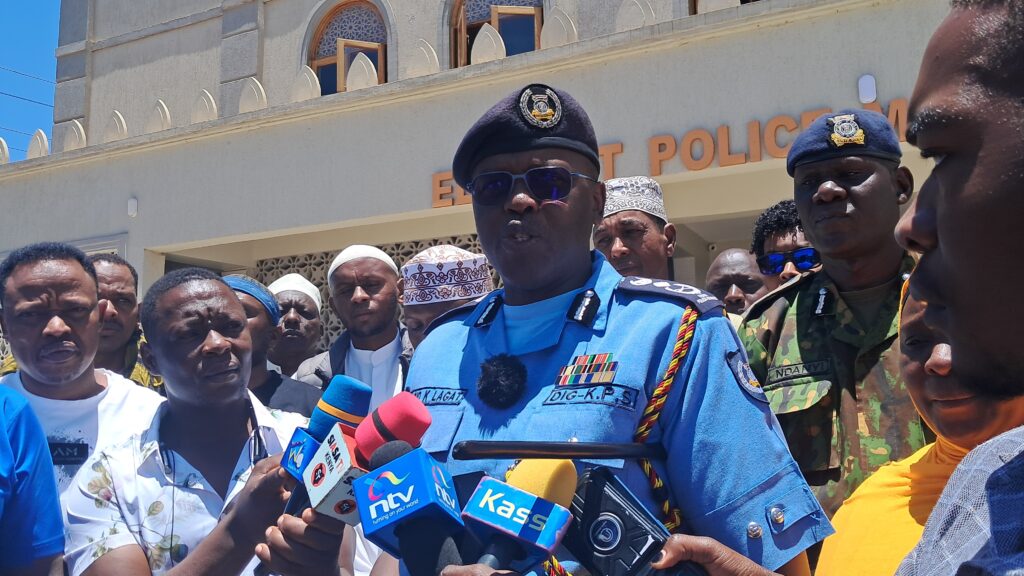
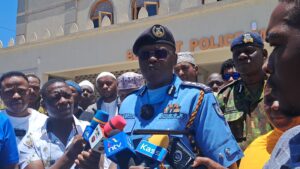
ELDORET, KENYA — OCTOBER 3, 2026: Deputy Inspector General of the Kenya Police Service Eliud Lagat addresses journalists outside the Eldoret Police Mosque following its commissioning in Eldoret, Uasin Gishu County. Photo by James Gitaka.
By James Gitaka
Deputy Inspector General of the Kenya Police Service (DIG-KPS), Eliud Lagat, has called for stronger partnerships between the police, faith-based organisations and local communities, saying closer cooperation is essential to improving security, building public trust and promoting peace in the North Rift.
Lagat spoke in Eldoret during the commissioning of the Eldoret Police Mosque, a facility built through a partnership involving the Muslim community and the National Police Service.
The mosque provides a place of worship for Muslim police officers and members of the wider community, as well as a facility where children can attend madrasa classes.
Lagat thanked the community and partners involved in the project, describing the Eldoret Police Mosque as an example of how police-community cooperation can strengthen social cohesion and improve the sharing of security information.
“This is a manifestation of the truthfulness of our belief that the police can work with the community,” Lagat said.
He said stronger relations between police and residents could reduce suspicion, encourage crime reporting and facilitate the sharing of information and intelligence.
“The net effect of this kind of cooperation is the fact that the cohesiveness between us and the community continues to grow stronger,” he said.
“They will be able to work together, the suspicion among themselves will definitely go down, and crimes can be reported easily. Information and intelligence can be shared freely.”
Faith leaders urged to promote peace ahead of elections
Lagat also called on Muslim and Christian leaders to play a greater role in promoting peace as the country approaches the 2027 General Election.
He urged faith-based organisations to provide platforms that promote dialogue and cohesion and prevent their institutions from being used to spread hate or political incitement.
“You will never go wrong with faith organisations when you partner with faith organisations. You will never go wrong because they are truthful and they mean well to the community,” Lagat said.
He said the National Police Service’s strategic plan recognises the importance of working with faith-based organisations to strengthen community relations and address social challenges.
The DIG also highlighted the role of the Kenya Police Service Directorate of Chaplaincy and Counselling in addressing mental-health and wellbeing concerns among police officers.
“We want to partner with the faith-based communities to address issues of mental health,” he said.
Lagat said mental-health challenges were becoming increasingly important not only within the wider community but also among members of the disciplined services.
“The issues of mental health is a problem, but we want to believe that with this department of chaplaincy, the department that deals with counselling, we’ll come together and make sure that issues of mental wellness are addressed,” he said.
He said faith-based organisations could contribute to a peaceful atmosphere by promoting cohesion and positive values within communities and the police service.
Lagat warns against illicit brews and drugs in North Rift
Lagat also warned people involved in the production and distribution of illicit alcohol and drugs in the North Rift that they would face the full force of the law.
He acknowledged that progress had been made in combating illicit brews but said some pockets of the problem remained in Uasin Gishu, Eldoret and other parts of the North Rift.
“We have made strides, yes, but we still have small pockets that need to be addressed,” he said.
He called on residents to work with police officers to eliminate illicit brewing and drug-related activities.
“We have to finish the issues of illicit brews in Uasin Gishu and in Eldoret in particular and the larger parts of North Rift,” Lagat said.
He specifically warned people involved in the illegal trade in ethanol and cannabis.
“All those people who are engaging themselves in those funny businesses, especially ethanol, bhang, will definitely face the full scale of the law,” he said.
“They should quit that kind of business and do something meaningful for the community.”
Lagat said the police were working with the National Authority for the Campaign Against Alcohol and Drug Abuse (NACADA) and faith-based organisations to address alcohol and drug abuse.
He also urged the media to support efforts to tackle the problem.
“Let’s work together and finish. We have an opportunity to make our people see the future,” he said.
DIG says North Rift security has improved
Responding to journalists’ questions about reports of renewed insecurity in parts of the North Rift, Lagat said the region had recorded significant improvements in security.
He acknowledged that a number of criminals remained under pursuit but said overall crime levels had declined in several counties.
“The issues of security in North Rift have improved tremendously,” Lagat said.
He said incidents involving armed criminals had reduced and that security agencies were continuing to pursue individuals involved in criminal activities.
“The crime in Uasin Gishu and Nandi and Marakwet has gone down,” he said.
Lagat said police had recently arrested a number of suspected criminals linked to insecurity in parts of the region.
He said the remaining challenges included phone snatching, illicit alcohol and drug-related activities.
“But we are on top of it,” he said.
Lagat said he would meet police officers in the region to listen to their concerns and assess how best they could be supported in dealing with criminal elements.
He also linked the security efforts to preparations for the upcoming national celebrations and the wider need to maintain peace ahead of the 2027 elections.
Police to address water and electricity challenges
The DIG also addressed concerns over water and electricity supplies at some police stations, where unpaid bills have occasionally resulted in disconnections.
He said a committee had already been established to address outstanding balances owed to county governments.
“There is already a committee set and that is why I’m actually accompanied by my CFO to make sure that if any pending balances to some county governments, we are able to sort it,” he said.
Lagat said the National Police Service was also implementing programmes aimed at improving the welfare and working conditions of police officers.
He cited the construction of boreholes, provision of new uniforms and plans to install solar power at police stations.
“We are going to solarise most of the police stations,” he said.
He added that improvements in lighting, water supply and other basic amenities would help improve the working environment and morale of police officers.
The borehole associated with the Eldoret Police Mosque, he said, would also help supplement water needs.
Police address insecurity along Turkana-West Pokot border
Lagat also responded to questions about insecurity along the Turkana-West Pokot border, where cattle rustling and resource-related conflicts have periodically affected communities.
He acknowledged the existence of what he described as small pockets of insecurity but said the police were addressing the situation.
According to Lagat, some of the tensions are linked to competition over resources, particularly during periods of drought.
“It is a resource-based conflict and that should not culminate into criminal activity,” he said.
He urged communities living along the border to develop peaceful mechanisms for sharing resources.
“The issue of resources should be… an old phenomenon that the two communities bordering that particular area should see how to share those resources,” he said.
However, Lagat warned that individuals who exploit resource disputes to engage in cattle rustling and other criminal activities would be pursued.
“We are going to deal with them squarely,” he said.
“Those few people who are advancing cattle rustling in that particular area, we will deal with them in the best way we know.”
Police seek titles for stations and facilities
Lagat acknowledged that some police stations and other National Police Service facilities remain in poor condition, with land ownership and documentation challenges complicating efforts to upgrade them.
He said the Inspector General of Police had established a select committee, led by the Director of Administration at National Police Service headquarters, to address the issue.
“The IG has formed a select committee led by the director administration at the national police headquarters to deal and to see to it that all police stations or all police facilities get the correct paperwork and the respective titles to it,” Lagat said.
He explained that securing title documents would make it easier for the police service to mobilise resources and enter partnerships for the construction and upgrading of police facilities.
“Once we have those titles, then it is easy to partner with anybody and it’s easy to inject money based on financial management. It’s easy to inject money and build police stations,” he said.
Lagat said the National Police Service was doing what it could to improve the condition of police facilities while longer-term documentation and infrastructure challenges were being addressed.
About Author