CS Ruku: Ol Kalou By-Election Cost Sh100 Million, Not Billions
He insisted the funds did not come from the National Treasury but were financed by the ruling United Democratic Alliance (UDA) party.
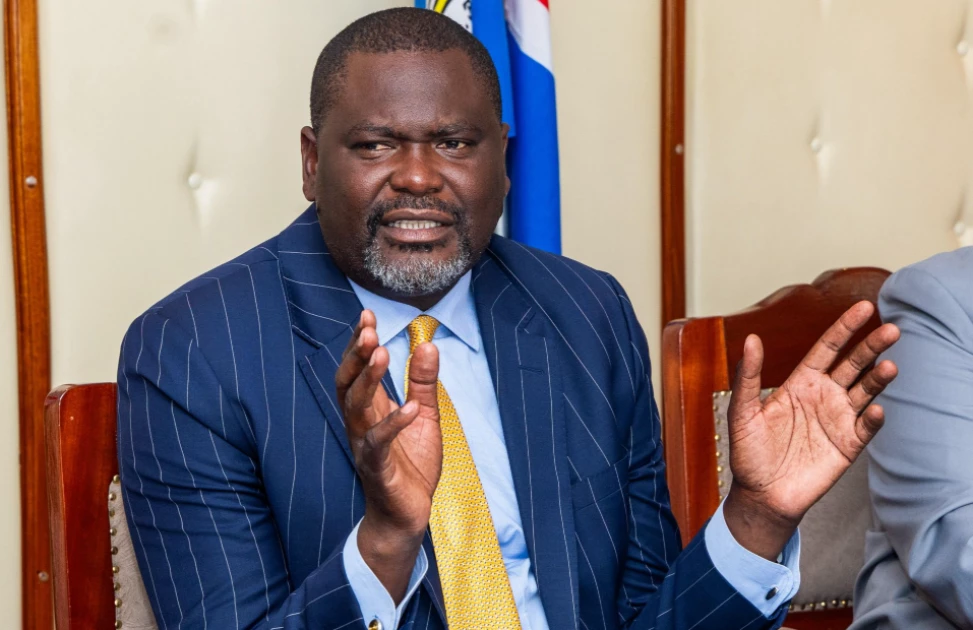
Public Service, Human Capital Development and Special Programmes Cabinet Secretary Geoffrey Ruku. Photo: Courtesy.
By Robert Mutasi
Public Service, Human Capital Development and Special Programmes Cabinet Secretary Geoffrey Ruku has dismissed claims by the Opposition that the government spent billions of shillings to influence the outcome of the Ol Kalou parliamentary by-election.
Speaking during an interview with Hot 96 on Sunday, Ruku said the total value of goodies and campaign support distributed in the constituency during the just-concluded by-election was approximately Sh100 million. He insisted the funds did not come from the National Treasury but were financed by the ruling United Democratic Alliance (UDA) party.
According to the Cabinet Secretary, the ruling party financed the distribution of thousands of 6-kilogramme LPG cooking gas cylinders, mattresses, two motorized fishing boats valued at Sh5 million, and 20,000 fish fingerlings to support aquaculture and fish farming in the area.
He said other development initiatives showcased during the campaign period included the revival of the Nairobi–Nyahururu railway line, construction of the 37-kilometre Ithangani–Ngorika–Kanyiriri road, improvements at the Ol Kalou Market such as installation of translucent roofing for vending areas, and the distribution of water pipes, electricity poles, food donations and cash handouts to residents.
Ruku defended the government, saying it is not allowed to fund campaigns.
“In any case, the government does not finance election campaigns, but the party does. Remember, UDA has money it gets from the Political Parties Fund,” Ruku said.
His remarks come as a direct response to allegations by former Deputy President Rigathi Gachagua, who claimed President William Ruto spent more than Sh1 billion in cash and over Sh14 billion on government projects in Nyandarua County to sway voters in the by-election.
Gachagua argued that the extensive spending, coupled with the deployment of senior government officials, increased security presence and distribution of items such as gas cylinders, mattresses and cash, amounted to a clear attempt to buy the electorate.
He nevertheless celebrated that voters rejected the government’s efforts, pointing to the victory of Democracy for Citizens Party (DCP) candidate Kamau Ngotho over UDA’s Samuel Muchina in the by-election. Gachagua described the outcome as a “dress rehearsal” for the 2027 General Election and framed it as a contest between President Ruto and the Mt Kenya region.
The heated claims have also renewed focus on campaign financing regulations in Kenya.
The Independent Electoral and Boundaries Commission (IEBC) has proposed new spending limits for candidates seeking elective office, with ceilings varying according to the size and characteristics of constituencies.
Under the proposed framework, North Horr Constituency in Marsabit County would have one of the highest campaign spending limits at Sh94 million because of its vast geographical size. Tetu Constituency in Nyeri County would have a spending cap of Sh11.2 million, Kilgoris Constituency in Narok County Sh22.4 million, while Kibra Constituency in Nairobi would have a ceiling of Sh14.5 million.
The proposed limits are intended to promote transparency and fairness in election campaigns, although they have yet to be implemented into law.
About Author