CS Kagwe Commissions KES 3 Billion De Heus Feed Plant to Boost Livestock Productivity and Exports
The De Heus feed plant opening marks an important achievement for Kenya which aims to enhance livestock productivity

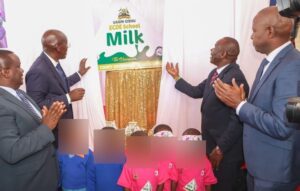
Cabinet Secretary for Agriculture and Livestock Development, Mutahi Kagwe, commissions the KES 3 billion De Heus animal feed manufacturing plant in Athi River, marking a major boost to Kenya’s livestock productivity and agricultural exports. Photo/Courtesy
By Ruth sang
Modernization Of Kenya Livestock Industry
The livestock sector in Kenya received a major modernization boost when De Heus Kenya inaugurated its KES 3 billion animal feed manufacturing facility in Athi River. The facility which operates as the biggest pellet-producing feed mill in the region will change livestock farming practices by replacing herd expansion with productivity-based operations.
The plant opening ceremony occurred after Cabinet Secretary for Agriculture and Livestock Development Mutahi Kagwe dedicated the facility. He showed how the government plans to increase milk production from 5.2 billion liters to 10 billion liters through better cow output instead of increasing herd numbers.
Kagwe stated that feed quality serves as the primary factor which determines both farmers’ output and the ability of Kenya’s livestock export markets to compete. He introduced plans to create a feed quality index which will remove all feed formulas that produce poor results with animals.
Broad Stakeholder Participation
The commissioning ceremony brought together national and county leaders, diplomats, farmers, and industry players. Henk Jan Bakker and Wavinya Ndeti and Principal Secretary for Livestock Development Jonathan Mueke and Co de Heus Chairman of Royal De Heus attended the event.
Royal De Heus started its operations in Kenya during the year 2023 after it established itself as one of the top 10 animal feed companies worldwide with over 80 production facilities in 20 different countries. The Athi River plant has an annual production capacity of 240,000 metric tonnes and operates two pellet lines, each producing 20 tonnes per hour. The project will provide direct employment to 280 workers while creating more than 1,000 indirect employment opportunities throughout the logistics and raw material supply chain.
Strengthening Feed Security and Farmer Integration
The government will unlock public land for sustainable feed production because Kagwe announced yellow maize and soya bean cultivation should start as structured feed production.
The agricultural sector will reach smallholder farmers through contract farming arrangements that will include them in agricultural production.
The government is constructing 50 dams nationwide to expand irrigation coverage and reduce reliance on rain-fed agriculture. The system will use structured feed reserves to prevent price fluctuations which occur during drought periods.
Advanced Technology and Farmer Support
The new facility features a modern laboratory capable of conducting advanced mycotoxin analysis, forage testing, shelf-life evaluation, and real-time raw material screening using handheld Near-Infrared Reflectance technology.
The plant will provide services to about 60,000 to 80,000 farmers each year according to Wiehan Visagie who described its operational capacity. The organization plans to grow its distribution system while enhancing its training programs for farmers and providing field-based advisory services.
Policy Support and Investment Climate
The industry stakeholders requested tariff incentives for yellow maize imports and unified inter-county levies and feed raw material tax exemptions and competitive power rates for production plants as essential policy support.
The Machakos County investment strengthens its position as an agro-industrial hub according to Governor Wavinya Ndeti who praised the investment. The Netherlands ambassador Henk Jan Bakker reaffirmed his country’s dedication to advancing agricultural research while strengthening economic connections between the Netherlands and Kenya.
CS Kagwe declared Kenya open for responsible agricultural investment during the official plant dedication. He stated that the government is increasing its regulatory framework while enforcing quality standards and commercializing land and modernizing irrigation systems and agricultural operations.
The De Heus feed plant opening marks an important achievement for Kenya which aims to enhance livestock productivity while developing animal nutrition capability and establishing itself as the leading African nation for feed manufacturing and agricultural product exports.
About Author