Ghost Students Exposed: Inside the US Student Aid Fraud Network Linked to Kenya
The suspects allegedly enrolled these fictitious students in community colleges and online learning institutions, creating the appearance of legitimate enrolment.
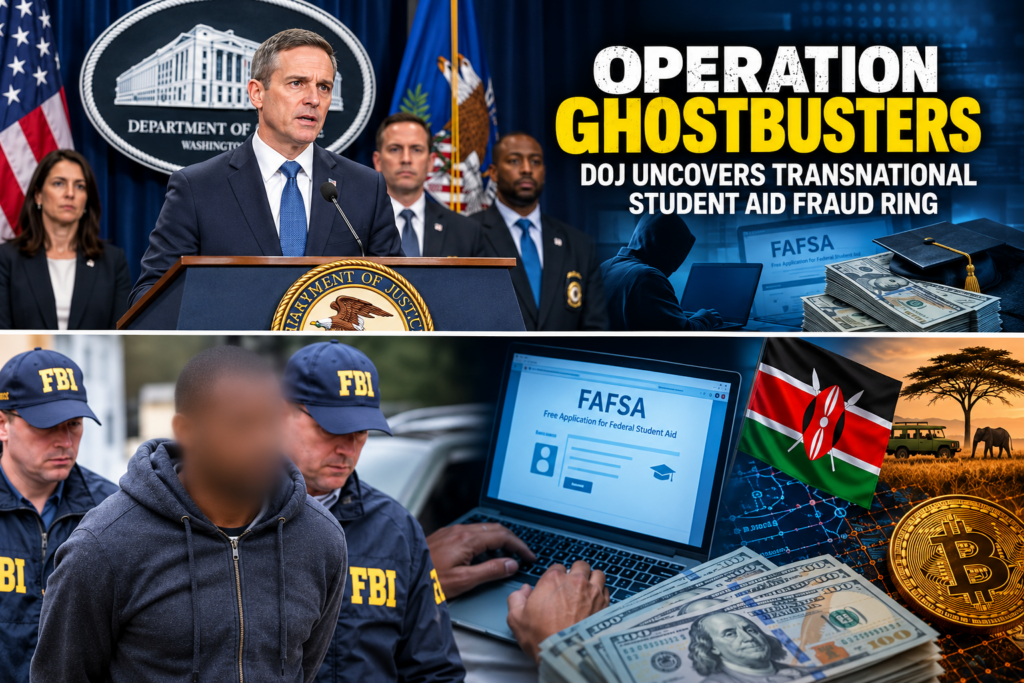
A major US federal investigation exposes an alleged international student aid fraud network involving stolen American identities, fake college enrolments and millions of dollars in suspected proceeds transferred to Kenya.
By Robert Mutasi
A major US federal investigation has exposed an alleged international student financial aid fraud network involving stolen American identities, fake college enrolments and millions of dollars in suspected proceeds transferred to Kenya.
The investigation, dubbed Operation Ghostbusters, has drawn attention to alleged links between individuals in the United States and Kenya, with prosecutors accusing several suspects of exploiting America’s federal student aid system to obtain money through fictitious student accounts.
According to the information contained in the Justice Department announcement and court filings provided, the alleged scheme involved the creation of fraudulent Free Application for Federal Student Aid (FAFSA) accounts using the personal information of unsuspecting American citizens.
Investigators believe the operation may have been running since at least 2021, with potential losses estimated at more than $200 million (approximately KSh25.9 billion).
Authorities have identified approximately 830,000 student aid accounts suspected of being fraudulent, although this figure does not necessarily represent confirmed victims or proven losses.
The investigation has resulted in charges against several individuals in Nebraska, New Jersey and Virginia, with federal authorities indicating that the operation could lead to further arrests and prosecutions.
How the alleged Ghost Student scheme worked
At the centre of the investigation is a method prosecutors describe as the use of ghost students.
According to the allegations, criminal networks obtained the personal information of American citizens and used it to create fraudulent student aid applications without the knowledge or consent of the individuals whose identities were stolen.
The suspects allegedly enrolled these fictitious students in community colleges and online learning institutions, creating the appearance of legitimate enrolment.
Once the applications were processed and financial aid approved, the fraudsters allegedly collected grants and student loan refunds intended to support students with education-related and living expenses.
The money was then reportedly transferred through various bank accounts and financial channels to conceal its origin and distribute proceeds among members of the alleged network.
The scheme is particularly concerning because many of the individuals whose identities were allegedly used had never applied for college admission or federal student assistance.
The US Department of Education has reportedly prevented more than $1 billion in attempted student aid fraud since January 2025, highlighting the scale of the challenge facing authorities.
The Nebraska case: Kenyan national Francis Mugambi
One of the most significant Kenyan connections in the investigation is a case filed in the US District Court for the District of Nebraska.
According to the indictment described in the supplied court documents, a Kenyan national identified as Francis Mugambi, whose surname is reportedly spelt Mogambi in some records, was charged with ten federal counts.
The charges comprise five counts of theft of government money and five counts of aggravated identity theft.
Prosecutors allege that Mugambi worked with other individuals, including associates in Kenya, to obtain the personal information of American citizens and use it to create fraudulent student aid applications.
The alleged operation involved enrolling individuals whose identities had been stolen in educational institutions before diverting financial assistance paid out in their names.
Investigators further allege that Mugambi retained part of the proceeds while transferring the remaining funds to alleged accomplices in Kenya.
The indictment reportedly covers transactions between November 2024 and May 2026.
Mugambi’s immigration history has also attracted attention. According to reports citing the indictment, he entered the United States on May 15, 2024, after winning the Diversity Visa Lottery, commonly known as the Green Card Lottery.
He subsequently obtained permanent residency and was living in Nebraska when investigators pursued the case.
He remains in federal custody as the case proceeds through the US judicial system.
It is important to emphasise that the charges against Mugambi remain allegations. He is presumed innocent unless and until proven guilty in court.
The financial figures circulating on Kenyan social media, including claims of approximately KSh2.6 million in loans and weekly payments of KSh260,000, relate to the specific allegations in the Nebraska case and should not be confused with the estimated losses associated with the wider investigation.
New Jersey investigation exposes alleged money transfer network
Another significant part of Operation Ghostbusters centres on New Jersey, where three individuals were charged over their alleged involvement in transferring proceeds from fraudulent student aid applications.
The defendants were identified as Mabed Utate-Alberto, Patricia Perez and George Arturo Mendez.
According to prosecutors, the three allegedly acted as money mules by opening and operating bank accounts used to receive financial aid refunds linked to hundreds of fictitious students.
Investigators allege that the accounts were subsequently used to move approximately $1.3 million (about KSh168 million) to Kenya.
The alleged transfers form part of a wider investigation into how proceeds from the fraudulent applications were collected, concealed and moved across international borders.
The New Jersey case illustrates the alleged financial infrastructure behind the scheme, with investigators examining not only those responsible for creating fraudulent applications but also individuals suspected of helping move the money.
Additional defendants were reportedly charged in Virginia, bringing the initial number of defendants in the first wave of the investigation to five.
Cryptocurrency seizure and alleged Kenyan connections
One of the most significant developments announced by US authorities was the seizure of cryptocurrency valued at more than $750,000, equivalent to approximately KSh97 million.
The Justice Department reportedly linked the digital assets to proceeds from the alleged student aid fraud network.
According to the New Jersey court filings, investigators traced some of the suspected proceeds to overseas recipients, including individuals allegedly connected to a safari business based in Kenya.
The reference to a Kenyan safari enterprise has added another dimension to the investigation, raising questions about whether legitimate-looking commercial operations were allegedly used to facilitate or conceal international financial transfers.
Reports by Kenyan media outlets People Daily and Capital FM indicated that Kenyan law enforcement agencies assisted in the cryptocurrency seizure.
The reported cooperation highlights the growing importance of cross-border investigations as criminal networks increasingly use digital currencies, international bank accounts and commercial transactions to move suspected proceeds.
However, the allegations against specific individuals should not be interpreted as evidence of wrongdoing by Kenya’s wider tourism industry or the Kenyan community in the United States.
About Author