Assam Flood Survivor Faces New Reality After Devastating Deluge
The experience has forced Baruah to reconsider her relationship with a threat she once believed was distant.
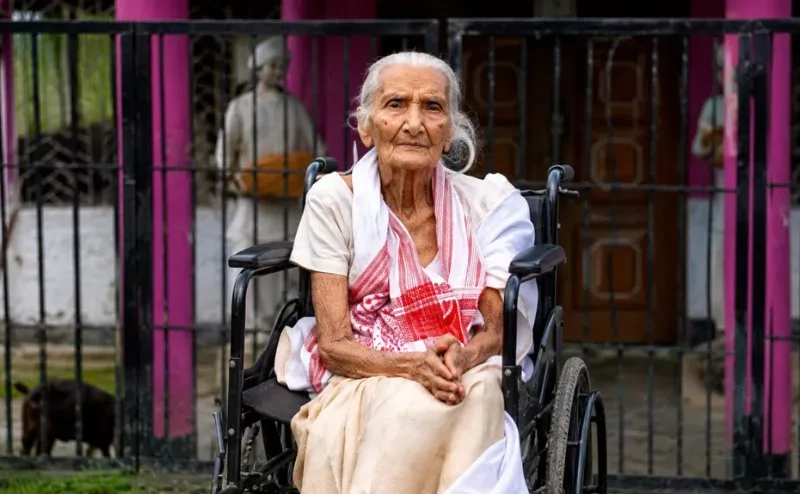
Assam Flood Survivor Faces New Reality After Devastating Deluge. Photo Courtesy: The Star
By Judith Waka
Well past midnight on July 19, floodwaters swept through Charing village in Assam, India, forcing Bornali Baruah and her husband into a desperate effort to save his 97-year-old mother, Lokada Duarah.
Almost bedridden and unable to walk, Duarah had no way of escaping on her own. With no boat, rescue team or neighbours available to assist, the couple placed her on a makeshift raft made from banana trunks and carried her through the rising water.
“Everyone was trying to save themselves,” Baruah said.
The family spent about an hour moving through water that had reached three to four feet deep. The current was so strong that they held each other’s hands and used sticks for support as they made their way to a shelter camp along a national highway.
By then, their eight-room home was being swallowed by the flood. Water eventually rose to about five feet inside the house.
The flooding was part of a wider disaster across Assam. The latest figures put the death toll at 100, with 10 districts and 456 villages affected. About 140,000 people were impacted in the latest wave, while 52 relief camps were established. Overall, nearly 1.2 million people across 25 districts have been affected, with more than 19,000 houses damaged and over 75,000 people accommodated in 252 relief camps.
For Baruah, the disaster was particularly shocking because Charing had not experienced such flooding during her lifetime.
The 40-year-old was born and raised in the village, where her family has lived for generations. Although she had heard about the devastating 1950 flood, she had never expected floodwaters to reach her own home.
The village lies in a region crossed by several rivers. The Brahmaputra is about 20 kilometres away, while the Dikhow, Jhanji and Mitong rivers are roughly 12, 10 and five kilometres away respectively.
The flood also destroyed much of Baruah’s livelihood. She previously worked as a journalist before leaving the profession in 2016 to pursue animal husbandry. In 2019, she was recognised as Assam’s Best Livestock Farmer.
Her farm eventually expanded to about 300 goats, 500 ducks and 1,000 chickens, as well as fish. She says the flood killed most of her goats, 300 ducks and 300 chickens. Fish stocks were also destroyed, together with an animal-feed machine, furniture, laptops, vehicles and family books.
Her livestock was not insured.
“There is no insurance system here for livestock, especially goats,” she said.
The first warning came on July 17 when the Jhanji River began rising. Two days later, the Dikhow and Mitong overflowed as the Brahmaputra and its tributaries rapidly swelled. Several rivers breached their embankments, sending strong currents into communities.
About a day later, Baruah and her family abandoned their home after water inside had reached four feet. They spent the next 10 days at a relief camp.
For five days, the camp had neither electricity nor mobile connectivity. Government assistance included rice, lentils and cooking oil. Other survivors also helped the family, with some volunteers assisting with food, cleaning and caring for the 60 goats that survived.
The flooding has raised questions about why water reached areas that had previously remained relatively safe.
Dhrubajyoti Sahariah, a geography professor and director of the Centre for Brahmaputra Studies at Gauhati University, says flooding is a natural feature of the Brahmaputra Valley. However, he says its frequency, intensity and severity are increasingly exceeding historical patterns.
The Brahmaputra carries enormous volumes of water and sediment as it flows into Assam’s floodplains. Sediment deposition contributes to erosion and flooding across the region.
Sahariah attributes the worsening impact to several factors, including settlement on active floodplains, forest clearance, mining, hill cutting and infrastructure development that does not always account for the region’s river systems.
He says Assam also needs greater cooperation with neighbouring states because many tributaries originate outside the state.
For Baruah, these broader environmental changes have become a personal crisis.
She has returned to the area near her damaged home and is temporarily staying with a neighbour. She hopes to return home within a week.
Despite everything, she says she has no plans to leave Charing. Relocating would require economic and social resources that her family does not have.
Instead, she is preparing for the possibility of another severe flood. She is considering raising the foundation of her house and constructing a higher platform where the family could seek refuge. She also plans to keep food and drinking water stored in advance.
The experience has forced Baruah to reconsider her relationship with a threat she once believed was distant.
She does not describe herself as a climate refugee. Rather, her story reflects the growing challenge faced by communities that remain in their ancestral homes while adapting to increasingly severe environmental risks.
About Author