Colombia Earthquake: Rescuers Race to Find Survivors as Death Toll Rises
Authorities said the death toll could rise as rescue teams reach remote communities and assess the full extent of the damage.
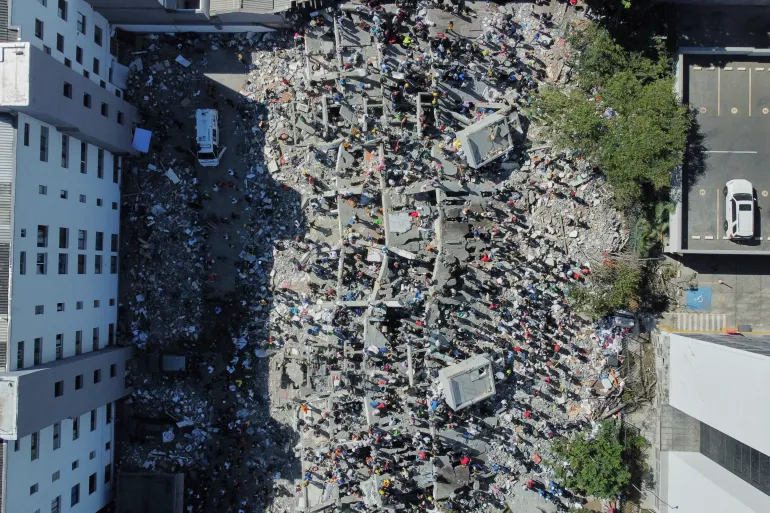
Colombia Earthquake: Rescuers Race to Find Survivors as Death Toll Rises. Photo Courtesy: Aljazeera
By Judith Waka
Rescue teams in western Colombia are continuing to search collapsed buildings for survivors after a powerful magnitude 7.4 earthquake killed at least 250 people and caused extensive destruction across several regions.
The earthquake struck at about 7:34 a.m. local time on Monday, with the epicentre near San José del Palmar in the Chocó region, according to the United States Geological Survey. The tremor was felt across a wide area, including Cali and Pereira.
Authorities said the death toll could rise as rescue teams reach remote communities and assess the full extent of the damage.
Cali was among the hardest-hit areas. President Abelardo de la Espriella said 35 people had died in the city, while local authorities in Risaralda reported at least 40 deaths. Nine deaths were confirmed in Chocó, two in Caldas and another in Antioquia.
More than 700 people were reported injured in Valle del Cauca, while initial reports placed the number of injured across the affected areas at more than 80.
The scale of the destruction has complicated rescue operations. About 1,600 buildings were reported damaged or destroyed, including parts of a historic cathedral in Manizales.
A hospital in Cali also suffered major damage after several upper floors collapsed. Some patients were trapped inside, while about 600 others were moved outside and treated amid the rubble, hospital director Irne Torres Castro said.
More than 2,700 people were reported missing on citizen-run websites, although officials cautioned that the figure had not been independently confirmed.
Rescue teams search through rubble
Soldiers, firefighters, police officers, volunteers and relatives have joined the search for people trapped beneath collapsed structures.
In Cali, residents formed human chains to remove bricks and concrete by hand. Rescue teams repeatedly stopped their work to listen for possible survivors beneath the debris.
Firefighters reported rescuing two women and two children from a collapsed building. In Pereira, rescuers said they had established contact with a boy trapped beneath a bakery as cranes worked to remove unstable sections of the building.
The situation in Chocó presents an additional challenge. The region is remote, and several communities can only be reached by boat or aircraft. Authorities have deployed military engineers, rescue personnel and search dogs to help assess the damage and locate survivors.
The Colombian Geological Service reported at least 21 aftershocks following the main earthquake and warned that more tremors could occur.
Government declares emergency
President de la Espriella declared a national state of emergency and said the government had mobilised the military and police to support rescue operations.
The president travelled to Quibdó, the capital of Chocó, and later visited affected areas. He said rescuing people trapped under rubble remained the government’s immediate priority.
Nighttime curfews were imposed in Cali, Armenia and Manizales as authorities increased security and sought to prevent looting.
Hospitals in five cities were placed on red alert, while several airports, including those in Pereira, Manizales, Quibdó, Armenia, Cartago and Buenaventura, suspended operations temporarily to allow structural inspections.
The earthquake also led authorities to postpone the Petronio Álvarez Music Festival in Cali and several professional football matches.
International assistance
International partners have offered support as Colombia responds to the disaster.
The United States announced $15.5 million in emergency assistance for shelters, food and other relief efforts. Secretary of State Marco Rubio said Washington was monitoring the situation and was prepared to provide further assistance.
The European Union activated its Copernicus satellite service to help authorities assess damage and support rescue operations.
El Salvador and Mexico also offered to send rescue teams, medical personnel, paramedics and emergency supplies if requested by the Colombian government.
As rescue operations continue, authorities face a race against time to reach people trapped beneath the rubble while emergency teams work to determine the full scale of the destruction.
About Author