Police Defend Nairobi Roadblocks During June 25 Commemorations in High Court Battle
Instead, officers deployed temporary checkpoints after field commanders assessed emerging security risks as events unfolded across the city.
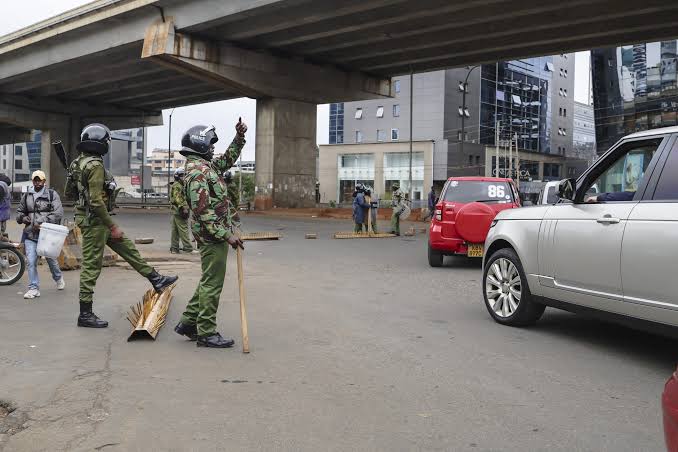
Photo: Courtesy.
By Robert Mutasi
The National Police Service has defended its decision to erect roadblocks and security checkpoints across Nairobi during the June 25, 2026 commemorations, telling the High Court that the measures were emergency responses to unfolding security threats rather than part of a pre-planned operation that required advance public notice.
In a replying affidavit filed before the High Court, Nairobi Regional Police Commander Issa Mohammed Mohamud argued that the temporary roadblocks complied with existing court orders because they were established in response to real-time security assessments made by commanders on the ground.
Mohamud, who swore the affidavit on behalf of the Inspector General of Police, was responding to a contempt application filed by Katiba Institute, which accuses the police of violating conservatory orders issued by Justice Lawrence Mugambi in July 2025.
According to the police, the conservatory orders did not prohibit officers from establishing roadblocks or security checkpoints. Instead, Mohamud said the orders required authorities to provide prior public notice only when implementing planned and structured road closures.
“I am advised that the true intent and spirit of the court order underscored the operational need for transparency, public predictability and the issuance of prior public notices or advisories whenever pre-planned, structural road closures are contemplated,” Mohamud stated in the affidavit.
The police further argued that no organizers notified the respective Officer Commanding Stations within Nairobi County of any planned demonstrations or processions at least three days before June 25, as required under Section 5 of the Public Order Act.
Mohamud said the notification requirement is not intended to seek police approval for demonstrations. Rather, it enables law enforcement agencies to prepare security arrangements, protect demonstrators and members of the public, and ensure public order during protests.
Because no statutory notices were received, the police said they were unable to develop a coordinated traffic management plan ahead of the commemorations.
Instead, officers deployed temporary checkpoints after field commanders assessed emerging security risks as events unfolded across the city.
“Any inevitable vehicular and pedestrian traffic inconveniences experienced on that day were entirely spontaneous and reactive, arising dynamically from real-time threats to public safety assessed on the ground by individual field and station commanders,” Mohamud said.
The affidavit also maintains that the checkpoints were not ordered through a centralized directive from the Office of the Inspector General. Instead, local area commanders independently made operational decisions based on security conditions within their jurisdictions.
Police said the temporary security measures were designed to identify individuals suspected of planning violent acts while allowing peaceful demonstrators and ordinary members of the public to continue their lawful activities.
Mohamud argued that, apart from security arrangements around protected government installations, the checkpoints did not amount to blanket road closures or infringe upon the constitutional rights to peaceful assembly, demonstration and movement.
The National Police Service further stated that temporary security checkpoints are lawful policing tools authorized under the National Police Service Act, the Public Order Act and the National Police Service Standing Orders.
The Inspector General has asked the High Court to dismiss Katiba Institute’s contempt application, describing it as speculative and an attempt to interfere with operational policing decisions made during rapidly evolving security situations.
Katiba Institute, however, maintains that the police ignored the July 2025 conservatory orders by erecting roadblocks at several major entry points into Nairobi without prior public notification.
The rights organization says barriers were established at Roysambu, Kangemi, Ngong Road, City Mortuary Roundabout, Integrity Centre, Uhuru Highway, Moi Avenue, Parliament Road, Karen, Kitengela, Ruiru and Githurai, disrupting movement across the capital.
“The conduct set out above constitutes a direct and deliberate violation of the orders of this Honourable Court and warrants immediate judicial intervention,” the organization states in its court filings.
Katiba Institute argues that the restrictions interfered with the daily lives of thousands of people traveling to work, seeking healthcare and carrying out other essential activities.
The organization is asking the High Court to find the Inspector General of Police in contempt of court and impose appropriate sanctions, arguing that failure to enforce court orders weakens the rule of law and public confidence in Kenya’s justice system.
The case is expected to test the balance between the constitutional right to peaceful assembly and the powers of security agencies to respond swiftly to emerging public safety threats during large public gatherings.
About Author