Xinhua Headlines: Why the world is looking more favorably at China
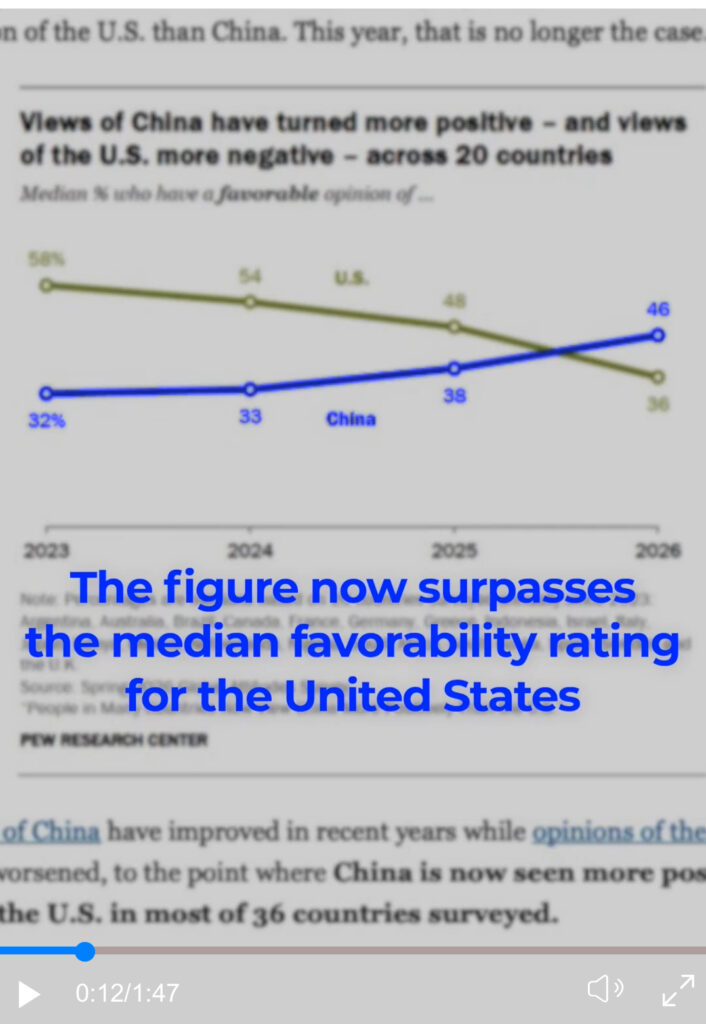
Favorability rate for China surpassing the United States in a Pew study in July reflects in part what much of the world expects from a major power amid mounting geopolitical uncertainty, such as shared development over zero-sum rivalry.
BEIJING, Aug. 6 (Xinhua) — For Canadians surveyed in a poll three years ago, the favorability rate gap between the United States and China was exceptionally wide. By this spring, China’s favorability rating in Canada had surpassed that of the United States, reaching 44 percent compared to 33 percent.
The shift is especially striking because it occurred not in a distant country, but in one of the United States’ closest allies and economic partners.
It is also the clearest illustration of a much wider change. In a Pew Research Center study in July of 42,151 adults, China was viewed more favorably than the United States in 25 of 36 countries.
The change reflects a shift in what much of the world now expects from a major power. At a time of mounting geopolitical uncertainty, the survey is more than a ranking of national images. Its findings suggest a growing preference for partnership over pressure, predictability over capriciousness and shared development over zero-sum rivalry.
WHY CHINA IS APPEALING
China’s appeal begins with what it has accomplished at home. Over four decades, China has lifted nearly 800 million people out of poverty. The country built the world’s largest high-speed rail network, transformed itself into a manufacturing power, and became a global leader in electric vehicles, renewable energy and digital services.

Taken together, these achievements tell a larger story: China has repeatedly turned long-term plans into changes that people can see in their incomes, mobility and daily lives.
That record carries weight abroad because many countries are wrestling with the same practical questions China has confronted: how to build infrastructure, create industrial jobs, reduce poverty and make new technologies affordable.
Wang Lei, a professor at Beijing Normal University, noted that a growing number of overseas scholars are studying China’s five-year plans and seeking to understand the logic of its governance. China’s record of stable development and improving living standards, he said, has become its most persuasive national calling card. In this sense, China’s appeal rests less on how it describes itself than on the results it has produced.
WHAT RELIABILITY LOOKS LIKE
Pew did not ask respondents to explain their overall opinion of China. But in 17 middle-income countries, it asked whether China was a reliable partner, took the interests of countries like theirs into account, and contributed to global peace and stability. In South Africa, 72 percent described China as reliable. Sixty-four percent said it respected their interests, and the same share credited it with contributing to peace and stability, up from 47 percent in 2023.
Wang said the findings reflected a desire for a partner whose policies remain steady and predictable. Reliability, however, is established less through diplomatic language than through repeated delivery.
Sizo Nkala, a researcher at the University of Johannesburg’s Center for Africa-China Studies, pointed to railways, ports, power plants and communications networks. “Young people see all these things.”
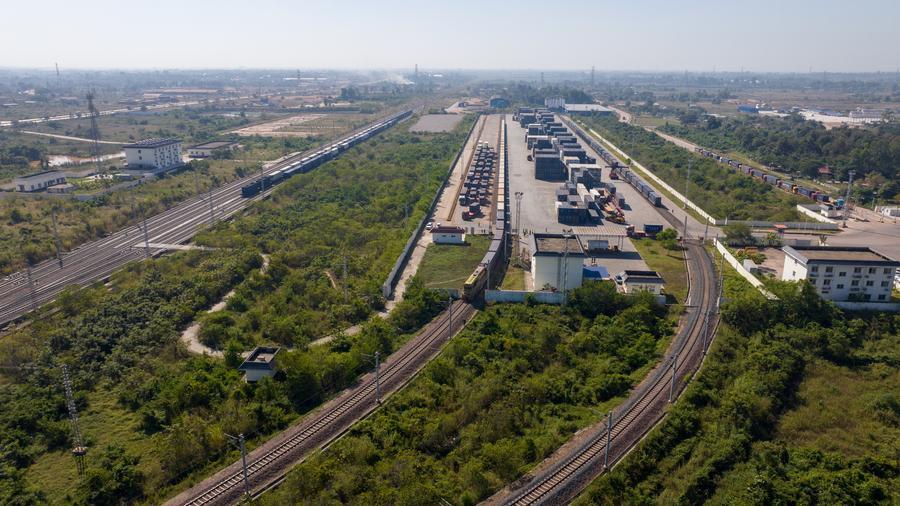
The China-Laos Railway, Indonesia’s Jakarta-Bandung High-Speed Railway and Peru’s Chancay Port have made cooperation visible on a national scale. Smaller-scale programs — from Juncao technology and Luban Workshops to Chinese medical teams — have delivered benefits more directly to local communities.
China is also extending its development cooperation into emerging technologies.
At the 2026 World Artificial Intelligence Conference in Shanghai, it announced 5,000 AI training opportunities for developing countries over the next five years and joined 28 other countries in establishing the World Artificial Intelligence Cooperation Organization. This move addresses a growing concern in the developing world: that countries lacking technological expertise and a voice in AI governance could be left further behind. Such initiatives also broaden the meaning of partnership with China — from building roads and ports to sharing know-how needed for the next stage of development.
SEEING CHINA UP CLOSE
China’s wider opening to foreign visitors has also created millions of smaller encounters. Its 240-hour visa-free transit policy is now available to travelers from 55 countries. Visitors have filled social-media feeds with high-speed trains, mobile payments, night markets and ordinary street life. Such videos cannot explain the results of a 36-country poll by themselves, but they allow distant audiences to compare inherited impressions with firsthand experience.

Roger Tan Wei Jian, deputy secretary-general of the Association of Interaction Malaysia-China, said visits to China had shown him a country sharing its experience in economic transformation, poverty reduction and innovation while also listening to others. What impressed him was the pursuit of progress through “mutual exchange, mutual learning and the creation of cooperation opportunities.”
Culture offers another point of entry.
The animated film Ne Zha 2 and the video game Black Myth: Wukong have recast Chinese mythology in contemporary forms, while UNESCO’s inscription of the Spring Festival has accompanied its growing visibility around the world. Together, these cultural expressions present a China that is not only ancient, but also creative, modern and open.
Impression changes when a distant country becomes tangible: a railway opens, a journey starts, a technology used or a story told.
(Video reporters: Liu Xiaoshui; Video editors: Zhu Cong, Hong Ling, Mu Xuyao, Hong Liang, and Wang Han)
About Author