Uhuru Kenyatta Honoured by WHO for Pivotal Role in Global Pandemic Agreement
The agreement also preserves national sovereignty while requiring transparent sharing of disease data, technology, and resources—ensuring no country is left behind in future pandemics.
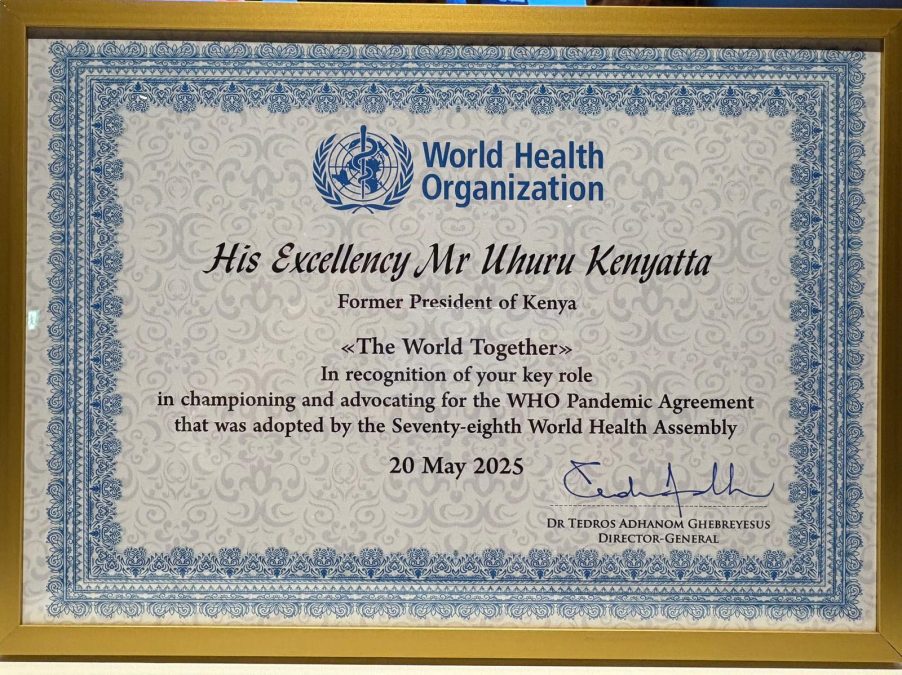
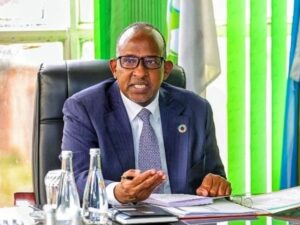
Former President Uhuru Kenyatta has been honoured by the World Health Organization (WHO) for his significant contribution to the successful adoption of the historic WHO Pandemic Agreement.
By Juliet Jerotich
Former Kenyan President Uhuru Kenyatta has been formally recognized by the World Health Organization (WHO) for his instrumental role in advancing the landmark WHO Pandemic Agreement, a global pact aimed at bolstering preparedness and equity in future health crises.
The honour was conferred during a high-level event on July 10, 2025, at WHO headquarters in Geneva, Switzerland, where global leaders were celebrated for their leadership in shaping the international agreement adopted earlier this year.
“Adopting the Pandemic Agreement was a defining moment in global public health. This achievement would not have been possible without strong and sustained political leadership,” said WHO Director-General Dr Tedros Adhanom Ghebreyesus.
Kenyatta was among 25 global leaders acknowledged for their contributions, joining figures from countries including the UK, France, South Africa, Indonesia, Rwanda, and Germany. The event also saw special recognition for Chile and Tunisia, whose early advocacy helped spark momentum toward the treaty.
The Pandemic Agreement, officially adopted by consensus during the 78th World Health Assembly in May 2025, is only the second global legal instrument created under Article 19 of the WHO Constitution, following the 2003 Framework Convention on Tobacco Control.
It establishes binding commitments to improve international coordination in responding to pandemics and ensure equitable access to vaccines, diagnostics, and treatments—particularly for developing nations. Key provisions include the Pathogen Access and Benefit-Sharing (PABS) mechanism, through which pharmaceutical companies will commit up to 20% of real-time production to WHO for fair global distribution.
Kenyatta’s involvement dates back to a 2021 joint statement signed by 25 world leaders and global organization heads, which called for a legally binding pandemic treaty following the devastating lessons of COVID-19.
Speaking at a recent Amref International University graduation on behalf of the former president, Margaret Kenyatta echoed his message on the need for Africa to build self-reliant health systems.
“As a country and continent, we must prioritize local research, vaccine manufacturing, and innovation hubs. Dependency on the West during COVID-19 highlighted our vulnerabilities,” Uhuru stated.
The agreement also preserves national sovereignty while requiring transparent sharing of disease data, technology, and resources—ensuring no country is left behind in future pandemics.
Dr Teodoro Herbosa, this year’s World Health Assembly president, praised the agreement as a rare opportunity to transform hard-earned lessons into long-term protections. “The pandemic agreement is a turning point—just as COVID-19 was an unprecedented crisis, this is an equally urgent call to action,” he said.
Uhuru Kenyatta’s recognition places him among global leaders committed to reshaping the world’s approach to pandemics, reinforcing his legacy as a champion for global health equity and resilience.
About Author