UASU Accuses Moi University Acting Management of ‘Toxic Leadership,’ Demands Retraction of ‘Parasites’ Remarks
“With two sets of managers—a substantive management reportedly receiving salaries while out of office and an acting management serving beyond the legally prescribed period—who, then, is parasitising the other?” the union posed.
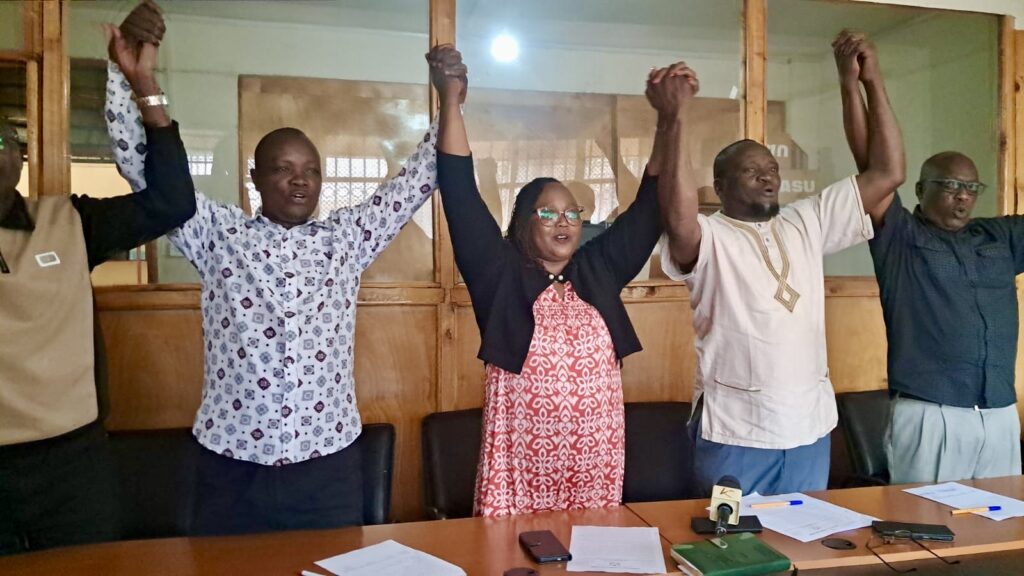
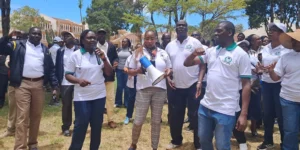
Officials from the Universities Academic Staff Union (UASU), Moi University Chapter, address the media during a press briefing in Eldoret, where they criticized the university's acting management over recent remarks directed at lecturers and called for improved governance, implementation of the return-to-work agreement, and the appointment of substantive leadership.
By James Gitaka
A fresh standoff has emerged at Moi University after the Universities Academic Staff Union (UASU), Moi University Chapter, accused the institution’s acting management of disrespecting lecturers by allegedly referring to them as “parasites,” remarks the union says have further eroded morale within the financially troubled university.
The union is now demanding an immediate withdrawal of the statement, an apology to academic staff, and the appointment of substantive university leaders, arguing that the acting administration has exceeded its legally permissible tenure while failing to resolve the institution’s longstanding governance and financial challenges.
In a strongly worded statement, UASU described the alleged characterization of lecturers as “parasites” as “unfortunate, uninformed and irresponsible,” saying such language was unbecoming of leaders entrusted with managing one of Kenya’s oldest public universities.
“The Universities Academic Staff Union, Moi University Chapter, on behalf of the academic fraternity of Moi University, takes exception to the language and tone of the Acting Vice-Chancellor and members of his acting management team in referring to lecturers—the people responsible for implementing academic programmes and related activities—as ‘parasites’,” the union said.
According to the union, the remarks demonstrate arrogance and disregard for the academic staff who form the backbone of the institution.
“An academic institution is defined by two entities—lecturers and students. You cannot talk of increasing student enrolment while referring to those responsible for implementing the curriculum as parasites,” the statement added.
Union Paints Picture of Low Staff Morale
UASU claims the current management has created a hostile working environment characterized by intimidation, threats and declining staff morale.
The union alleges that Heads of Departments and Deans have been subjected to intimidation while academic staff have become increasingly demoralized.
According to the chapter, more than 40 senior academic staff members have resigned over the past year, citing low morale rather than retirement.
The union further claims that Moi University previously had approximately 800 lecturers, but that the current number has dropped to about 690, with an average of two lecturers leaving the institution every month.
It argues that the continued loss of experienced academics threatens the university’s ability to sustain quality teaching, research and mentorship.
Strike Agreement Yet to Be Fully Implemented, Says UASU
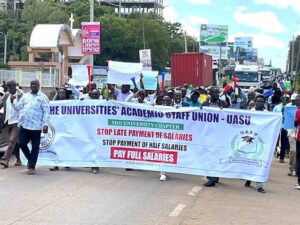
The union also accused the acting administration of failing to honour commitments made following the lecturers’ 97-day strike, despite the Government releasing funds intended to facilitate implementation of the return-to-work agreement.
Speaking to journalists, UASU Moi University Chapter Secretary said lecturers were never invited by the acting management after the government released over ksh6B.
According to the union, the Government released KSh500 million to offset statutory remittances and staff loan obligations, as well as KSh1.25 billion for salary payments.
However, UASU maintains that several commitments, including non-financial clauses contained in the return-to-work agreement, remain unimplemented.
The union argues that failure to implement the agreement amounts to a breach of labour relations commitments and continues to fuel tensions between staff and management.
National UASU Official Calls for Acting Team’s Exit
Dr. Jane Michael, UASU National Trustee and Treasurer, demanded that the university administration withdraw the statement referring to lecturers as “parasites.”
She also questioned the continued stay in office of the acting management, saying their appointments were intended to last only six months.
“The acting team was appointed to serve for only six months, yet they have remained in office for more than one year. They should vacate office and allow the appointment of substantive leadership to steer Moi University forward,” she said.
Dr. Michael argued that stable leadership is essential if the institution is to recover from years of financial and governance challenges.
Parliament Previously Flagged Governance Concerns
The union noted that the National Assembly Departmental Committee on Education had previously visited Moi University in 2024 and concluded that the institution’s challenges were largely managerial and governance-related.
UASU argues that those concerns remain unresolved and have, instead, worsened under the acting administration.
The union questioned why Parliament did not seek explanations regarding the continued tenure of the acting officials during the committee’s latest engagement with university management.
“With two sets of managers—a substantive management reportedly receiving salaries while out of office and an acting management serving beyond the legally prescribed period—who, then, is parasitising the other?” the union posed.
University Defends Recovery Programme
The union’s criticism follows a statement issued by Acting Vice-Chancellor Prof. Kiplagat Kotut after the university appeared before the National Assembly Departmental Committee on Education on July 2, 2026.
In the statement, Moi University assured students, staff, parents and the public that the institution remained fully operational and was making steady progress toward financial recovery.
The university said teaching and learning were continuing uninterrupted across all campuses, the academic calendar had been fully restored, examinations and graduation ceremonies were proceeding as scheduled, while research, innovation and community engagement activities had recorded notable growth.
Management also said staff salaries were being paid on time and attributed improvements in the university’s financial position to Government support, strengthened financial management, increased revenue mobilisation and expenditure control measures.
The administration maintained that Parliament had expressed support for ongoing recovery efforts and pledged to assist the university in addressing its historical financial obligations.
Union Questions Recovery Narrative
Despite the administration’s assurances, UASU insists that meaningful institutional recovery cannot be achieved without restoring trust between management and staff.
The union argues that academic excellence depends not only on financial reforms but also on respectful labour relations, sound governance and adherence to the law.
It maintains that lecturers remain committed to delivering quality education but says they expect the university administration to honour agreements, respect academic staff and create an environment that supports teaching, research and innovation.
The dispute now sets the stage for renewed tensions at Moi University as both management and the academic staff union advance competing narratives over the institution’s recovery, governance and future leadership.
About Author