Uasin Gishu Leaders Demand Action Against Wainaina Over ‘One-Term’ Warning to a Section of Rift Valley Residents
“If you do not want the two-term arrangement here, leave peacefully and come back after we finish the election.” Nominated Mp Joseph Wainaina said.
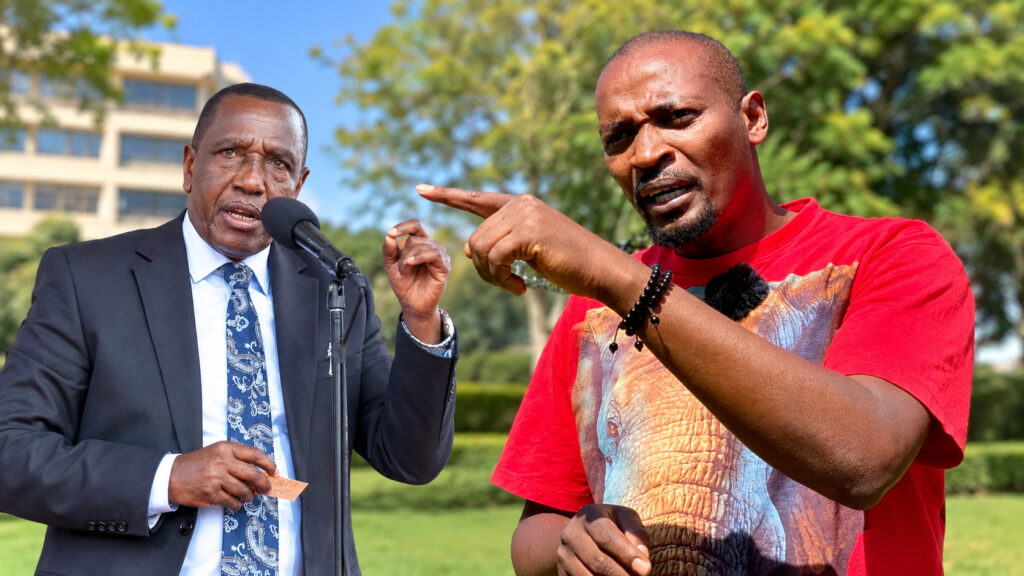
Nominated UDA MP Joseph Wainaina Iraya (l) and Harun Maina .
By HubzMedia Reporter
Leaders in Uasin Gishu County, led by politician Harun Maina, are demanding action against nominated UDA Member of Parliament Joseph Wainaina Iraya over remarks they say could heighten ethnic tensions and create divisions among communities living in the Rift Valley.
The leaders want the UDA leadership and relevant state institutions to scrutinise Wainaina’s remarks, which they say crossed the line from political mobilisation into statements capable of creating fear and suspicion among communities that have lived together in the region for decades.
The controversy follows remarks by Wainaina in a video circulating online in which he addressed members of his community in Kapseret. He later spoke at an interdenominational church service at Kipsamoo in Kapseret, Uasin Gishu County, attended by several leaders, including Deputy President Kithure Kindiki.
Wainaina Links Political Unity to Two-Term Agenda
In the remarks, Wainaina called on members of his community in the Rift Valley to remain united around President William Ruto’s two-term bid, while warning those who do not support the political arrangement that they would have to leave the region temporarily.
In remarks seen by HubzMedia, Wainaina is heard saying:
“If you do not want the two-term arrangement here, leave peacefully and come back after we finish the election.”
He further suggested that members of his community would distinguish themselves politically from those living in the Rift Valley and those in Central Kenya.
“We will separate ourselves from those who are saying one term in central Kenya because we are two-term people,” Wainaina is heard saying.
The remarks have triggered concern among local leaders, who say political affiliation should not determine whether Kenyans have the right to live and do business in any part of the country.
Wainaina also referred to Kenya’s history of election-related violence, particularly the experiences of 1992, 1997 and 2007, while calling on his community to remain united and maintain peace.
“I have told our community here in the Rift Valley that we must be one and that we must continue talking about peace. What happened here in 1992, 1997 and 2007, the problems we experienced here, we cannot allow them to happen because of a few people seeking leadership,” he said.
Maina Accuses Wainaina of Creating Tension
Reacting to the remarks, Harun Maina, a politician and Huruma Ward aspirant, accused Wainaina of creating unnecessary fear and tension through his political messaging.
“The remarks by Wainaina have created tension and fear. We are asking ourselves what kind of leader this is whom the President gave us as a community, yet today he says he will have a voice to divide our community,” Maina said.
Maina particularly took issue with the suggestion that people who do not support the two-term political agenda should leave the Rift Valley until after the elections.
“You are saying that some people will leave this place. Whether you were sent to say that or you decided to say it yourself, it means you are planning for division and creating an impression that there will be conflict so that people can leave the Rift Valley,” he said.
He maintained that the Rift Valley belongs to Kenyans from different communities and warned political leaders against using ethnicity to determine who should be accepted in the region.
“Our communities have no problem with the people living here. We have lived together. We work together and have built this region together. We cannot allow political statements to divide us,” Maina said.
Leaders Invoke 1992, 1997 and 2007 Violence
The leaders said references to Kenya’s past election-related violence should serve as a warning against inflammatory political rhetoric rather than become part of political mobilisation.
Maina said the people of the Rift Valley were determined to protect the peace that has enabled communities from different parts of the country to settle and prosper in the region.
He urged President Ruto to intervene and called for Wainaina to be removed from any special government or political role if his statements were found to violate the standards expected of a national leader.
“We are giving President William Ruto an ultimatum: Wainaina should be removed as a special envoy if that is the position he holds. We have seen what he is planning and we cannot remain silent,” Maina said.
He also called on the National Cohesion and Integration Commission (NCIC) to examine the remarks and establish whether they breach laws governing hate speech, ethnic discrimination or incitement.
“I am asking the NCIC, where is it? This leader must be held accountable for his remarks,” Maina said.
Warning Against Community Separation
Maina further criticised what he described as an attempt to separate members of the same community based on where they live or their political preferences.
He said political differences should not determine whether a person is regarded as an outsider in the Rift Valley or Central Kenya.
“We will not accept statements that tell Kenyans who belong here and who does not. Political competition must never become a reason for communities to turn against one another,” Maina said.
He urged members of UDA who disagree with Wainaina’s remarks to speak out, saying silence could allow divisive political narratives to gain ground.
Calls for Restraint Ahead of 2027
The leaders are now calling on political parties, elected leaders and state institutions to discourage rhetoric that could create ethnic suspicion as political activity gathers momentum ahead of the 2027 elections.
They said the Rift Valley had made significant progress in building inter-community relations and should not be pushed back into the political tensions associated with previous election cycles.
The controversy has also placed renewed attention on the responsibility of political leaders to distinguish legitimate political mobilisation from rhetoric that could potentially undermine national cohesion.
Wainaina’s remarks, particularly those concerning the “two-term” versus “one-term” debate and the suggestion that those opposed to the political position should leave the Rift Valley until after the election, are now at the centre of the criticism.
About Author