Treasury Sets Out Plan to Borrow Ksh1.02 trillion to Cover Expanding Budget Shortfall
In May, President William Ruto also announced that Ksh1.6 billion will be spent on teacher training and another Ksh1 billion towards teacher promotions.
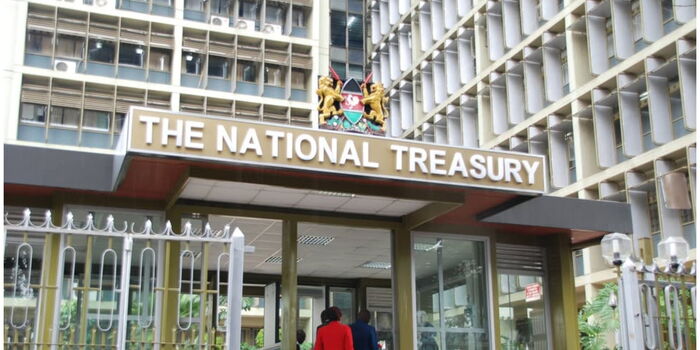
An image showing the entrance of the National Treasury buildings. Photo/Courtesy
By Ruth Sang
The National Treasury has announced its intention to raise an additional Ksh1.02 trillion to plug the country’s deepening budget deficit, in a move that reignites debate over Kenya’s spiralling public debt burden. This development was confirmed by Treasury Principal Secretary Chris Kiptoo on Wednesday, who said the borrowing is needed to stabilise government operations at a time when financial pressures continue to mount.
A Reuters report says the new borrowing is set to bridge a fiscal gap projected at 4.9 per cent of Kenya’s GDP, which is a marginal increase from the 4.8 per cent shortfall in the current financial year. The Treasury outlined that the financing plan comprises Ksh241.8 billion (USD 1.86 billion) in net external borrowing and Ksh775.8 billion in net domestic borrowing.
According to updated government statistics, by September 2025, the total public debt for Kenya rose to Ksh 12.06 trillion. This was comprised of domestic debt, which stood at around Ksh 6.66 trillion, while loans from abroad reached approximately Ksh 5.39 trillion, underlining the country’s continuous reliance on borrowed money to maintain services and essential operations.
The latest plan from the government has elicited criticism from different quarters, with Kiharu MP Ndindi Nyoro questioning the rate at which the country is borrowing currently. Nyoro stated that the administration was acquiring debt at an average rate of more than Ksh3 billion per day, a trend he warned could strain the country’s economic prospects if not managed prudently.
The Treasury is, however, adamant that it needs the funds to meet pressing public expenditure needs. A huge chunk of the money is apportioned to the education docket. The government aims to cover salaries for newly hired teachers and also pave the way for the hiring of another 20,000 intern teachers starting January 2026, in a bid to ease the critical shortage witnessed across the country. In May, President William Ruto also announced that Ksh1.6 billion will be spent on teacher training and another Ksh1 billion towards teacher promotions.
Other key sectors are also set to be big winners. The health and security departments, which have been facing constrained operations due to a lack of resources, will also get increased allocation. Last week, the government hired 10,000 police officers, the first mass recruitment in over three years after delays occasioned by budget cuts. The recruitment is consistent with attempts to enhance security operations before the 2027 General Election.
Meanwhile, Kenya’s hopes of a fresh programme with the International Monetary Fund have hit delays, mainly because of unresolved issues relating to the categorisation of securitised loans. The postponement further complicates the country’s broader financing plans. PS Kiptoo further called on ministries, departments, and agencies to adopt current financial reforms, including the implementation of an integrated national electronic government procurement system. This, he added, is likely to promote transparency, reduce cases of corruption, and stem the theft of public resources.
About Author