Specialists in the Village: How Local Doctors Are Reversing Kenya’s Healthcare Brain Drain
Since 2012, 244 Kenyan doctors — half of them women — have received scholarships to train in critical specialties. Kenya’s First Lady Rachel Ruto
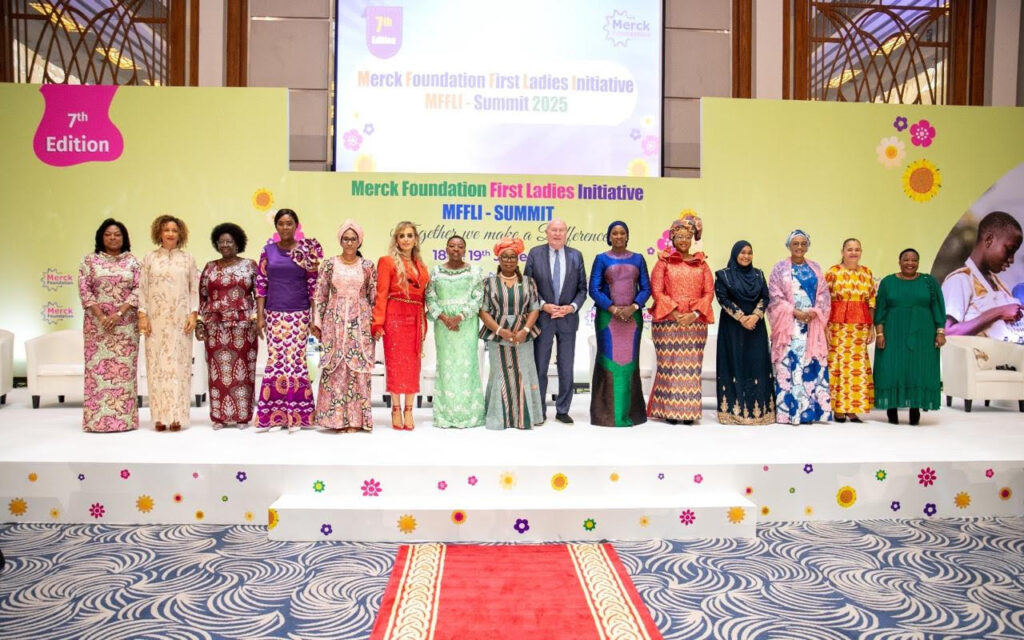
Kenya’s First Lady, H.E. Rachel Ruto (seventh from the left), pictured during the 7th Merck Foundation First Ladies Initiative (MFFLI) Summit. The high-level event brought together African First Ladies to advance healthcare capacity, advocate for women’s health, and promote equitable access to medical education across the continent
By Calister Bonareri| June 21, 2025
As Kenya grapples with persistent healthcare gaps, a quiet revolution is unfolding — not in major urban hospitals, but in county health centres once overlooked by the medical elite. Fueled by the Merck Foundation’s specialized training scholarships, local doctors are choosing to return home and serve, reversing a long-standing trend of medical brain drain.
Investing in Human Capital, Not Just Infrastructure
Kenya’s First Lady Rachel Ruto, speaking during the 7th Merck Foundation First Ladies Initiative (MFFLI) Summit, underscored the shift from foreign aid dependency to sustainable local capacity building.
“Since 2012, 244 Kenyan doctors — half of them women — have received scholarships to train in critical specialties. These are not just numbers; they represent communities now within reach of lifesaving care,” said the First Lady.
She also highlighted the Educating Linda program, which sponsors high-potential, underprivileged girls. “We are not just educating individuals, we are creating entire ecosystems of change,” she added.
From Overseas Classrooms to County Clinics
One such agent of change is Dr. Elijah Mwaura Chege, Kenya’s first urologist in Tharaka-Nithi County. After completing a Master of Surgery in Urology at the University of Edinburgh, he returned home in 2023.
“Before this, my patients had to travel over 200 kilometers for care,” said Dr. Chege. “Now, they walk into a county hospital and find help. That’s a quiet kind of revolution.”
His return is symbolic of a larger movement — where merit meets purpose and global education meets local application.
The Fertility Frontier: A Tanzanian Breakthrough
In neighboring Tanzania, Dr. Nicholaus Stephen Mazuguni, another Merck Foundation alumnus, opened the country’s first fertility clinic owned by a local doctor. His work has led to the birth of over 600 IVF babies and catalyzed the first public IVF unit in Tanzania through public-private partnerships.
“We’re mentoring clinicians, not just treating patients,” Dr. Mazuguni said. “Because true access means building a pipeline of providers, not just patients.”
Why This Matters: The Data Behind the Mission
According to Merck Foundation CEO Dr. Rasha Kelej, the initiative isn’t charity — it’s strategic infrastructure development.
“Africa has only 1.3 doctors per 1,000 people compared to the global average of 16.4. We’re closing that gap with over 2,520 scholarships in 44 medical specialties,” she said.
In Kenya alone, specialist shortages in areas like oncology, endocrinology, and fertility medicine remain critical. A 2024 Ministry of Health report found that 70% of counties had no access to at least three essential specialist services — a gap programs like Merck’s are narrowing.
A Model for Policy and Replication
As Africa seeks to strengthen its health systems in line with the African Union’s Agenda 2063 and the WHO Universal Health Coverage goals, such scholarship-based models may prove more sustainable than large infrastructure projects with no human capital to run them.
The Merck Foundation’s 8th anniversary summit didn’t just celebrate milestones — it posed a compelling question to policymakers: What if the most powerful healthcare investment isn’t a building, but a brain?
Expanding the Vision: Insights from Merck Foundation Leadership
The 8th Merck Foundation Africa First Ladies Initiative (MFFLI) Summit welcomed new members including the First Ladies of Ghana, Mozambique, Nigeria, and Senegal. Dr. Rasha Kelej, CEO of Merck Foundation, emphasized the Foundation’s core mission: enabling every individual to live a healthy, dignified life through healthcare capacity building, patient care transformation, infertility destigmatization, women empowerment, and girl-child education.
Highlighting the persistent challenges in African healthcare, Dr. Kelej referenced the 2024 Global Health Report, which notes Africa has only 268 public medical schools—11 countries have just one, and 11 have none. This scarcity contributes to the continent’s stark imbalance: 24% of the global disease burden but only 2.91 healthcare workers per 1,000 people, according to the WHO (2021).
Before Merck Foundation’s intervention in 2012, many countries such as The Gambia, Liberia, Sierra Leone, Central African Republic, Guinea, Burundi, and others had no trained specialists in oncology, fertility, or intensive care. Since then, the Foundation has awarded over 2,270 postgraduate scholarships in 44 critical specialties to doctors from 52 countries, many of whom became the first specialists in their disciplines in their respective nations.
Dr. Kelej emphasized that the scholarship program is more than academic—it is an economic and social development tool. By enabling doctors to remain and serve in their countries, Merck Foundation is helping bridge the health gap between urban and rural communities.
About Author