Ruto Signs Two New Laws to Strengthen Financial Sector, Reform Parliamentary Pensions
The reforms are intended to enable the Central Bank to respond quickly to financial shocks while safeguarding the stability of Kenya’s banking sector.
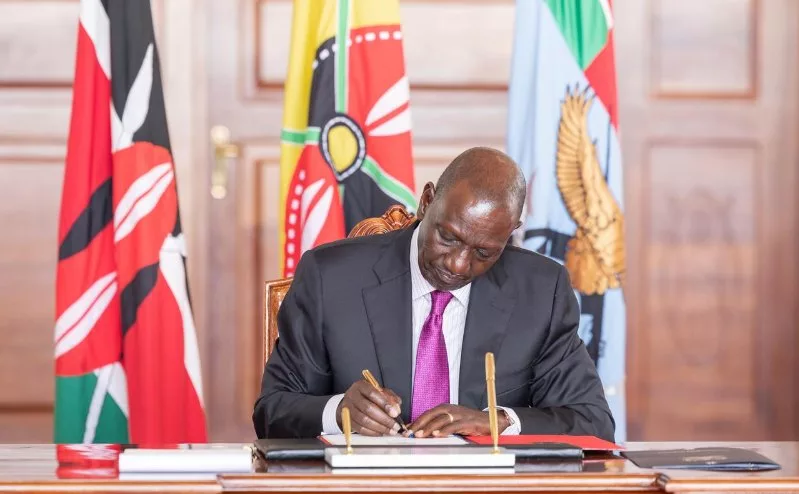
President William Ruto. Photo: Courtey.
By Robert Mutasi
President William Ruto has signed into law two key pieces of legislation aimed at strengthening Kenya’s financial system and modernizing the country’s parliamentary pensions framework to align with the Constitution and current governance standards.
The President assented to the Central Bank of Kenya (Amendment) Act, 2026 and the Parliamentary Pensions (Amendment) Act, 2026 during a ceremony at State House, Nairobi. The event was attended by senior government officials, lawmakers and representatives from key state institutions.
The new laws are expected to bolster financial stability, expand the mandate of the Central Bank’s training institution and update pension provisions that have remained largely unchanged since the early 1980s.
CBK Retains Discretion on Emergency Liquidity Support
One of the most significant changes introduced under the Central Bank amendments is the preservation of the Central Bank of Kenya’s authority to provide emergency liquidity assistance to licensed financial institutions experiencing temporary financial distress.
The legislation grants the Central Bank discretion to determine which institutions qualify for emergency funding, the interest rates to be charged and the duration of the support.
Under the amended law, emergency liquidity assistance may initially be provided for up to 12 months. The support may be extended for a cumulative period of up to five years, subject to the institution’s recovery plan and financial performance.
The reforms are intended to enable the Central Bank to respond quickly to financial shocks while safeguarding the stability of Kenya’s banking sector.
According to the Central Bank of Kenya, emergency liquidity assistance is an internationally recognized tool used by central banks to maintain confidence in the financial system and prevent liquidity shortages from escalating into broader financial crises.
The amendments are expected to particularly benefit deposit-taking microfinance institutions, which provide financial services to millions of Kenyans, especially small businesses and low-income households. By allowing viable institutions facing temporary liquidity constraints to access structured support, the law seeks to protect depositors, preserve confidence in the financial sector and reduce systemic risk.
The legislation is also consistent with broader financial sector reforms supported by the International Monetary Fund (IMF) and the World Bank, both of which have encouraged stronger crisis management frameworks and enhanced financial sector resilience in Kenya.
School of Monetary Studies Receives Expanded Mandate
The new law also broadens the responsibilities of the Central Bank’s School of Monetary Studies.
Previously focused mainly on domestic training, the institution will now be permitted to offer professional courses across the region, collaborate with universities and other organizations and generate revenue through educational programmes and consultancy services.
Government officials said the expanded mandate is intended to position the school as a regional centre of excellence in banking, monetary policy and financial regulation.
Parliamentary Pensions Law Updated
President Ruto also signed the Parliamentary Pensions (Amendment) Act, updating legislation first enacted in 1983 to reflect constitutional changes introduced by the Constitution of Kenya, 2010.
The amendments were sponsored by Makueni MP Makali Mulu on behalf of the Parliamentary Pensions Committee chaired by National Assembly Speaker Moses Wetang’ula.
Among the key reforms is the alignment of the Act with Kenya’s legal definition of the age of majority. The previous law recognized dependants only up to the age of 16. The amended legislation raises that threshold to 18 years, bringing it into conformity with the Constitution and the Children Act.
The law also reflects Kenya’s bicameral Parliament by formally recognizing both the National Assembly and the Senate in the administration of parliamentary pension matters. Pension committees and tribunals established under the Act will now include representation from both Houses.
Another notable reform addresses gender equality by recognizing widowers as eligible beneficiaries of the pension benefits of deceased female Members of Parliament. The previous legislation expressly referred only to widows, despite administrative practice having evolved over time.
Officials said the amendments remove outdated provisions and ensure that the law complies with constitutional principles on equality, representation and non-discrimination.
Reforms Aim to Strengthen Governance
The two laws form part of the government’s broader agenda to modernize Kenya’s financial and public sector legal framework.
Following the presidential assent, copies of the Acts were handed to Deputy President Kithure Kindiki, Attorney General Dorcas Oduor and National Treasury officials for publication in the Kenya Gazette and implementation by the relevant institutions.
Government officials said the reforms are expected to enhance confidence in Kenya’s financial system, strengthen regulatory oversight and ensure that parliamentary pension administration reflects the country’s current constitutional and legal order.
The enactment marks the completion of the legislative process for the two Bills after their passage by Parliament and presidential approval, paving the way for their implementation in accordance with Kenya’s laws and regulations.
About Author