Rigathi Gachagua Criticises Finance Bill 2026, Questions Ksh.17 Billion State House Budget
The DCP leader says the Finance Bill 2026 will increase the cost of living and deepen economic hardship, while arguing that government spending should focus more on essential sectors and less on administrative expenditure.
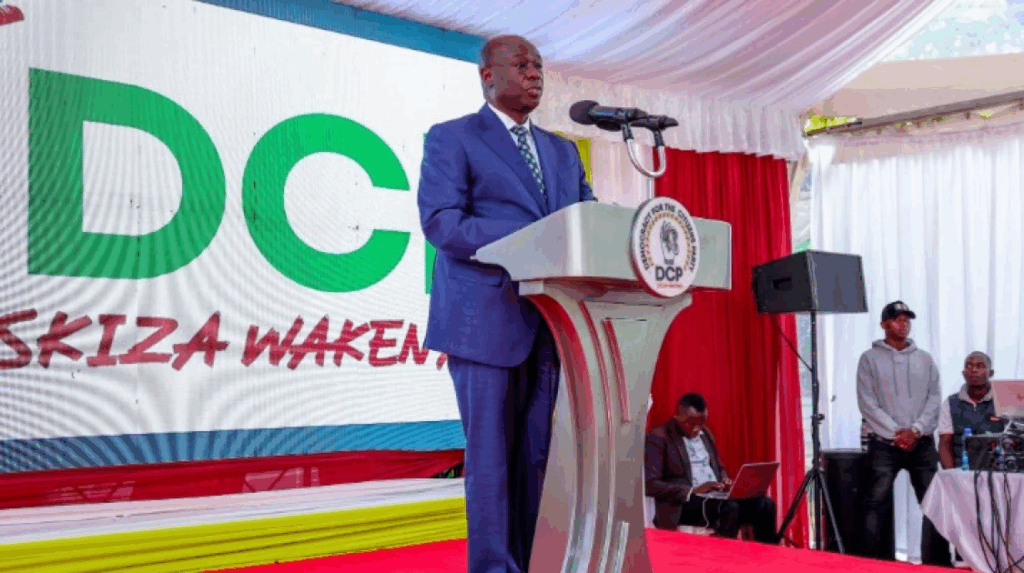
DCP Leader Rigathi Gachagua speaks during a press conference in Nairobi. Photo/Courtesy
By Ruth Sang
Democracy for the Citizens Party (DCP) leader Rigathi Gachagua has faulted the proposed 2026/27 Budget Estimates and the Finance Bill 2026, accusing the government of prioritising non-essential spending while placing a heavier tax burden on Kenyans.
Speaking at a press conference in Nairobi, Gachagua described the budget proposals and the Finance Bill as measures that would increase the cost of living without delivering meaningful economic growth.
“The Budget Estimates and the Finance Bill 2026 are a twin evil. They place more pressure on citizens through taxation while failing to address the country’s economic challenges,” he said.
The former Deputy President took issue with the allocation of Ksh.17 billion to the Presidency and State House, arguing that the funds should instead be directed toward sectors that have a direct impact on citizens’ livelihoods.
“Even as key sectors struggle with inadequate funding, allocations to the Presidency and State House continue to rise to Ksh.17 billion. This is funding opulence and corruption. What does State House need Ksh.17 billion for? Are there schools and hospitals in State House?” Gachagua posed.
He maintained that education, healthcare and agriculture should receive greater budgetary priority, noting that the sectors are critical to the country’s social and economic well-being.
“Education, health and agriculture are the sectors that touch the lives of all Kenyans. Any government that is serious about development must adequately fund them,” he said.
Gachagua also questioned the government’s borrowing practices, alleging that the administration is relying on debt to finance recurrent expenditure contrary to existing legal provisions.
“Why is the government openly violating Article 211 of the Constitution and provisions of the Public Finance Management Act that prohibit financing recurrent expenditure through borrowing?” he asked.
According to the DCP leader, the country continues to borrow heavily despite concerns over limited development outcomes.
Turning to the Finance Bill 2026, Gachagua described it as one of the most punitive tax proposals in recent years, claiming it would increase household expenses and compliance costs for businesses.
“This Bill is deeply harmful. It raises taxes, increases compliance burdens and escalates the cost of living for ordinary Kenyans,” he stated.
He specifically opposed a proposal to raise excise duty on mobile phones from 10 per cent to 25 per cent, arguing that mobile devices have become essential tools for learning, communication and economic participation.
“Phones are no longer luxury items. They are vital for education, financial services, job searches, entrepreneurship and content creation. Increasing their cost will only widen the digital divide,” he said.
Gachagua further argued that the government is pursuing ambitious revenue targets despite challenges in revenue collection and sluggish economic growth.
“At a time when Kenyans are struggling with high living costs, unemployment, expensive credit and increased statutory deductions, introducing more taxes will only worsen the situation for households and businesses,” he added.
To ease the burden on citizens, Gachagua proposed a series of measures including halting Housing Levy deductions, reducing what he termed wasteful government spending, slowing the growth of public debt, prioritising funding for education, agriculture and health, settling pending bills owed to businesses, broadening the tax base through improved transparency, strengthening parliamentary oversight and enhancing accountability in public spending.
He said a DCP administration would reduce the national budget from Ksh.4.8 trillion to Ksh.3.7 trillion while increasing allocations to key productive sectors.
Under his proposal, funding for agriculture would rise from Ksh.97 billion to Ksh.300 billion, while the health budget would increase from Ksh.167.4 billion to Ksh.450 billion. At the same time, expenditure on public administration would be reduced from Ksh.354.9 billion to Ksh.250 billion.
Gachagua also proposed eliminating new government borrowing.
“This Finance Bill is taxing Kenyans into poverty. It is a threat to ordinary wananchi and risks placing even greater pressure on households across the country,” he claimed.
About Author