Nairobi Locked Down as Kenya Marks Second Anniversary of Deadly Gen Z Protests
She questioned the process used to identify beneficiaries, claiming only a small number of affected families had received payments.
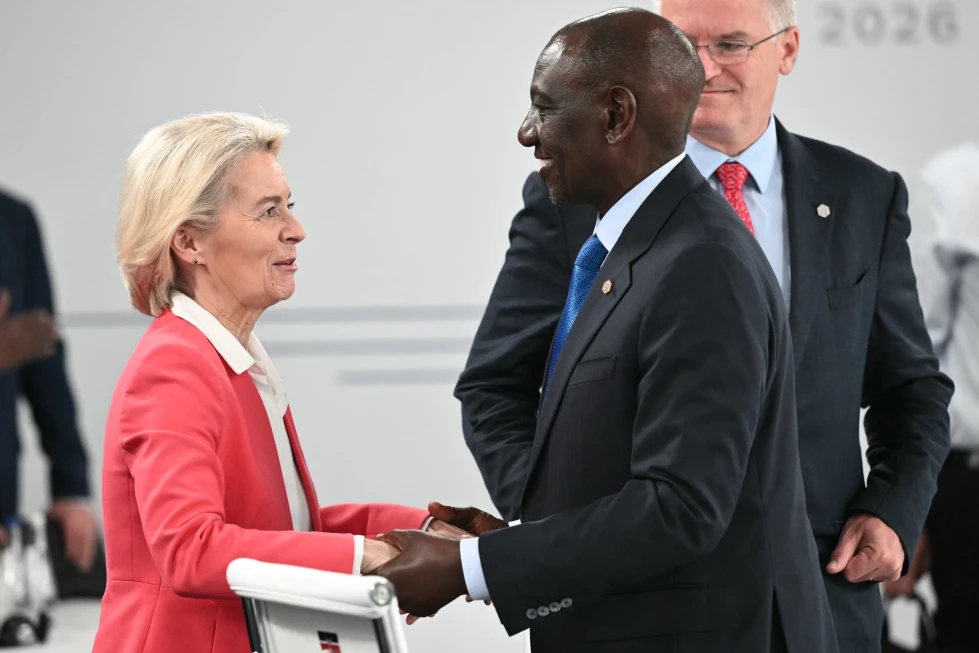
European Commission President Ursula von der Leyen greets President William Ruto of Kenya before a working session during the G7 Summit in Evian-les-Bains, France, on June 17, 2026. PHOTO COURTESY OF AP.
By Robert Mutasi
Police mounted extensive security operations across Nairobi on Thursday, sealing off major entry routes into the city ahead of demonstrations marking two years since the deadly anti-government protests that left at least 60 people dead and culminated in the storming of Parliament.
Roadblocks were erected on key highways leading into the capital, severely restricting movement as authorities sought to prevent unrest during the planned anniversary protests. Security personnel were also deployed around critical government installations, including Parliament Buildings, which remained heavily barricaded throughout the morning.
Several businesses in the city centre remained closed as fears of possible confrontations between demonstrators and security agencies prompted traders to stay away.
The planned demonstrations have been organized by families of victims killed during the June 2024 protests and human rights activists who continue to demand justice and accountability for those who lost their lives. The protests are also aimed at highlighting concerns over delays in compensating victims and their families.
The anniversary comes two years after thousands of young Kenyans took to the streets in opposition to the controversial Finance Bill 2024, which proposed new taxes amid growing public frustration over the high cost of living. The demonstrations reached a climax when protesters breached Parliament grounds as lawmakers debated the legislation.
Police responded with force, opening fire on demonstrators outside Parliament. The violence left dozens dead and hundreds injured, sparking widespread condemnation from local and international human rights organizations.
President William Ruto last week reaffirmed the government’s commitment to protecting the constitutional right to peaceful assembly while warning against actions that could disrupt normal economic activity.
“People will be allowed to protest, but we must also protect the rights of children to attend school and workers to carry on with their duties,” the President said, cautioning against attempts to shut down the country.
Interior Cabinet Secretary Kipchumba Murkomen echoed the government’s position on Wednesday, stating that police officers would provide security and escort peaceful demonstrators. However, he warned that authorities would take firm action against individuals seeking to exploit the protests to engage in criminal activities, including looting and destruction of property.
Opposition leaders have thrown their support behind the demonstrations, accusing the government of failing to provide adequate transparency regarding the compensation programme established for victims of the 2024 protests.
Among those expected to participate is Edith Wanjiku, whose 19-year-old son, Ibrahim Kamau, was killed after being shot twice in the neck during the demonstrations near Parliament.
Speaking ahead of the protests, Wanjiku said her family continues to struggle with the emotional burden of the loss.
“We have suffered emotionally for the last two years,” she said, adding that despite submitting all the required documentation, her family has not received compensation.
She questioned the process used to identify beneficiaries, claiming only a small number of affected families had received payments.
“Only two out of ten families whose children were shot that day near Parliament have been compensated, and we do not understand the criteria being used,” she said.
The government recently announced plans to compensate nearly 2,000 victims of human rights violations linked to the 2024 protests. However, questions have persisted over the pace of implementation and the selection process.
President Ruto has defended the compensation initiative, describing it as recognition by the state that citizens suffered harm during the unrest. He emphasized that the payments should not be interpreted as an admission of liability by the government.
“The compensation is not the price of life, pain or loss,” he said recently. “Neither should it be viewed as a reward for violence or criminality.”
About Author