Police Intensify Security Preparations Ahead of Gen Z Protest Anniversary
In Nairobi, authorities are considering restricting access to some sensitive areas, including Parliament Square, to authorised personnel only.
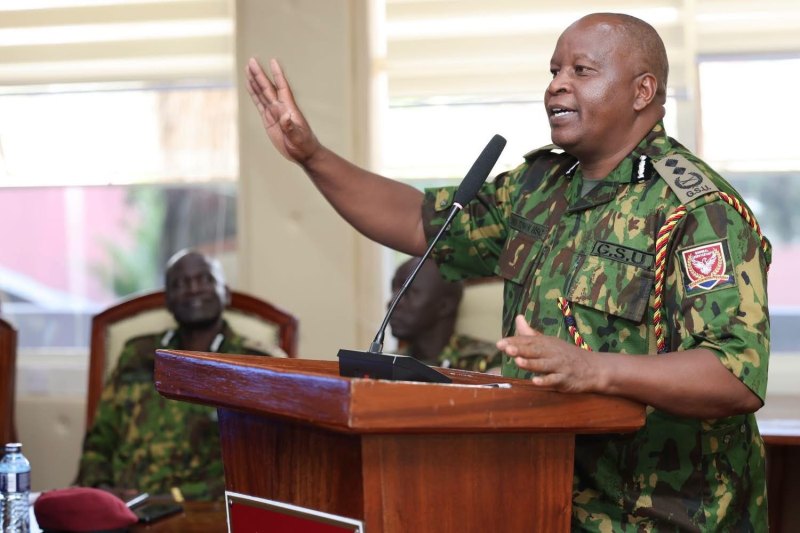
GSU Commandant Johana Tonui. Photo/Courtesy.
By Robert Mutasi
Senior police commanders have stepped up security preparations ahead of anticipated demonstrations marking two years since the 2024 Gen Z protests against the Finance Bill, with meetings held across the country to coordinate deployment plans and maintain public order.
Although security officials have indicated that they do not expect large-scale protests, police units have spent the past week reviewing operational strategies and assessing potential security risks in key regions.
At the General Service Unit (GSU) headquarters, newly appointed Commandant Johana Tonui convened a meeting with commanders expected to oversee deployments in areas identified as potential security hotspots. The regions include Nairobi, parts of Central Kenya, Machakos, Kajiado, Eldoret and Kitale.
During the meeting, Tonui directed officers to uphold professionalism and exercise restraint while handling public demonstrations. He emphasized the need for law enforcement officers to operate within the law while safeguarding public safety.
Anti-riot teams from the GSU are expected to be deployed to designated locations ahead of Thursday’s planned commemorations.
In Nairobi, authorities are considering restricting access to some sensitive areas, including Parliament Square, to authorised personnel only. Security agencies say the measure is intended to prevent unauthorised access by individuals planning to gather or lay flowers at the site during the anniversary events.
Parliament Square remains a symbolic location following the events of June 2024, when protesters breached Parliament precincts shortly after lawmakers passed the controversial Finance Bill. The demonstrations sparked nationwide unrest and became one of the most significant episodes of public dissent in recent Kenyan history.
Human rights groups and activists have maintained that more than 200 people lost their lives during the protests. Additional fatalities were reported during commemorative activities held last year to mark the first anniversary of the demonstrations.
As preparations continue, Inspector-General of the National Police Service Douglas Kanja has also directed attention to emerging security threats, particularly the resurgence of criminal gangs in several parts of the country.
Speaking during a high-level security summit at the National Police Leadership Academy, Kanja instructed police commanders to adopt efficient and adaptive policing strategies capable of maximising available resources while maintaining law and order.
He warned against complacency in addressing criminal activities, adopting what he described as a zero-tolerance approach towards operational laxity within the service.
“The National Police Service remains committed to protecting lives and property, enforcing the law and ensuring a secure environment that supports social and economic stability,” Kanja said.
The security summit brought together senior leaders from the Kenya Police Service, the Administration Police Service and the Directorate of Criminal Investigations (DCI). The meeting focused on reviewing the country’s security landscape, evaluating emerging crime trends and developing strategies aimed at strengthening the national security framework.
Among those present were Deputy Inspector-General of the Kenya Police Service Eliud Lagat, Deputy Inspector-General of the Administration Police Service Gilbert Masengeli and Director of Criminal Investigations Mohamed Amin.
Kanja commended senior officers for their efforts in combating evolving security challenges and urged them to maintain vigilance and professionalism in service delivery.
The discussions covered a broad range of security concerns, including criminal gangs, organised goonism, money laundering, cyber-enabled crimes and other emerging threats that authorities say could undermine public safety, economic growth and national stability.
Commanders also reviewed intelligence-sharing mechanisms, inter-agency collaboration and the importance of intelligence-led investigations in tackling increasingly sophisticated criminal networks.
During the summit, regional commanders presented security assessments from their respective jurisdictions, highlighting prevailing threats, operational challenges and measures already in place to address security concerns.
They further outlined response frameworks and operational plans designed to strengthen the prevention, detection and disruption of criminal activities.
Following the summit, commanders held separate consultative meetings to refine local operational strategies. The sessions focused on reviewing security conditions on the ground, assessing possible protest scenarios and aligning regional priorities with the broader national security agenda.
The heightened security preparations come as the country approaches a sensitive anniversary that continues to evoke strong memories of the protests that reshaped Kenya’s political discourse and sparked renewed debates about governance, accountability and citizens’ rights.
About Author