Ruto Apologises for Historical Marginalisation, Pledges Massive Development Push for Northern Kenya
President William Ruto was captured inside his motorcade while en route to an official engagement, highlighting the tight security and coordination that accompanies presidential movements during state functions and public events.
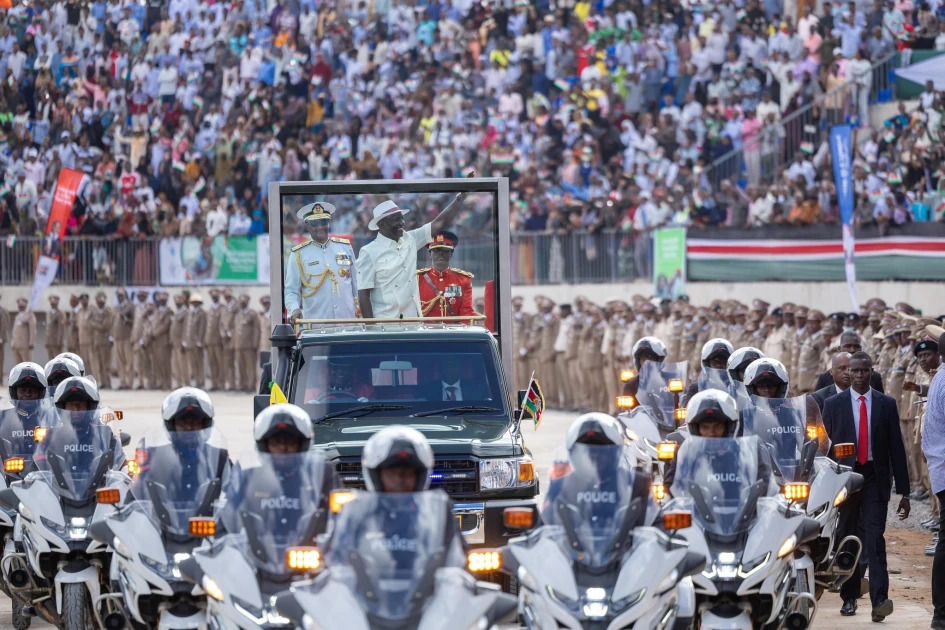
President William Ruto inside his motorcade as he travels for a public engagement, underscoring heightened security and presidential movement during official duties. Photo/Courtesy
By Ruth Sang
President William Ruto has issued a heartfelt apology to residents of Northern Kenya, acknowledging decades of state-driven marginalisation that left the region far behind in development compared to other parts of the country.
The President attributed the historical imbalance to the 1965 Sessional Paper No. 10 on economic planning, which prioritized so-called “high potential” areas while neglecting the vast northern frontier, which was largely considered too remote and arid for major investment. He noted that this policy gap denied the region essential infrastructure such as roads, water, schools and healthcare for many years.
“That was wrong then, it is wrong now and it will forever remain wrong,” President Ruto said during the 63rd Madaraka Day celebrations held at Wajir Stadium, the first time a national holiday has been hosted in Northern Kenya.
He added:
“On behalf of the people and the Republic of Kenya, I offer my sincere apology for the marginalisation you have endured over the years. Poleni sana ndugu zetu. It was never meant to be this way.”
The historic celebration was attended by First Lady Mama Rachel Ruto, Deputy President Kithure Kindiki, senior government officials, security chiefs, parliamentary leaders and members of the diplomatic corps.
Also present were Wajir Governor Ahmed Abdullahi, top military commanders including Chief of Defence Forces General Charles Kahariri, and service commanders from the Army, Air Force and Navy.
Affirmative Action and Inclusion Agenda
President Ruto said his administration is actively working to reverse years of exclusion through targeted affirmative action programmes. He cited reforms in the issuance of national identity cards and birth certificates in Northern Kenya as part of efforts to promote equal citizenship.
“Every Kenyan deserves equal protection, equal dignity and equal treatment under the law,” he said.
He, however, clarified that the reforms do not abolish citizenship verification and are not meant to enable illegal acquisition of Kenyan documents by non-citizens.
Education and Youth Empowerment
On education, the President announced the establishment of teacher training colleges in Wajir, Kotulo and Mandera, complementing the existing Garissa TTC. He revealed that more than 4,600 trainees from the region are currently enrolled.
He also directed the Ministry of Education to integrate Duksi, Madrassa and the Programme for Pastoral Instruction into the national curriculum to reflect the cultural and social realities of local communities.
Additionally, he ordered the fast-tracking of the establishment of Wajir University to expand access to higher education in the region.
Healthcare and Housing
On healthcare, Ruto said over 800,000 residents in the region have registered under the Social Health Authority (SHA), which has already paid KSh8.1 billion in claims to hospitals across Wajir, Garissa and Mandera counties.
In housing, he noted that the government is investing KSh38.5 billion in affordable housing projects across Northern Kenya, aimed at improving livelihoods and creating employment opportunities for young people.
“Our message to the youth of Northern Kenya is simple: Your future will not be defined by your geography. It will be defined by your talent, your skills, and your determination,” he said.
Infrastructure and Livestock Development
The President also highlighted ongoing infrastructure projects, including the 750-kilometre Northern Kenya Gateway Corridor connecting Isiolo, Wajir and Mandera, which he said will open up historically isolated regions.
He further announced the creation of a KSh5 billion County Livestock Investment Company to support over 350,000 pastoralists across 21 arid and semi-arid counties, enabling them to commercialise livestock production and improve incomes.
Stadium Renaming and Hospital Launch
President Ruto approved a request by local leaders to rename the newly refurbished Wajir Stadium after the late Wajir West MP and former minister Ahmed Khalif, who died in a plane crash in 2003.
Later, he commissioned the modern Accident and Emergency Wing at the Wajir County Teaching and Referral Hospital, marking another milestone in strengthening healthcare services in the region.
The Madaraka Day celebrations were also attended by top security officials including Inspector-General of Police Douglas Kanja, senior prison and wildlife service chiefs, principal secretaries, MPs and MCAs.
About Author