Ruto Clarifies ‘Nigerian English’ Remarks After Online Backlash, Says Comments Misinterpreted
Both Kenya and Nigeria use English as an official language, though variations in accent and expression reflect each country’s cultural and linguistic heritage.
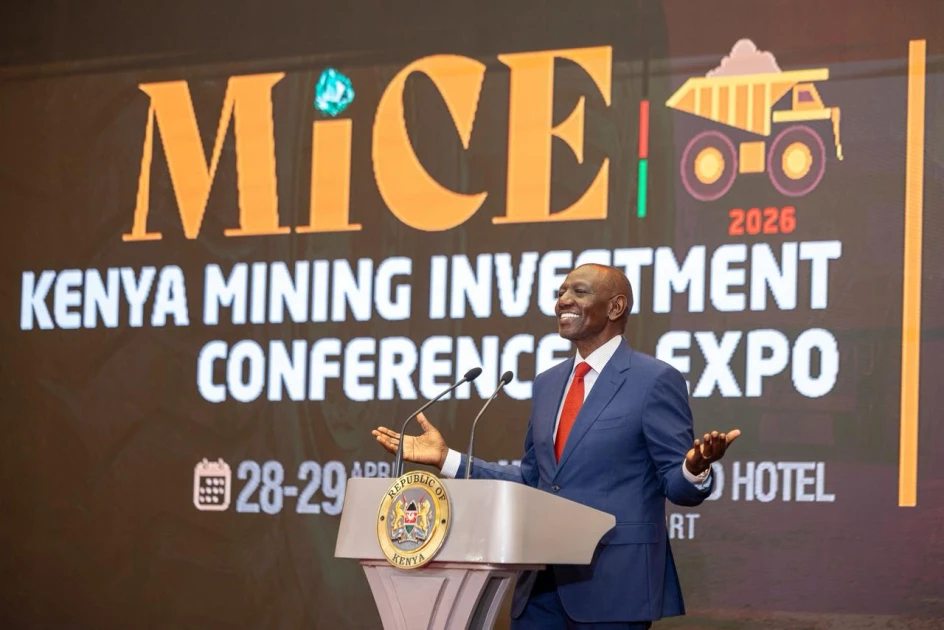
President William Ruto speaking at the Mining Investment Conference and Expo, Nairobi on April 28, 2026. Photo/Courtesy
By Ruth Sang
President William Ruto has addressed the controversy surrounding his remarks on Nigerian-accented English, saying his comments were taken out of context and did not intend to disparage any country.
Speaking on Tuesday during the Mining Investment Conference and Expo in Nairobi, the Head of State said the viral clip misrepresented his original message, which he explained was meant to highlight the strength of English proficiency across Africa.
“I was recorded when I was speaking to fellow citizens somewhere. It was supposed to be a private conversation, but someone decided that it should be public. But they also misrepresented the facts,” Ruto said.
He added that his comments were intended as a comparison of linguistic proficiency rather than criticism.
“The facts are that I was talking about how we in Africa speak very good English. In fact, in some countries like Nigeria, if you don’t speak excellent English like the one we speak in Kenya, you may need a translator for you to understand the excellent English in Nigeria,” he explained.
Ruto further expressed hope that the incident would not affect diplomatic ties between Kenya and Nigeria.
“My in-laws, I hope there will be no consequences for whatever was done,” he added.
The clarification follows widespread backlash online after earlier remarks made on April 23 while addressing Kenyans in Italy, where the President praised Kenya’s education system and described its English proficiency as among the best globally. In that address, he compared it to Nigerian English, suggesting it could be difficult to understand.
The remarks triggered criticism from social media users in both Kenya and Nigeria, with many accusing the President of undermining a fellow African nation.
During the same conference in Nairobi, Nigeria’s Minister of Solid Minerals Development, Henry Dele Alake, responded in a light-hearted manner, saying Nigerians had “mandated” him to affirm their command of the language.
“The people of Nigeria have mandated me to inform you and assure you that Nigerians speak good English,” Alake said, drawing laughter from the audience.
The debate also drew reactions from public figures, including Zimbabwean journalist Hopewell Chin’ono, who called for greater appreciation of linguistic diversity, noting that English should not be used as a benchmark for intelligence or national progress.
Both Kenya and Nigeria use English as an official language, though variations in accent and expression reflect each country’s cultural and linguistic heritage.
About Author