Ruto Maps Out Ambitious Ksh.5 Trillion Strategy to Revolutionise Kenya’s Future
The third pillar is energy production. Ruto said the current output of 2,300 MW in Kenya is a far cry from what a modern industrial economy needs.
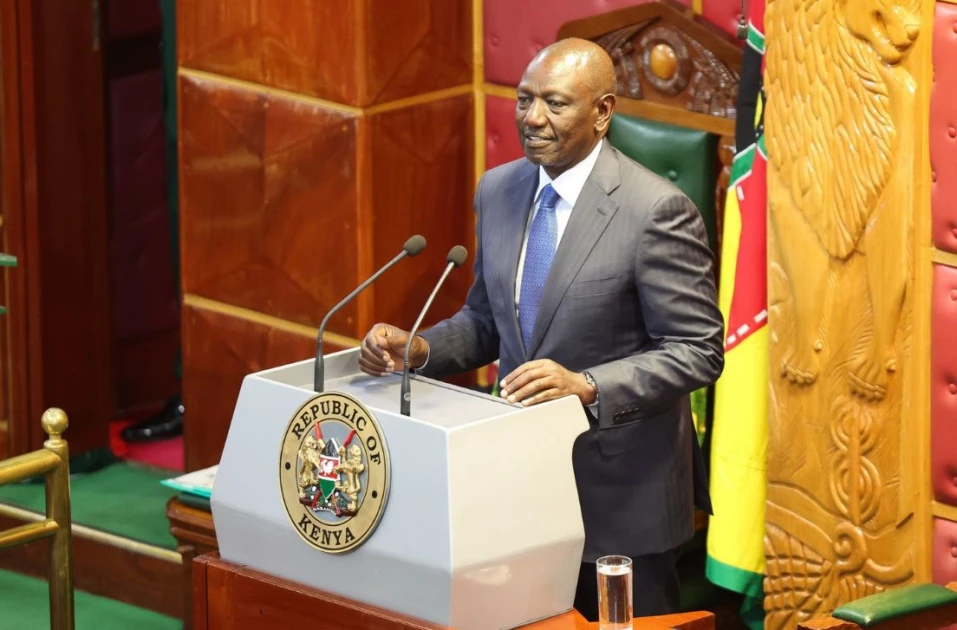
President William Ruto delivers the State of the Nation address in Parliament on November 20, 2025. Photo/Courtesy
By Ruth Sang
President William Ruto launched an ambitious nationwide transformation agenda, which he says shall propel Kenya toward first-world status, benchmarking other rapid-development economies such as Singapore, Japan, South Korea, and Malaysia. According to the Head of State, this dream will require nothing less than a Ksh.5 trillion investment, targeted at four major pillars his administration considers indispensable for long-term national development.
Addressing Parliament during the State of the Nation speech on Thursday, President Ruto explained that his plan hinged on strategic reforms in human capital development, economic restructuring, energy expansion and modernization of transport and logistics. These, he said, would form the basis upon which Kenya can transition into a globally competitive and industrialized country.
Beginning with the first pillar of investing in people, the President underscored that no country has ever attained first-world status without strengthening its education and innovation ecosystem. He noted that the Government has already initiated an expansion of opportunities through curriculum reforms, increased training in science, and a prioritization of STEM programs. In the last four years alone, he said, the education budget has increased significantly from Ksh.490 billion to more than Ksh.700 billion, allowing for the hiring of more teachers, expanding learning facilities, and increasing funding for higher education institutions. These measures, he explained, are to cultivate a highly skilled and innovative workforce that can drive growth.
On economic transformation, the President repeated that Kenya must break from relying on imported goods and create the capacity to produce and export more. The country is currently spending about Ksh.500 billion annually on agricultural imports. Even though the government has taken measures to cut imports of maize, rice, wheat, sugar, and edible oils, the President stated that unpredictable weather conditions continue to pose a threat to progress. However, in efforts to counter this, the government plans to construct 50 mega dams and 200 smaller and medium-scale dams that will put at least 2.5 million acres under irrigation within five to seven years.
The third pillar is energy production. Ruto said the current output of 2,300 MW in Kenya is a far cry from what a modern industrial economy needs. His government seeks to increase this to 10,000 MW, which he thinks will spur technological advancement and a considerable rise in productivity across other sectors.
The final pillar focuses on transport and logistics, which the President described as critical to enhancing Kenya’s competitiveness. Plans are underway to dual 2,500 km of highways and tarmac 28,000 km of roads in the next decade. The key entry points lined up for modernization through public-private partnerships include JKIA, Mombasa Port, and Lamu Port. The government also intends to extend the SGR from Naivasha to Kisumu and onward to Malaba starting January 2026.
These flagship projects will be financed through the National Infrastructure Fund and the Sovereign Wealth Fund. The NIF is designed to attract private capital through privatisation, capital markets, and PPP models, while the SWF will be capitalised from natural resource royalties and privatisation proceeds of state assets. President Ruto concluded by calling on legislators and national stakeholders to rally behind this vision, noting that he had discussed it with both the late Rt. Hon. Raila Odinga and former President Uhuru Kenyatta, both of whom underscored the importance of large-scale investment in energy, roads, and food security for Kenya to industrialise.
About Author