U.S. and EU Avert Complete Trade War
U.S. officials noted the EU will lower non-tariff barriers for cars and some farm products, though specifics are on the table.
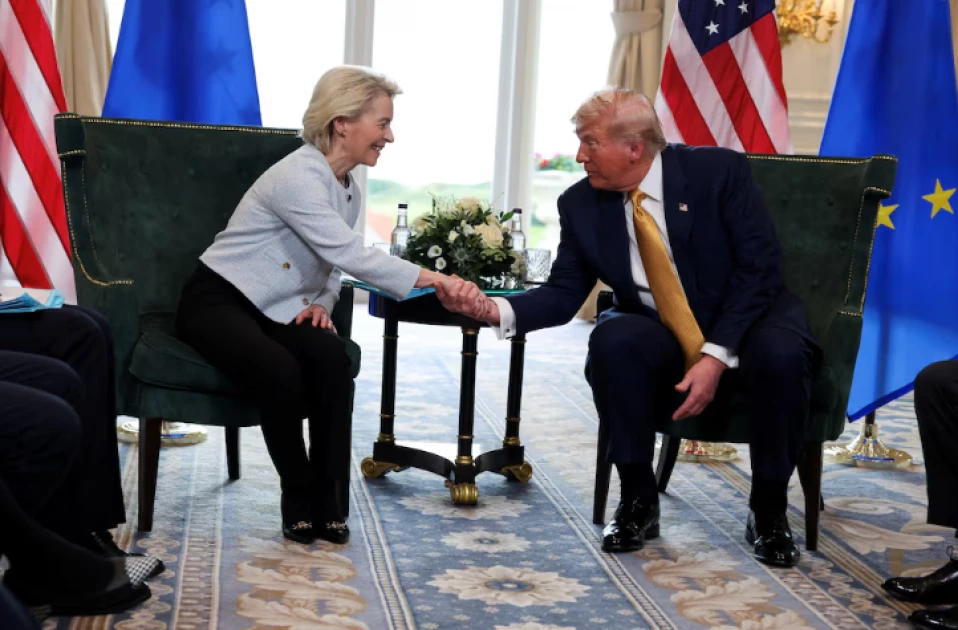
The deal is part of Trump's broader trade agenda, which has so far produced similar deals with the U.K., Japan, Indonesia, and Vietnam. Photo/ Citizen Digital
By Juliet Jerotich
The United States and the European Union reached a last-minute trade deal on Sunday, putting a 15% tariff on most of the EU’s exports—half of the initial rate they threatened—preventing a full-fledged trade war between the two economic powers, which collectively enjoy nearly one-third of total world trade.
The agreement was finalized in a meeting between U.S. President Donald Trump and European Commission President Ursula von der Leyen at Trump’s golf club in western Scotland. The one-hour meeting brought an end to tense months of negotiations that came close to a 30% tariff increase earlier scheduled to start on August 1.
Referring to it as “the biggest deal ever made,” Trump praised the EU for committing to invest roughly $600 billion in U.S. industries and boosting American energy and military hardware purchases. The agreement follows a comparable $550 billion trade pact with Japan last week. Trump pointed out that the deal would cement enduring transatlantic ties and respond to what he called years of unfair trading against U.S. exporters.
Von der Leyen described the U.S. president as a blunt but pragmatic negotiator and stated that the 15% tariff was “the best possible outcome” the situation permitted. “This agreement brings stability and predictability between the world’s two biggest economies,” she told reporters.
Although the reflecting elements of Washington’s deal with Japan, there are still issues outstanding—namely on tariffs on spirits. The agreement foresees $750 billion of EU imports of U.S. energy products and “hundreds of billions” of arms sales, a bonanza for top EU firms such as Airbus, Mercedes-Benz, and Novo Nordisk if the agreement is passed in full.
German Chancellor Friedrich Merz, who unveiled the deal, said it safeguarded Germany’s export-driven economy and automotive sector from catastrophic tariffs. German automakers were hit hard by a 27.5% American tariff on automobiles and auto components, which remains in place to some extent.
While progress has been made, most in Europe consider the 15% tariff too high against previous expectations of zero tariffs. The chairman of the European Parliament’s trade committee, Bernd Lange, argued that the deal is pro-U.S. and could divert considerable EU investment away from EU standards.
The agreement also continues a 50% tariff on steel and aluminum. However, von der Leyen indicated negotiations would continue towards a quota solution. Aircraft and aircraft parts, certain chemicals, generic medicines, semiconductor equipment, and certain agricultural and raw materials will have no tariffs.
U.S. officials noted the EU will lower non-tariff barriers for cars and some farm products, though specifics are on the table. The White House also left open the possibility of increasing tariffs if European investment promises are not delivered.
Financial markets responded positively as the euro gained 0.2% against the dollar, pound, and yen following the announcement.
The deal is part of Trump’s broader trade agenda, which has so far produced similar deals with the U.K., Japan, Indonesia, and Vietnam. While as much as the administration’s ambitious goal of “90 deals in 90 days” is still short, officials noted the massive opportunity symbolized by Europe’s $20 trillion economy for American farmers, ranchers, and manufacturers.
Trump has long blamed the EU for accumulating a U.S. merchandise trade deficit, which stood at $235 billion in 2024. The response from Brussels is to mention America’s services surplus, claiming it keeps overall trade balanced.
Defying economists’ threats of inflationary risks, Trump says tariffs have brought “hundreds of billions of dollars” into American coffers. The EU had already prepared retaliatory measures totaling €93 billion ($109 billion) in case talks broke down.
About Author