TSC Amendment Bill Seeks Fairness in Acting Positions and Enhanced Teacher Allowances
According to the bill, acting appointments will now follow a structured process, ensuring that teachers are selected based on clear qualifications and criteria.
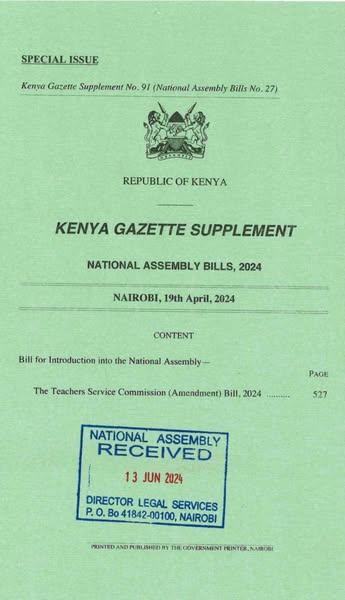
The Teachers Service Commission (Amendment) Bill (National Assembly Bill No. 27 of 2024), sponsored by Mandera South MP Hon. Abdul Haro, has passed its first reading and is set to undergo further scrutiny. Photo/ Parliament of Kenya.
By Robert Assad
A significant move to improve the welfare of teachers in Kenya has been introduced in the National Assembly.
The Teachers Service Commission (Amendment) Bill (National Assembly Bill No. 27 of 2024), sponsored by Mandera South MP Hon. Abdul Haro, has passed its first reading and is set to undergo further scrutiny.
The proposed amendments to the Teachers Service Commission (TSC) Act of 2012 aim to ensure fairness in the appointment of acting positions and provide additional allowances for teachers across the country.
The key objectives of the bill are twofold. First, it seeks to address the fairness in the appointment process for acting positions within the Teachers Service Commission.
According to the bill, acting appointments will now follow a structured process, ensuring that teachers are selected based on clear qualifications and criteria.
A new clause, Section 32A, is introduced to set clear guidelines for acting appointments.
Under this clause, a teacher appointed to an acting role will serve for a period ranging from at least 30 days up to a maximum of six months, provided they meet the necessary qualifications.
Furthermore, teachers appointed to acting positions will be entitled to a special duty allowance, recognizing the additional responsibilities they undertake. However, the bill also stipulates that a teacher can only hold one acting position at a time, reinforcing a structured and fair approach to such assignments.
In addition to the acting appointments, the amendment bill also proposes a range of allowances aimed at improving the financial welfare of teachers.
These allowances, which are largely non-pensionable, cover a wide array of circumstances.
Teachers will be eligible for house allowance, commuter allowance, hardship allowance, special duty allowance, responsibility allowance, special school allowance, leave allowance, transfer allowance, and reader’s facilitation or aid allowance.
Notably, the responsibility allowance is the only one with a provision for pensionability, continuing until the teacher’s retirement.
The bill’s introduction has been hailed as a step towards recognizing the importance of teachers in shaping the future of Kenya.
It highlights the government’s commitment to improving the working conditions of educators by ensuring that acting positions are awarded fairly and that teachers are adequately compensated for the various roles they play.
The bill is now set to proceed to the Education Committee, where public participation and stakeholder engagement will take place.
This phase will allow various stakeholders, including teachers’ unions, parents, and education experts, to provide their input before the bill is debated further in Parliament.
If passed, this amendment could significantly impact the professional lives of teachers across the country, enhancing their working conditions and ensuring they are better supported in their critical roles.
About Author