New Policy Brief Calls for Stronger Support to Empower SMEs in Kenya’s Circular Agri-Food Economy
A policy brief by the O-Farms Project highlights Kenya’s progress in circular economy policies while calling for stronger support to help SMEs overcome implementation gaps in the agri-food sector.
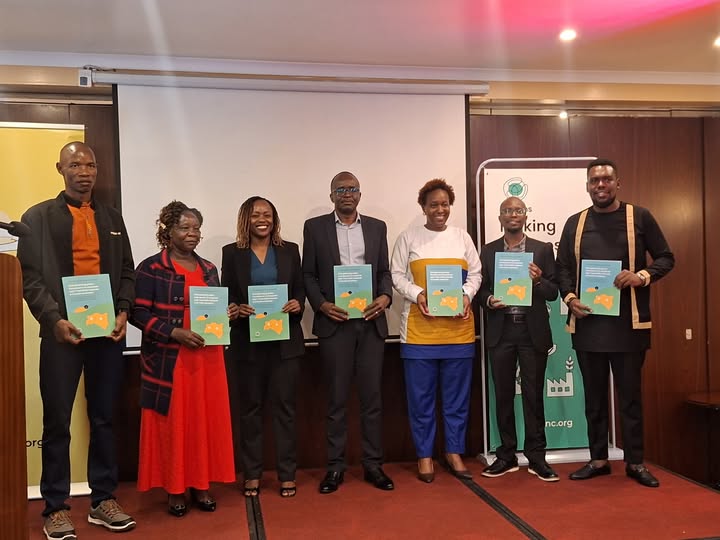
SMEs and partners at the O-Farms policy brief launch in Nairobi, calling for stronger support to drive Kenya’s circular agri-food economy. Photo/Courtesy
By Ruth Sang
A new policy brief from the O-Farms Project has highlighted progress in Kenya’s circular economy policies while warning that small and medium enterprises (SMEs) continue to face major barriers in implementation within the agri-food sector.
The report, titled *“Strengthening Policy Frameworks to Empower Agri-Food SMEs Towards a Circular Economy in Kenya,”* examines both enabling factors and challenges affecting SME participation in zero-waste and circular economy value chains.
The O-Farms Project is a regional initiative focused on accelerating circular food systems in East Africa by supporting enterprises working to reduce food loss and waste.
The study notes that Kenya continues to experience significant food losses due to inefficiencies in storage, transport, and market access, rather than production shortages. These losses, it says, undermine food security, reduce smallholder incomes, and contribute to greenhouse gas emissions.
The policy brief was launched on April 28, 2026, under the O-Farms Project led by Bopinc in partnership with Biovision Africa Trust and Unconventional Capital, and funded by the IKEA Foundation. The event brought together stakeholders from government, development agencies, and the private sector working in agribusiness and circular economy innovation.
Speaking during the launch, Bopinc Country Director Beryl Oyier said Kenya has made notable progress in developing supportive policies for circular economy growth.
Oyier cited frameworks such as the Sustainable Waste Management Act of 2022, the Extended Producer Responsibility Regulations of 2024, and the Green Economy Strategy and Implementation Plan as evidence of strong policy commitment.
However, she noted that SMEs are still struggling to benefit from these frameworks.
“Despite this evolving policy landscape, only 18 percent of SMEs report familiarity with prevailing circular economy laws, evidencing an enormous policy-implementation gap,” she said.
The study, based on surveys of 45 SMEs and consultations with 26 key informants, highlights several structural challenges. It found that 93 percent of SMEs struggle to access stable markets, limiting their ability to scale and invest.
It also shows that 80 percent rely on word-of-mouth for customer acquisition, while 64 percent sell directly from production sites. In addition, 78 percent of respondents described certification processes as costly, complex, and largely centralized in Nairobi.
Access to finance remains a major constraint, cited by 60 percent of SMEs, while 63 percent reported limited access to appropriate production technologies, especially in remote areas. A further 56 percent said they were unaware of existing supportive policies and regulations.
Senior Inclusive Business Advisor at Bopinc, Jackson Kinyanjui, noted that inconsistencies between national and county regulations are also complicating business operations.
“This increases administrative complexity and raises operational costs. It can also introduce uncertainty for businesses seeking to expand or replicate their models across locations,” he said.
He added that awareness and implementation support have not kept pace with policy development.
Acting CEO of Biovision Africa Trust, Frederick Ochieng, said limited SME participation in circular markets contributes to continued food loss and environmental strain.
“When SMEs are unable to participate effectively in circular economy markets, food loss continues at scale. This contributes to greenhouse gas emissions and leads to inefficient use of water and land resources,” he said.
He further noted that missed opportunities reduce value for farmers and slow job creation in green innovation.
Senior Program Manager at Bopinc and O-Farms Strategy Lead Ebenezer Amadi said the main challenge lies in bridging the gap between policy and practice.
“What we are seeing in Kenya is that SMEs are already innovating, turning waste into value and building markets, often through informal channels. The challenge is not a lack of effort but navigating systems that are complex and not always well understood,” he said.
The policy brief recommends improved access to tailored financing, stronger awareness campaigns for both consumers and policymakers, clearer product labelling, and enhanced SME education on existing regulations and standards to strengthen participation in the circular economy.
About Author