NACADA-Led Night Raids Uncover Drug Networks, Illegal Brew Operations in Uasin Gishu
The latest operation comes just days after police in Kesses sub-county seized more than 400 litres of ethanol from a hideout believed to be operated by a notorious illicit brew supplier.

NACADA Deputy Director Simon Mwangi addresses the media during a night-long multi-agency crackdown on drug dens and illicit brew operations in Munyaka, Ainabkoi Sub-County. Photos by Kemuma Achieng.
A multi-agency security team led by the National Authority for the Campaign Against Alcohol and Drug Abuse (NACADA) carried out intensive night raids in the Munyaka area of Ainabkoi sub-county ,Uasin Gishu County on Friday, targeting suspected drug dens and illegal alcohol distribution points. The sting operation, spearheaded by NACADA’s Deputy Director for Corporate Communications, Simon Mwangi, is part of an ongoing crackdown on narcotics and illicit brews in Uasin Gishu County.
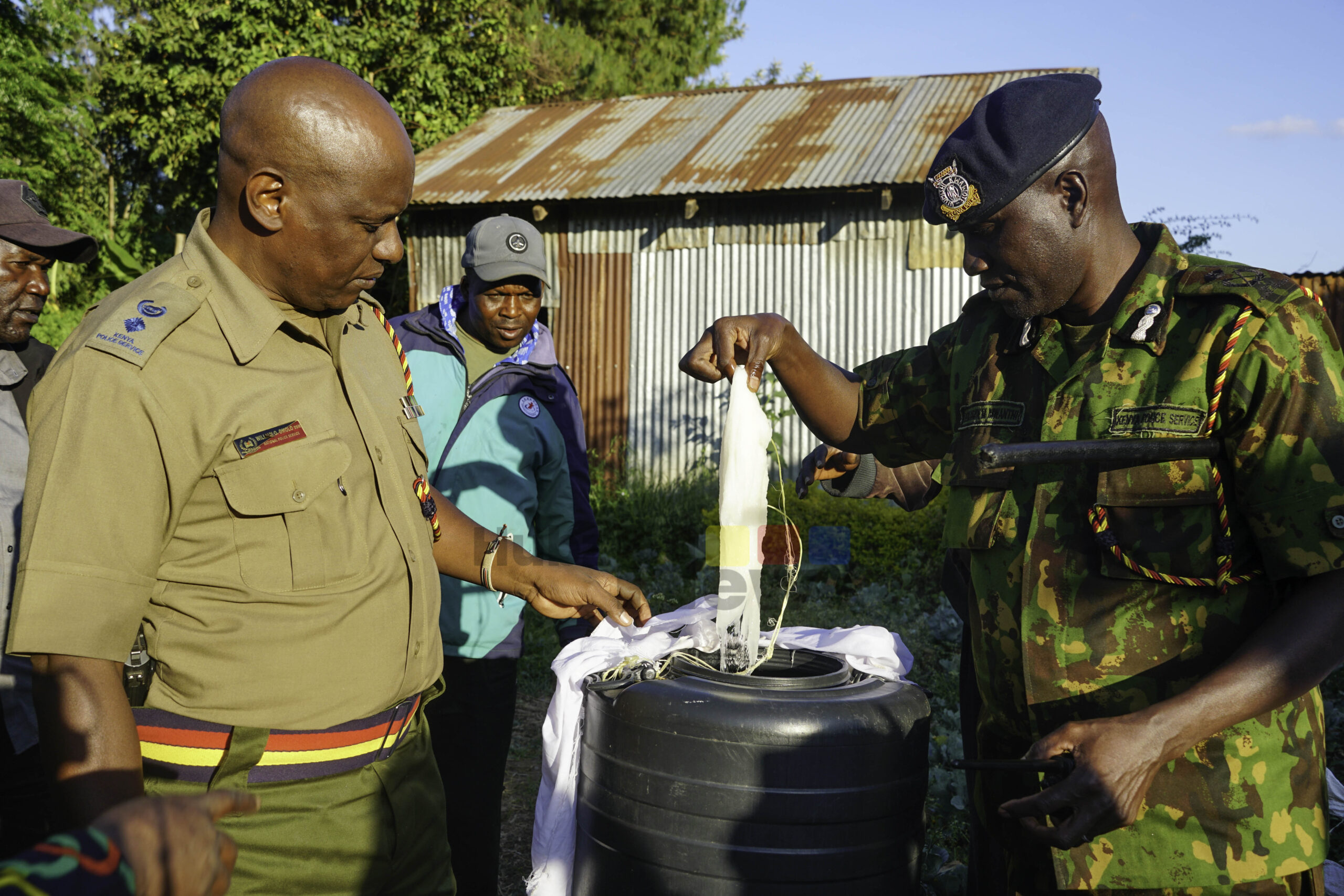
The latest operation comes just days after police in Kesses sub-county seized more than 400 litres of ethanol from a hideout believed to be operated by a notorious illicit brew supplier. The earlier raid was led by Uasin Gishu County Police Commander Benjamin Mwanthi and the Director of Criminal Investigations in the county, Daniel Muleli.
Speaking to the press shortly after the Friday night operation, Mwangi said the multi-agency effort marked an escalation in the fight against illegal drugs as the country enters the festive season, a period often associated with increased circulation of unregulated alcohol.
“We want to urge members of the public not to shy away from providing information about individuals believed to be involved in these illegal businesses,” Mwangi stated. “This crackdown will continue across Uasin Gishu as we work closely with other government agencies to dismantle these networks.”
During the operation, one of the premises raided was a private residence suspected of being a distribution point for heroin and other highly addictive narcotics. Local leaders, including Kesses Member of Parliament Julius Rutto, have in recent weeks raised concerns about the rising presence of drug cartels in the region. Some of the illegal supply chains are believed to be facilitated by influential individuals implicated in the unlawful importation of ethanol and other substances.
County Police Commander Benjamin Mwanthi warned that security agencies will intensify surveillance and conduct impromptu inspections in Eldoret’s rapidly growing entertainment joints, many of which authorities fear have become key markets for illicit drinks manufactured in hidden dens. Mwanthi said the proliferation of unlicensed nightspots has created fertile ground for the circulation of cheap, unsafe alcohol that poses serious health risks.
Nationwide data from NACADA paints an even grimmer picture. According to a 2022 survey conducted jointly with the Kenya National Bureau of Statistics, one in every six Kenyans aged between 15 and 65—approximately 4.7 million people—is currently using at least one drug or substance. The study revealed that alcohol remains the most abused substance, with more than 3.2 million Kenyans consuming it regularly. Tobacco use stands at about 2.3 million users, while over 518,000 Kenyans are estimated to be using cannabis. Another 60,000 people are misusing prescription drugs, and more than 1.7 million are engaged in polydrug use.
The report also noted a staggering 90 per cent rise in cannabis consumption over a five-year period, indicating a rapidly escalating public-health challenge. Among young people aged 15 to 24, NACADA data shows that one in every eleven is currently using at least one substance—an alarming trend that continues to worry health officials and parents.
In institutions of higher learning, the situation remains equally concerning. NACADA’s 2024 report on drug use among university students found that 45.6 per cent had used at least one drug in their lifetime. Alcohol, shisha, cigarettes, miraa, vapes, and cannabis topped the list of substances consumed, with the networks of supply often traced back to friends, neighbourhood kiosks, entertainment spots, and in some cases, rogue lecturers.
The multi-agency crackdown in Uasin Gishu is therefore seen as crucial in curbing the fast-rising drug culture in the county, where authorities estimate that more than 30 per cent of young people are already affected by substance abuse. Security officials say the threat is amplified by the increasing sophistication of illicit brewers, with a recent operation uncovering ethanol consignments concealed under sand inside a building under construction.
As more raids continue across the region, authorities maintain that the goal is not only to cut off supply but also to send a clear signal that the enforcement net is tightening. With the festive season approaching—a period when the circulation of counterfeit and deadly alcohol traditionally spikes—the multi-agency team says its operations will be intensified.
“This is not just an enforcement mission; it is a public safety effort,” Mwangi emphasized. “We must protect our young people and ensure that communities remain safe from illegal drugs and harmful brews.”
About Author