Kenya Targets 100 Million Trees on Mazingira Day – But Is the 15 Billion Tree Goal Still Realistic?
PS Mugambi pointed out that fruit trees will yield nutritional, economic, as well as environmental benefits in the long term.

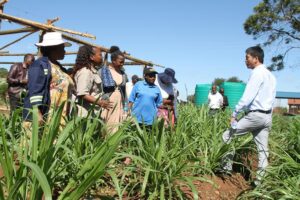
Ruto initiated a nationwide tree planting activity in Murang'a County, as a gesture of respect for the flood victims and as a bid to propel Kenya's reforestation agenda. PHOTO| PCS
By Juliet Jerotich
Kenya is set to hold a mega tree planting exercise on October 10th, now officially known as Mazingira Day, with the goal of planting at least 100 million trees nationwide. The initiative was recently kicked off by Forestry Principal Secretary Gitonga Mugambi and Environment PS Festus Ng’eno, who further said that 71 millions of them will be fruit trees to be planted in schools across the nation. At least 2,000 trees will be planted in each school, blending environmental restoration with food security and economic empowerment.
Mazingira Day is now a national day of environmental action—spotlighting not only tree planting but also promoting sustainable environmental conduct. PS Mugambi pointed out that fruit trees will yield nutritional, economic, as well as environmental benefits in the long term. He invited all Kenyans to take part in the campaign using the theme “Turudi Primo: Tu-kadonate Fruit Trees na Ku-clean Environment,” inviting citizens to return to their former schools, donate seedlings, and take part in clean-up initiatives.
The project is one of the components of the big “Jaza Miti” program, which was started in December 2022 by President William Ruto. The project aims at planting 15 billion trees by 2032, one of Kenya’s flagship programs against climate change and land degradation. Ruto has focused on reforestation as a way of reducing greenhouse emissions and rehabilitating over 5.1 million hectares of degraded land. He has even participated symbolically—planting 56 trees on his birthday to drive home his personal commitment.
In May 2024, Ruto initiated a nationwide tree planting activity in Murang’a County, as a gesture of respect for the flood victims and as a bid to propel Kenya’s reforestation agenda. During the activity, he ordered that there would be a target of planting 200 million trees within one year in 2024.
But the journey to this lofty goal has not been controversy-free. A similar tree planting holiday in November 2024 was under fire when senior officers employed fuel-guzzling cars and helicopters, prompting questions about the cost-effectiveness as well as sustainability of the programme. Critics argued such actions were contrary to the very essence of conservation, especially at a time when there were public-sector budget cuts. Government Spokesperson Isaac Mwaura, however, justified the action, calling it a “resounding success.”
Despite decades of analogue campaigns such as the Operation Gavisha (1977) and Greening Kenya Initiative (2010), Kenya is still lagging behind the 30% tree cover target by 2032. The country’s natural forest cover remains at just 4.6% as of today. Between 2002 and 2024, Kenya lost over 54,000 hectares of forestland despite ongoing reforestation campaigns.
A major stumbling block has been underfunding. Ksh.10.15 billion was allocated to forestry in 2022/23 and Ksh.14.3 billion in 2023/24 by the government—far short of the estimated Ksh.600 billion needed over 10 years. Also, roll-out of the Special Presidential Forestry and Rangeland Restoration Program has been slowed by leadership gaps, including the empty Forest Conservation Secretary (FCS) position, a focal point coordinator of national forestry programmes.
In order to succeed, Kenya must fill these systemic gaps while promoting community participation, environmental education, and public-private partnerships. Planting trees isn’t just about quantity—it’s about creating stable ecosystems, combating climate change, and generating economic dividends for the future.
About Author