CS Kagwe Raises Red Flag Over Procurement Choices in World Bank-Funded Agricultural Projects
Baringo Governor Benjamin Cheboi also emphasized the need for proper management of funds from donors, where he indicated that resources need to translate into benefits for farmers on the grass-root levels.
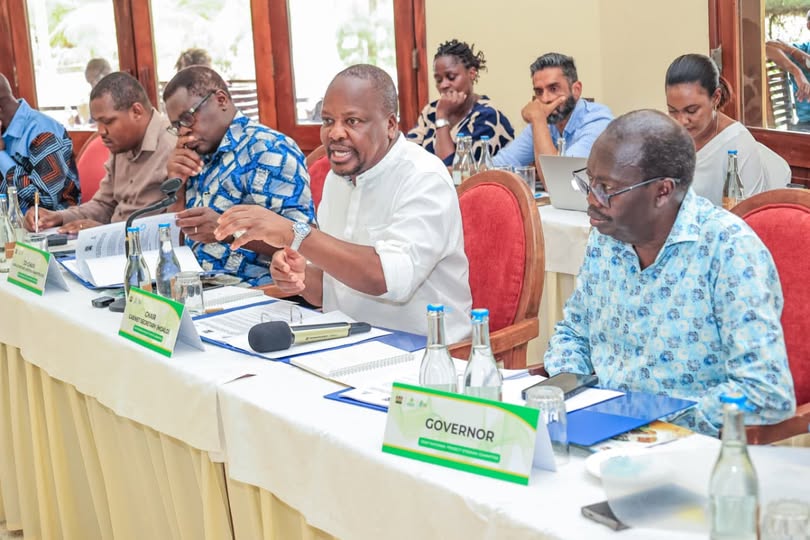
The Cabinet Secretary for Agriculture and Livestock Development, Mutahi Kagwe in a meeting. Photo/Courtesy.
By Ruth Sang
The Cabinet Secretary for Agriculture and Livestock Development, Mutahi Kagwe, has expressed worries regarding planes for procured services that ended up being dubious in project plans for World Bank-funded agricultural projects and could negatively affect projects that receive funding from abroad.
In his presentation to the Joint National Project Steering Committee meeting held in Kilifi, Kagwe raised questions about the relevance and source of funding of some of the listed items such as ice cream machines, milk containers, and motorbikes. These aspects in the list raised questions about whether the acquisition aligns with the priorities of the country and the economy.
“Procurement should be economically viable and benefit Kenyan industries,” Kagwe said, while highlighting that development project-funded procurement should enable more value addition in Kenyan manufacturing and agriculture as opposed to depending on imported or selected non-rationalized equipment.
In a similar statement, Cabinet Secretary, Francis Kimemia, called on the National Treasury to improve cooperation with line ministries before making any negotiations on external sources of financing. Cabinet Secretary Kimemia explained that projects designed in a manner less dependent on technical knowledge could likely be inefficient in execution.
“In the case where financing agreements are signed without adequate engagement of the respective ministries, the risk exists that agreements would commit to projects that would not adequately meet the sector needs or make value for money,” Kagwe explained.
The forum brought together top officials from the national and county governments, development partners, and implementation agencies to evaluate the performance of the current World Bank-funded agricultural projects in the country. The agenda of the discussion covered accountability, performance metrics, and the optimal utilization of donor funds towards improving agricultural productivity and farmer livelihoods.
The chair of the agriculture committee in the Council of Governors, Bungoma County Governor Ken Lusaka, echoed the sentiments expressed by Kagwe. He warned that counties that do not meet the performance criteria will have projects they support ceased. He called on all counties to comply with rules guiding the projects.
“We should lift the living standards of farmers and do so in a manner that promotes accountability and performance,” Lusaka stated, hinting that the counties need to show dedication to proper planning and implementation.
Baringo Governor Benjamin Cheboi also emphasized the need for proper management of funds from donors, where he indicated that resources need to translate into benefits for farmers on the grass-root levels.
The results of the Kilifi meeting are also expected to feed into the formulation of annual work plans and budgets for the financial year of 2025/2026. The resolutions will also impact how financing for sustainable rural development of agricultural sectors by Kenya will be applied. The government has reaffirmed its pledge on transparency, accountability, and value-for-money in the use of donor funds in agricultural projects undertaken in the country.
About Author