COMESA Summit: CS Kagwe Urges Digitization to Accelerate Agricultural Growth
COMESA Secretary General Chileshe Mpundu Kapwepwe, speaking at the same event, emphasized the importance of digitalization, green growth,
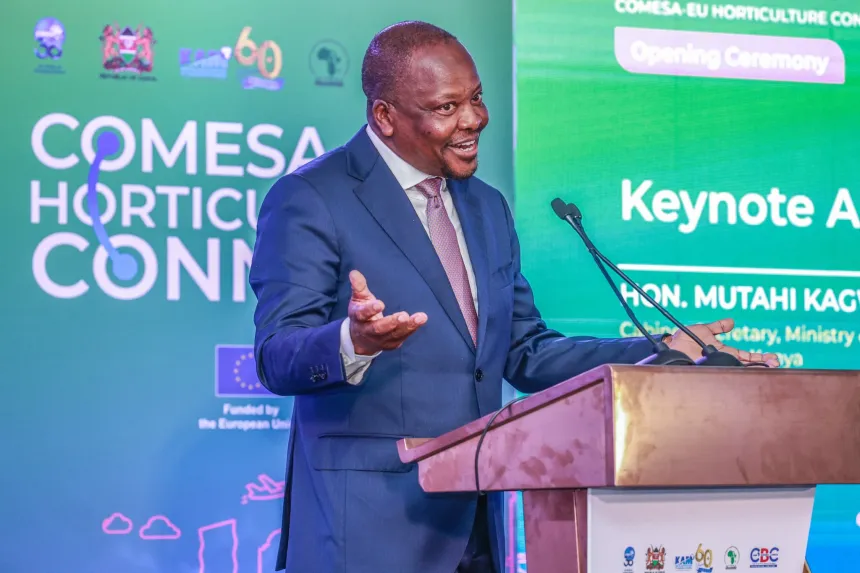
CS Kagwe acknowledged the adverse effects of climate change, noting that the disruptions in 2024 severely affected flower exporters who faced delays in shipping their produce.Photo/ Courtesy
BY Juliet Jerotich
Agriculture Cabinet Secretary Mutahi Kagwe has urged the European Union (EU) to collaborate with Kenya in transforming and digitizing agricultural training institutions to ensure that farmers and extension officers are equipped for a modernized agricultural future.
Speaking during the 24th COMESA Summit held in Nairobi, Kagwe emphasized the importance of training and knowledge sharing across borders. He noted that Kenya continues to offer agricultural training opportunities to several East and West African countries, focusing on areas such as horticulture and digital agriculture.
“To unlock even more potential, we must not only trade with each other but also train each other,” Kagwe stated. “Kenya is offering training opportunities through its agricultural colleges to East and West African countries. We invite the EU to partner with us in modernizing and digitizing our agricultural training institutions to ensure our farmers and extension officers remain future-ready.”
Digitization as a Tool for Regional Economic Transformation
Aligning his message with the summit’s theme—“Leveraging digitization to deepen regional chains for sustainable and inclusive growth”—Kagwe underlined that technology is a crucial driver for regional economic transformation.
He pointed out that embracing digital solutions is no longer optional but essential to make African economies competitive, resilient, and climate-smart. “The theme reflects the urgency of our times—harnessing digital tools not just as enablers but as engines for a transformed regional economy,” Kagwe remarked.
The government, he added, has initiated several programs aimed at integrating technology into agriculture, including the National Multi-Task Agricultural Traceability Program and the modernization of agricultural institutions. These initiatives aim to improve farm-to-market transparency, ensure compliance with export standards, and enhance food safety across the value chain.
Kenya’s Agricultural Export Success
Highlighting Kenya’s strong agricultural performance, Kagwe revealed that in 2024, the country’s agricultural exports surpassed KSh 129 billion ($1 billion), with flowers, fruits, and vegetables reaching over 70 global markets.
He noted that cut flowers remain Kenya’s flagship export, accounting for about 40% of all roses sold in the EU. “The horticulture sector alone exports over 60 million stems daily to the European Union, employing millions of Kenyans,” he said.
Additionally, avocado exports have experienced significant growth, with over 128,000 metric tons shipped in 2024, positioning Kenya as Africa’s top avocado producer. Vegetables such as beans and peas also continue to sustain thousands of smallholder farmers across the country.
Climate Change and Market Challenges
CS Kagwe acknowledged the adverse effects of climate change, noting that the disruptions in 2024 severely affected flower exporters who faced delays in shipping their produce. “These challenges remind us of the urgent need to build resilience in logistics, financing, and climate adaptation,” he said.
He also appealed for greater consistency in EU regulatory standards, pointing out that frequent changes in export requirements cause uncertainty among exporters. “We value our strong relationship with the EU, built on mutual interests and shared history, and we look forward to deepening it further,” Kagwe added.
COMESA’s Commitment to Inclusive Growth
COMESA Secretary General Chileshe Mpundu Kapwepwe, speaking at the same event, emphasized the importance of digitalization, green growth, and inclusive value chains in maintaining COMESA’s competitiveness.
She noted that the COMESA–EU Horticulture Connect initiative presents a valuable opportunity to strengthen partnerships and advance sustainability. “Together, we must leverage digitalization, green growth, and inclusive value chain development to ensure that COMESA remains a competitive and sustainable market,” Kapwepwe affirmed.
About Author