Ruto Calls for UN Security Council Reform, Fairer Global Financial System
He said Africa, despite having 54 UN member states and representing more than a quarter of the General Assembly, has no permanent seat on the Council.
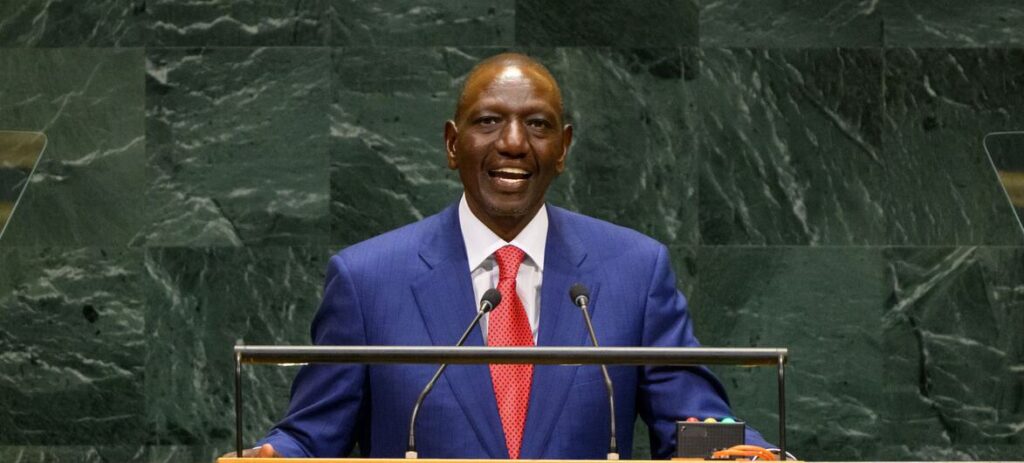
President William Ruto addresses the General Debate of the 81st session of the United Nations General Assembly in New York. Photo: UN Photo/Loey Felipe.
By Robert Mutasi
President William Ruto has called for reforms to the United Nations Security Council and the international financial system, arguing that existing global institutions do not adequately reflect today’s geopolitical and economic realities.
Addressing the 81st United Nations General Assembly on Wednesday, September 23, Ruto said the principle of sovereign equality was undermined by the structure of the Security Council, where five permanent members hold veto powers.
He said Africa, despite having 54 UN member states and representing more than a quarter of the General Assembly, has no permanent seat on the Council.
“The equality proclaimed in this assembly ends at the doors of the Security Council,” Ruto said, according to his address.
The President said Africa had been repeatedly involved in discussions about reform while remaining excluded from permanent decision-making structures.
He also warned that confidence in the international system was being weakened by what he described as inconsistent application of international law.
“International law cannot be invoked loudly in one crisis, cautiously in another crisis, and disregarded when convenient,” he said.
Ruto urged member states to accelerate Security Council reform, noting that negotiations on the issue have continued for years. UN records show that intergovernmental negotiations on Security Council reform have been ongoing since 2008.
The Kenyan leader also turned his attention to global finance, citing rising debt pressures facing developing countries.
He said global public debt had reached $102 trillion in 2024 and argued that high borrowing costs were limiting the ability of developing countries to finance essential services and development.
“The hospital competes with a creditor. The classroom competes with debt service,” Ruto said.
He cited a UN Development Programme estimate that subjectivity in sovereign credit ratings has cost African countries about $75 billion. He also argued that developing countries often borrow at significantly higher interest rates than developed economies.
“Capital must price risk. It must not price prejudice,” he said.
Ruto said Africa should be viewed as an economic partner with significant resources and opportunities, pointing to the continent’s mineral wealth, renewable energy potential and growing population.
He highlighted Kenya’s planned $16 billion refinery in Lamu, which he said would have the capacity to process 700,000 barrels of oil a day.
The President said Kenya and other African countries were seeking investment and economic partnerships rather than preferential treatment.
“This is not a plea for special treatment. It is a proposition for shared prosperity,” he said.
Ruto’s call for Security Council reform echoes Kenya’s longstanding position that Africa should have permanent representation in the body. UN discussions on reform have continued during the current General Assembly session, with African states maintaining that the continent remains underrepresented in global peace and security decision-making.
He concluded by calling for a United Nations in which all member states have a meaningful voice and populations have a stake in the international system.
About Author