Kenya’s Political Chessboard: The Dirty Games Behind the 2027 Race
Ruto’s government would point to the fact that graft prosecutions and audits are happening publicly, which itself is a form of accountability absent under earlier administrations.
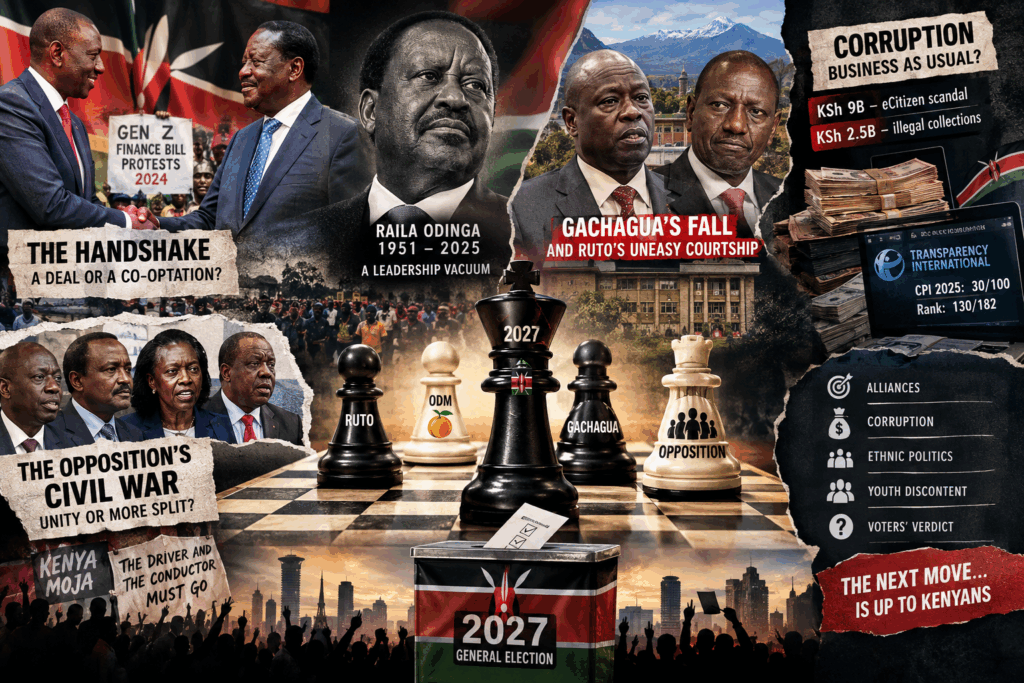
From broken alliances to recycled scandals, Kenya’s road to 2027 is revealing the calculations, rivalries and political manoeuvring taking place behind the scenes.
By Robert Mutasi
Kenyan politics between 2025 and 2027 has been less a contest of ideas than a scramble for survival, alliances built to be broken, and scandals that seem to recycle themselves every election cycle. What follows is an assessment of the maneuvering, grounded in verified reporting, but offered as opinion where the facts themselves are contested.
The handshake that reshaped the field , then lost its author
The defining move of this period was President William Ruto’s 2024 “broad-based government,” which absorbed Raila Odinga’s ODM into the administration after the deadly 2024 Gen-Z protests against the Finance Bill.
It was, depending on who you ask, a pragmatic peace deal or political co-optation designed to defang the opposition. The tax-reform protests had triggered a genuinely violent political crisis, and the resulting deal to review Kenya’s electoral laws was seen by some as a move toward stability and by others as a calculated weakening of dissent.
Then, on October 15, 2025, the calculus collapsed overnight. Raila Odinga, the towering opposition figure who had just signed a pact bringing his party into government, died of a cardiac arrest while traveling in India.
His death left a significant leadership vacuum in Kenya’s opposition just as the country headed toward the 2027 elections. It was, as one wire report put it, a political earthquake — and it blew open a succession scramble inside ODM itself that is still playing out.
Gachagua’s fall, and Ruto’s uneasy courtship of him
The other seismic break was the impeachment of Deputy President Rigathi Gachagua, which turned him from the president’s running mate into his most vocal accuser.
Gachagua has since alleged that Ruto personally bribed MPs and senators to secure votes for that impeachment, a claim Ruto has not credibly rebutted, and one that critics say undercuts the president’s own subsequent anti-corruption posture.
Analysts have pointed out that Ruto dropping corruption cases against his own allies after taking office in 2022 sent an early signal that his commitment to fighting graft was selective.
Despite the bitterness, Ruto has kept a door open to reconciliation, not out of sentiment, but arithmetic.
Mt Kenya’s millions of registered voters remain the single most decisive bloc in national elections, and analysts warn that alienating Gachagua entirely could trigger a regional revolt against the ruling party in 2027.
This is the “dirty game” in its purest form: yesterday’s traitor is tomorrow’s essential ally, and principle rarely survives contact with a vote count.
Corruption as background noise, not scandal
What’s striking is how normalized the corruption allegations have become. In mid-2025, Auditor General Nancy Gathungu found that KSh9 billion had vanished from the government’s eCitizen digital payments platform and a further KSh2.5 billion had been illegally collected by officials, prompting Ruto to publicly vow to jail bribe-taking MPs, even as scandals kept mounting inside his own administration.
Political analysts quoted at the time were skeptical of the timing, suggesting the tough talk was more about signaling ahead of 2027 than a genuine reform push.
The opposition has run its own version of this playbook. In April 2026, the United Alternative Government accused the Ruto administration of turning the energy sector into what it called a “criminal enterprise,” pointing to fuel costs as evidence of one of the biggest scandals in Kenya’s history.
That’s a serious charge, but it’s also an opposition talking point ahead of an election, not an independently adjudicated finding, and it should be read as such.
Kenya’s own numbers give the accusations some context. On Transparency International’s 2025 Corruption Perceptions Index, Kenya scored 30 out of 100 and ranked 130th out of 182 countries, below the sub-Saharan African average of 32.
That’s not a verdict on any single scandal, but it does suggest the political noise reflects a real, longstanding institutional weakness rather than pure campaign theater.
The opposition’s own civil war
Perhaps the messiest game is being played inside the opposition itself. A “united front” of Gachagua, Kalonzo Musyoka, Martha Karua, and Fred Matiang’i has spent much of 2025 and 2026 in closed-door talks trying to agree on a single 2027 candidate, a task complicated by the fact that Kenya’s politics remains deeply shaped by ethnic blocs, meaning any unity candidate needs the backing of regional kingpins to be seen as genuinely national.
Meanwhile, a breakaway faction called Kenya Moja, formed by defectors from Ruto’s, Gachagua’s, and Odinga’s own camps — has complicated the map further, with ODM’s own secretary-general publicly declaring he’d rather be expelled from his party than back Ruto’s re-election.
Political observers have described this fragmentation as reviving last year’s protest slogan calling for both “the driver and the conductor” — Ruto and Gachagua alike — to leave the political stage entirely.
The November 2025 by-elections became the first real stress test of all this jostling, widely seen as a dress rehearsal for the full 2027 general election.
The honest caveat
None of this is unique to Kenya, and none of it should be read as a settled verdict on any individual’s guilt. Much of what gets called a “dirty game” here, defections, bribery allegations, timed corruption exposés, is standard, if unflattering, democratic hardball, and each side has a self-interested reason to accuse the other.
Ruto’s government would point to the fact that graft prosecutions and audits are happening publicly, which itself is a form of accountability absent under earlier administrations.
The opposition would point out that convenient timing doesn’t make an accusation false. Both things can be true at once, and Kenyan voters in 2027 will be the ones who have to weigh it.
About Author