Universities Owe KUCCPS Sh300 Million in Placement Fees
The agency had projected to collect Sh284 million in placement-related revenue during the financial year but managed to realise only Sh261 million.
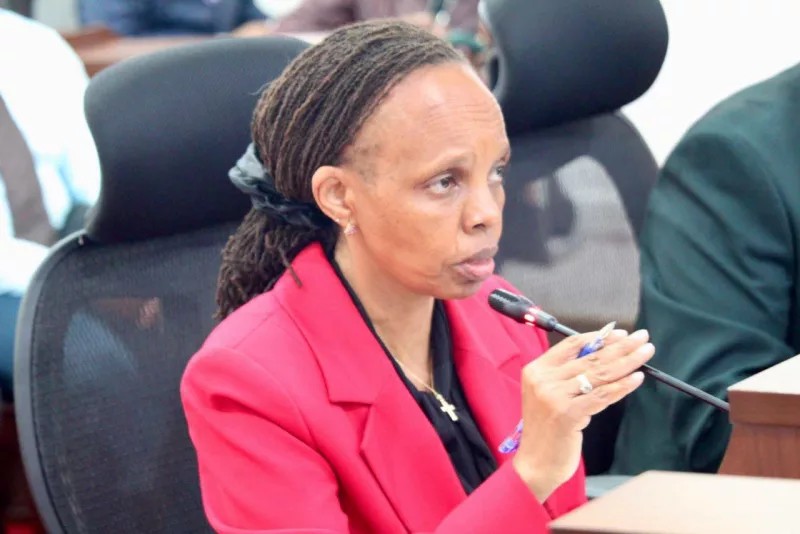
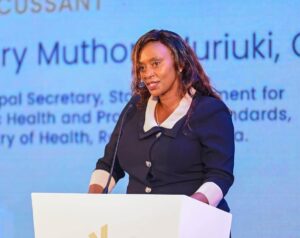
KUCCPS CEO Mercy Wahome appears before the National Assembly Committee on Education on September 9, 2026. Photo: Courtesy.
By Robert Mutasi
Universities and other tertiary institutions owe the Kenya Universities and Colleges Central Placement Service (KUCCPS) about Sh300 million in unpaid placement fees, a situation that has affected the agency’s ability to meet its revenue targets.
The outstanding payments emerged on Wednesday when KUCCPS appeared before the National Assembly Committee on Education to present its budget implementation report for the 2025/2026 financial year.
KUCCPS Chief Executive Officer Mercy Wahome told the committee that institutions are required to pay Sh1,500 for every student successfully placed and subsequently validated by the institution.
She said some institutions, particularly universities, had failed to honour their financial obligations, leaving the placement agency with a significant amount of uncollected revenue.
“Placement fees are monies invoiced to institutions after we have finished with placement. But some institutions fail to honour their obligations to pay, thus we could not achieve our target. We have about Sh300 million that has not been paid by institutions, mainly universities,” Wahome told the committee.
The agency had projected to collect Sh284 million in placement-related revenue during the financial year but managed to realise only Sh261 million.
Wahome explained that the Sh1,500 fee is linked to the validation of student placement data after learners report to their respective institutions.
According to KUCCPS, the validation process is important because the information is subsequently used by the Universities Fund and the Higher Education Loans Board (HELB) in processing funding for universities.
“Once we place the students and they report, the service we give to the universities is to validate the data for them every semester so that the Universities Fund and HELB can process the funds to the universities. For that, we charge a one-off minimal fee of Sh1,500. Unfortunately, we have a situation where some universities do not remit,” Wahome said.
The disclosure prompted committee vice chairperson Eve Obara to seek clarification on the institutions responsible for the arrears and the steps being taken to recover the money.
Obara asked whether the defaults were concentrated among public universities, private institutions or technical and vocational education and training (TVET) institutions. She also sought details on the legal and administrative measures available to KUCCPS to compel institutions to settle their outstanding obligations.
Wahome said KUCCPS had reached an agreement with universities to recover the accumulated debt through instalment payments beginning in the 2026/2027 financial year.
The issue comes as KUCCPS continues to handle a large number of students seeking admission to universities, TVETs and other institutions of higher learning.
In the 2026/2027 academic year, the agency placed 293,869 students in institutions of higher learning. Of these, 202,133 were placed in university degree programmes.
If all the students reported to their institutions at the beginning of the first semester in September, the Sh1,500 placement and validation fee would translate into at least Sh440.8 million in fees payable to KUCCPS.
The placement fee is separate from other charges paid to KUCCPS. Universities pay an annual membership fee of Sh100,000, while colleges pay Sh70,000. Students also pay a one-off Sh1,500 application or course revision fee during the placement process.
KUCCPS also reported that it spent Sh710 million during the 2025/2026 financial year, representing an 89 per cent absorption rate against its approved budget of Sh796.5 million.
The agency told lawmakers that the entire budget was internally generated.
Other institutions appearing before the committee also reported relatively high levels of budget utilisation. The Jomo Kenyatta Foundation recorded a 100 per cent budget absorption rate, while the National Council for Nomadic Education in Kenya (NACONEK) reported utilisation of 96.46 per cent.
NACONEK spent Sh5.44 billion out of an approved budget of Sh5.64 billion during the period under review.
The KUCCPS debt disclosure is likely to put greater focus on how public institutions manage obligations linked to placement and student financing, particularly as universities continue to rely on accurate enrolment and validation data to access government support.
About Author