Kenya Shilling Holds Steady as CBK Releases Daily Exchange Rates for 9 September 2026
The Central Bank also released rates for key regional currencies, which are critical for cross-border trade within the East African Community and beyond.
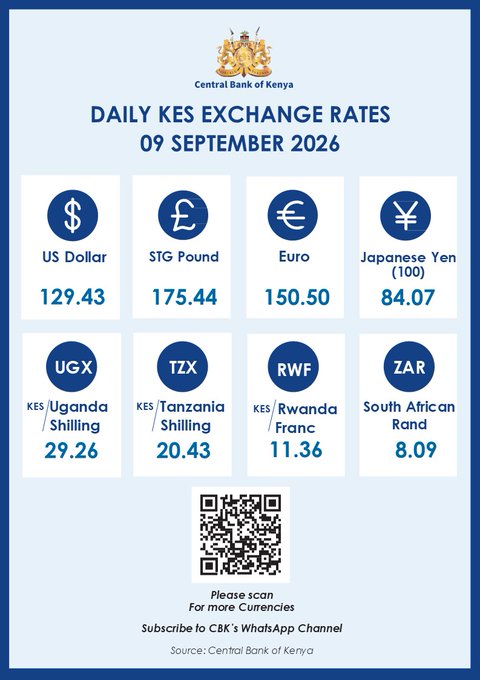
Photo: CBK.
By Robert Mutasi
The Kenya Shilling has maintained its stability against major international currencies, according to the latest daily exchange rates released by the Central Bank of Kenya (CBK) for Wednesday, 9 September 2026.
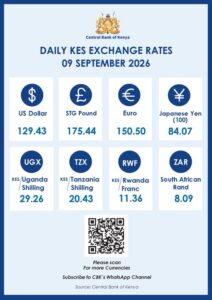
In its official bulletin, the CBK indicated that the shilling is trading at KES 129.43 against the US Dollar, continuing the currency’s relatively stable performance in recent months supported by improved foreign exchange inflows, diaspora remittances, and prudent monetary policy measures.
Against other major global currencies, the shilling exchanged at KES 175.44 to the British Pound Sterling (STG Pound) and KES 150.50 to the Euro, reflecting the strength of the two currencies in the global market. The Japanese Yen (100) traded at KES 84.07.
The Central Bank also released rates for key regional currencies, which are critical for cross-border trade within the East African Community and beyond. The shilling traded at KES 29.26 against the Ugandan Shilling (KES/UGX), KES 20.43 against the Tanzanian Shilling (KES/TZS), KES 11.36 against the Rwandan Franc (KES/RWF), and KES 8.09 against the South African Rand (ZAR).
The figures come at a time when the Kenya Shilling has been ranked among the best-performing currencies in Africa over the past year, having recovered from volatility experienced in 2023-2024. Analysts attribute the stability to increased dollar inflows from tea, horticulture and tourism exports, strong diaspora remittances, and the successful issuance of external debt instruments that boosted CBK’s foreign exchange reserves.
A stable shilling has significant implications for Kenya’s economy. For importers and manufacturers, it helps contain the cost of imported raw materials, fuel and machinery, which in turn eases pressure on domestic inflation. For consumers, it means relatively stable prices for imported goods. For the government, a stable exchange rate reduces the cost of servicing external debt denominated in foreign currencies.
Traders dealing in regional commerce will also be keen on the EAC rates. The KES/UGX and KES/TZS rates are particularly important for small-scale traders at border points such as Busia, Malaba, Namanga and Isebania, who rely on daily rates to price goods and settle transactions.
The Central Bank of Kenya, which publishes daily indicative rates, urged members of the public and businesses to scan the QR code on its official graphic or subscribe to its WhatsApp Channel for more currencies and real-time updates. The CBK noted that the rates are average indicative rates and that commercial banks and forex bureaus may offer slightly different buying and selling rates depending on market conditions.
Market watchers will continue to monitor the shilling’s performance in the coming days, with attention focused on global oil prices, US Federal Reserve policy decisions, and Kenya’s current account performance.
Source: Central Bank of Kenya – Daily KES Exchange Rates, 09 September 2026
About Author