Safaricom’s Sh51 Million Eldoret Special School Project Puts Skills, Dignity and Opportunity at the Centre of Inclusion
Safaricom has supported 106 projects in Uasin Gishu County, with education accounting for the largest share of the interventions.
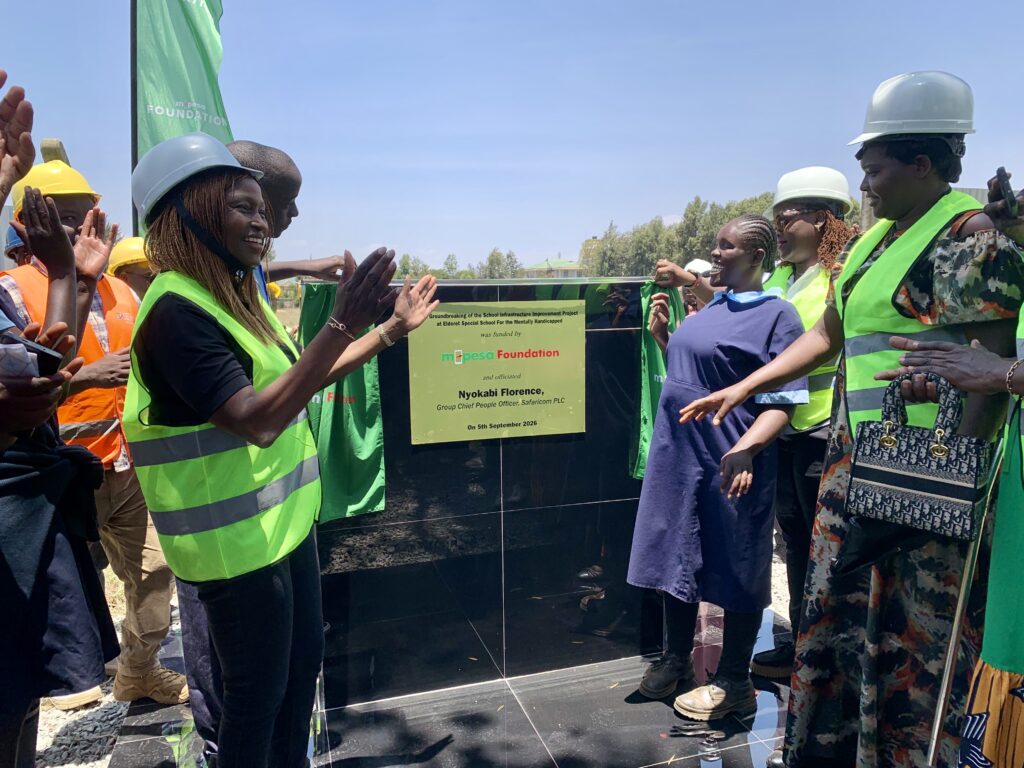
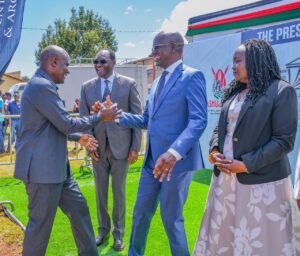
Safaricom Group Chief People Officer Florence Nyokabi commissions the Sh51 million infrastructure project at Eldoret Special School, set to deliver new dormitories, classrooms, vocational facilities and a solar-powered borehole for learners with intellectual disabilities.
By James Gitaka
For learners at Eldoret Special School, the construction of new dormitories and classrooms is about more than bricks, concrete and roofing. It could mean a safer place to live, more room to learn, greater access to practical skills and, ultimately, a better chance of building independent lives beyond school.
That is the promise behind a Sh51 million investment by Safaricom to upgrade infrastructure at the institution, which serves learners with intellectual disabilities in Uasin Gishu County.
The project will deliver two dormitories, three classrooms, vocational learning facilities and a solar-powered borehole, marking one of the most significant infrastructure investments at the school in recent years.
The works are expected to take 45 weeks, with completion scheduled for June 2027.
For a school where learning is closely linked to practical and life skills, the investment could have an impact extending well beyond the classroom.
From infrastructure to independence
Safaricom Group Chief People Officer Florence Nyokabi said the investment was part of the company’s wider partnership with Uasin Gishu County, which has supported initiatives in education, healthcare and economic empowerment.
According to Nyokabi, Safaricom has supported 106 projects in Uasin Gishu County, with education accounting for the largest share of the interventions.
She said the Eldoret Special School project also honours a commitment made by Safaricom CEO Dr Peter Ndegwa during an earlier visit to the institution.
“Today is the opportunity for us to bring to life that commitment he made,” Nyokabi said.
But the significance of the project, she argued, should not be measured only by the value of the buildings being constructed.
“When I look at infrastructure projects, I see on one hand that, yes indeed, we are building physical infrastructure,” Nyokabi said. “But importantly, the reason behind that physical infrastructure is the empowerment that that learning will have to children and people with special needs.”
Her argument reflects a broader challenge facing special-needs education in Kenya: infrastructure is not simply an operational requirement; it can determine whether learners have adequate space and facilities to acquire the skills needed for independent living.
A national need reflected at Eldoret
The scale of Kenya’s special-needs education needs provides context for the investment.
In a statement to Parliament in November 2024, Education Cabinet Secretary Julius Migos Ogamba said Kenya had 2,514 special primary schools serving 77,283 learners, alongside 378 integrated primary Special Needs Education schools with another 40,282 learners. The country also had 81 secondary SNE schools serving 7,183 learners.
The Ministry of Education’s National Education Sector Strategic Plan records Eldoret Special School among institutions providing Special Needs Education in Uasin Gishu County.
Government digital education records also show that Eldoret Special School received 76 learner devices under the Digital Literacy Programme in 2017, alongside teacher devices and digital-learning equipment.
Public school-directory records have previously placed enrolment at the institution at 88 learners, although that figure should be treated as a historical or directory figure rather than a current Ministry of Education enrolment statistic.
Together, the figures underline the importance of sustained investment in institutions serving learners with disabilities — particularly where education requires specialised infrastructure, equipment and practical training.
80 new beds and more room to learn
The project will provide separate boys’ and girls’ dormitories, each designed to accommodate 40 learners, creating a combined additional capacity of 80 beds.
For the school administration, the significance goes beyond increasing sleeping capacity.
School head Dina Chepkwan Kumol said the dormitories would provide learners with a safer, more comfortable and secure environment.
“For us, the learners with special needs and intellectually challenged, it is a safe place, comfortable to learn, and also secure,” she said.
The three new classrooms are expected to ease pressure on existing learning spaces while supporting both academic and vocational programmes.
For learners who may require more individualised instruction and practical approaches to education, additional space can create room for teachers to work more effectively with different abilities and learning needs.
Turning talent into livelihoods
Perhaps the most consequential component of the project is the planned expansion of vocational learning.
Kumol said learners with intellectual disabilities should not be defined by their limitations but by the skills and abilities they can develop when given the right environment.
She said some learners may face difficulties with conventional reading and writing but can demonstrate significant potential in practical activities.
“A talent learned today will be a career tomorrow, and the skill learned today will bring about better livelihood for the learners with special needs tomorrow,” she said.
That philosophy is already reflected in the school’s vocational work.
Safaricom has previously supported the institution with vocational equipment, including hairdressing equipment, allowing learners to gain practical experience.
The new facilities are expected to build on that foundation by creating more opportunities for learners to develop marketable skills.
Safaricom’s previous engagement with the school has also included support for vocational activities. In 2025, Safaricom Foundation launched the seventh phase of its Ndoto Zetu initiative at Eldoret Special School, with vocational equipment and materials provided to help learners develop skills that could potentially generate income.
For families, such interventions can carry significance beyond education. Practical skills can increase the prospects of learners participating more independently in household, community and economic activities as they transition from school.
Water security could unlock another learning opportunity
The project’s water component could prove equally important.
A solar-powered borehole will provide the school with a more reliable source of water while reducing its dependence on conventional electricity for pumping.
Colin Skipchichir of Freecall Enterprises Limited, which is involved in the water component, said the initial investment in solar-powered infrastructure could translate into lower operating costs over time.
The water supply could also support agricultural activities within the institution, creating another avenue for practical learning.
Learners could potentially use such projects to gain experience in basic agriculture, responsibility and enterprise — skills that complement the school’s vocational programmes.
In that sense, the borehole is not simply a utility project. It could become part of the learning environment itself.
The community dimension
The investment also comes against a history of community efforts to make the school more visible and inclusive.
In 2023, the Eldoret City Marathon and its partners involved learners from the school in a tree-planting initiative, combining environmental education with community inclusion. The school has also worked with Moi Teaching and Referral Hospital on medical support for learners.
Such partnerships point to a wider reality: the development of learners with disabilities cannot rest on schools alone.
Teachers, parents, healthcare providers, businesses, government agencies and the wider community all have a role to play in creating an environment where children with disabilities can develop their abilities and participate meaningfully in society.
Kumol said some learners had demonstrated potential in sports and other areas, including at national and international levels.
However, she noted that the school’s sports field requires improvement, with a swampy section limiting learners’ ability to train consistently.
Better sporting infrastructure, she argued, could provide another pathway for learners to develop their talents.
A contractor with a personal stake
For Shadrack Vichy, a director at Tanjen Nini Construction Company Limited, delivering the project is also a personal opportunity to contribute to the community in which he lives.
The construction programme includes the classroom block, a small office and the separate boys’ and girls’ dormitories.
Vichy said his company would focus on delivering the facilities to the required standards.
As an Eldoret resident, he said the project was particularly meaningful because it would directly benefit children with special needs within his community.
Measuring the impact beyond the buildings
The real test of the Sh51 million investment will ultimately come after the construction crews leave.
Its success will be measured not only by whether the dormitories are completed or whether the borehole produces water, but by what those facilities enable learners to do.
Will more learners gain practical skills?
Will the vocational programmes expand?
Will the additional classrooms allow teachers to provide better individualised support?
Will the new accommodation improve safety and dignity?
And will the skills acquired at school translate into greater independence and livelihood opportunities?
Those are the outcomes that will determine the project’s long-term value.
For Eldoret Special School, the infrastructure provides the foundation. The larger ambition is to ensure that learners with intellectual disabilities are given the opportunity to discover what they can do — and the tools to turn those abilities into productive lives.
As construction begins, the Sh51 million investment therefore represents more than a corporate social investment project.
It is a bet on the potential of learners who have too often been defined by disability rather than ability.
And if the new classrooms, dormitories, vocational facilities and water system are matched with sustained teaching, skills development and community support, the most important structures built at Eldoret Special School may ultimately be the confidence, independence and opportunities created in the lives of its learners.
About Author