Inside Eldoret National Polytechnic’s Digital Revolution: How a TVET Institution is Building the Future Through Innovation
“We are developing a system that covers the entire institution — from security, teaching, assessment and management. It is about making services easier, faster and more accountable.”

A collage showcasing Eldoret National Polytechnic’s digital transformation journey, highlighting innovations in smart security, digital classrooms, online assessment, digital Portfolio of Evidence (PoE), management systems and the planned electric vehicle charging infrastructure. The visual represents the institution’s shift towards a smarter, greener and future-ready TVET environment.
By James Gitaka
For years, the first interaction with Eldoret National Polytechnic began with a familiar routine: a visitor arriving at the gate, picking up a pen and recording their details in a physical register.
Names, vehicle details, time of arrival, purpose of visit and departure time were captured manually.
The system served its purpose, but as the institution expanded, so did the challenges.
Finding a single record could mean going through pages of handwritten entries. Monitoring visitor trends required manual reviews. Maintaining accurate, easily accessible records became a demanding task.
Today, that experience is changing.
At the heart of Eldoret National Polytechnic’s transformation is a digital system developed internally by the Computing and Informatics Department — a platform designed to digitise services across the institution, from security operations at the gate to teaching, assessment and academic management inside classrooms.
The innovation is part of the institution’s broader vision of becoming a technology-driven TVET centre capable of preparing students for a rapidly changing world.
“We are rolling out a system that tries to digitise our services within the institution, starting from the gate up to the classroom,” says Shadrack Yabei, the Head of Computing and Informatics Department.
The system, which is currently about 95 per cent complete, brings together several institutional operations into one digital ecosystem aimed at improving efficiency, accountability and access to information.
A smarter approach to campus security
One of the most immediate changes can be seen at the institution’s entrance.
Previously, security officers relied on physical books to record every person and vehicle entering or leaving the institution.
While effective, the manual approach made retrieval of information difficult, especially when officers needed historical records.
The new digital security system has transformed the process.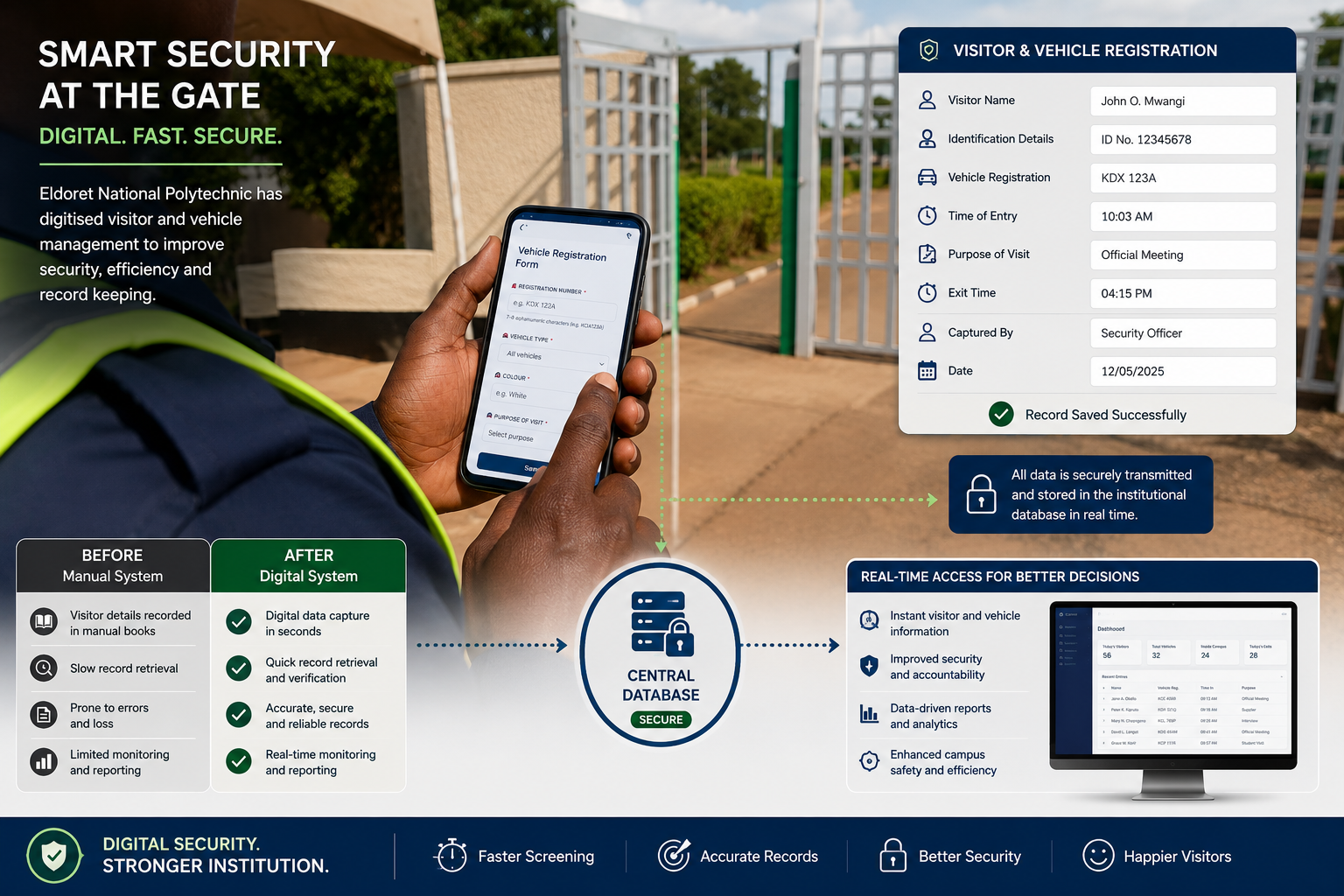
A visual representation of Eldoret National Polytechnic’s digital security transformation, showing how technology can streamline visitor and vehicle registration, improve record management and enhance campus security. The details displayed on the interface are illustrative and do not represent real visitor, vehicle or institutional records.
With the platform, security officers can instantly access visitor records, know who entered the institution, the time they arrived, the purpose of their visit and other important details.
John Mutai, a security supervisor at Eldoret National Polytechnic, says the system has significantly improved security operations.
“Digitization has led to a very short turnaround time when screening our guests and their vehicles. This means there are no longer long waiting queues, and visitors are happy because the process is faster,” Mutai says.
“With just a click on a phone, their details are captured. This has enhanced our record keeping, and that is critical for improved security.”
The move has also reduced congestion at the gate while allowing security teams to maintain more accurate and reliable information.
Reimagining the classroom through technology
The digital transformation extends beyond the gate into classrooms where learning processes are also being redefined.
For many years, lecturers used paper attendance sheets to track students’ participation during lessons.
Trainers would carry forms to class, manually mark attendance and later submit the documents for departmental monitoring.
The new system has replaced much of this paperwork.
Lecturers can now record attendance digitally, allowing academic managers to monitor learning sessions in real time.
According to Yabei, the platform has introduced greater accountability among both trainers and students.

“If a lecturer misses a session, the Head of Department is notified, and the trainer also receives a notification that they have missed a lesson,” he explains.
“This has really helped us improve attendance and ensure that learning sessions are conducted as planned.”
The system also allows students to monitor their own academic progress, including units covered and topics completed.
For class representatives, the change has created greater transparency.
Ateng Kanyegunda, a student class representative at Eldoret National Polytechnic, says the digital system has changed how students follow their academic progress.
“Before, it was difficult to know our class attendance percentage because only the trainers could access that information,” she says.
“Now we can track our progress and know where we stand. This has also motivated more students to attend classes because they understand that attendance is being monitored.”
She adds that the system has also solved challenges associated with managing physical documents.
“Previously, I could misplace my paperwork, especially the Portfolio of Evidence (PoE), but now we can follow digital records and even track trainers’ attendance through the system.”
Digitizing the Portfolio of Evidence
In technical training, practical skills assessment is a critical part of student certification.
Trainees are required to maintain a Portfolio of Evidence (PoE), which contains records demonstrating the skills they have acquired during training.
Traditionally, these documents were stored physically, creating challenges in storage, retrieval and verification.
The new digital platform allows trainees and trainers to upload and manage these records online.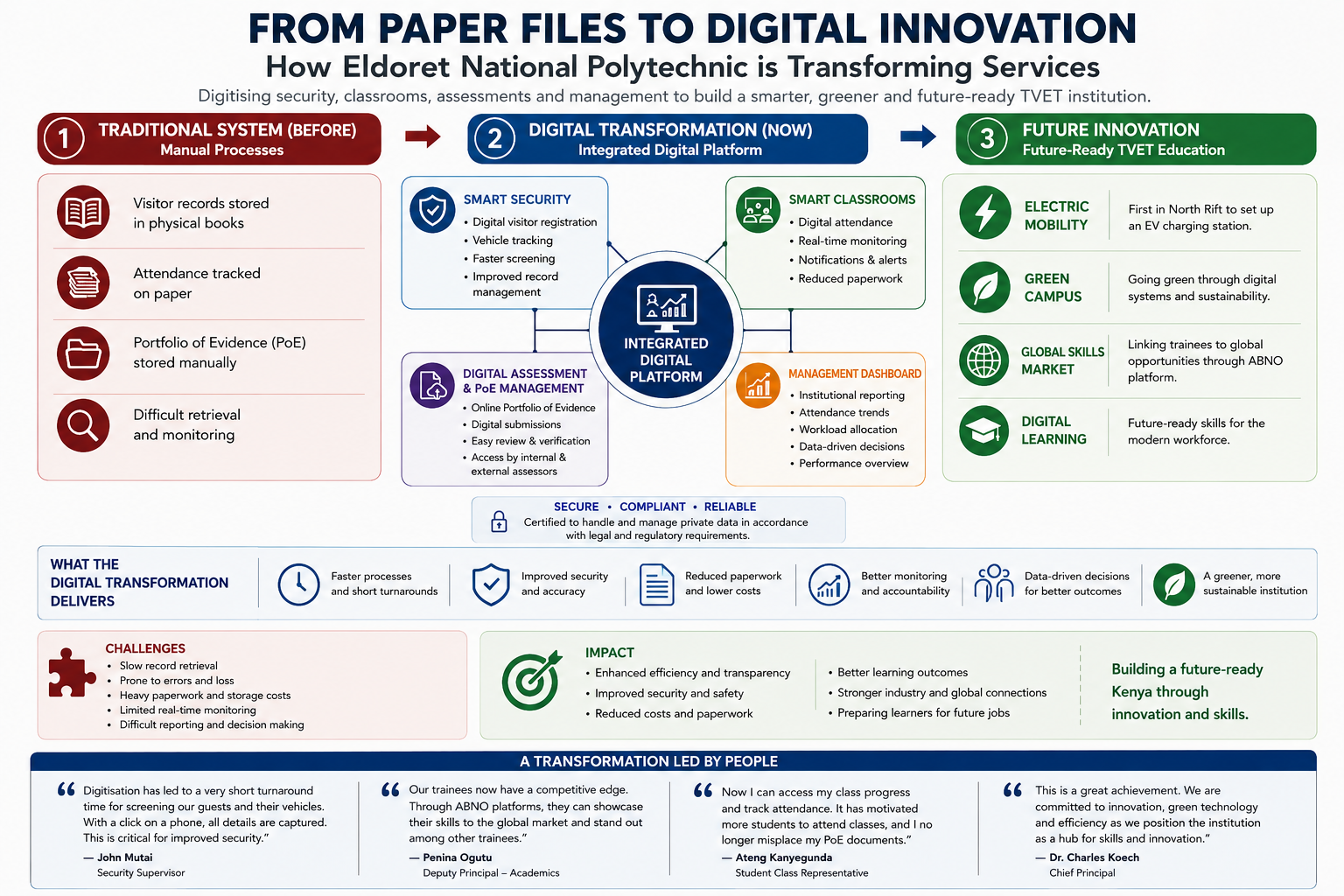
Students can submit evidence of their work, while trainers upload professional documents including lesson plans, schemes of work and assessment records.
Yabei says the system has made it easier for internal and external assessors to review student progress.
“Internal assessors, verifiers and even external assessors can access what is happening internally without having to come and go through physical files,” he says.
The system also provides dashboards that allow institutional leaders to monitor academic activities, attendance trends and departmental performance.
Connecting trainees to global opportunities
Beyond internal operations, Eldoret National Polytechnic is also expanding its digital ecosystem to connect students with opportunities beyond Kenya.
Penina Ogutu, the Deputy Principal in charge of Academics at Eldoret National Polytechnic, says the institution’s mandate goes beyond training — it includes curriculum development and certification.
“Our mandate as a National Polytechnic is to develop a curriculum, train and offer certification,” she says.
She explains that the institution has partnered with ABNO Softwares International to strengthen digital assessment and student visibility.

“For certification purposes, the Portfolio of Evidence that goes towards the trainee’s qualification has been integrated through ABNO Software International.”
According to Ogutu, the organization has provided two key platforms.
“One is an assessment module that will handle processing from registration all the way to marks processing and certification.”
“The second is the PoE platform where trainees subscribe for their own spaces, and those spaces belong to them. They can continue paying to own those spaces, which becomes a way of marketing themselves as trainees of Eldoret National Polytechnic.”
She says the platform gives graduates a competitive advantage by linking them to global industry.
“It links our trainees to the global market, giving them a competitive edge over trainees from other institutions.”
Through digital portfolios, employers can assess the competencies and practical skills of students even before they enter the job market.
Building a paperless and greener institution
The transformation is also aligned with the institution’s environmental goals.
The Deputy Principal says digitization is helping the institution reduce reliance on paper while improving service delivery.
“Going digital means less paperwork, and this supports our goal of becoming a greener institution,” she says.
The move is part of wider efforts to integrate sustainability into institutional operations.
Preparing for the electric mobility era
As part of its innovation agenda, Eldoret National Polytechnic is also preparing to become the first institution in the North Rift region to establish an electric vehicle charging station.
The project comes at a time when Kenya is beginning to embrace electric mobility as part of efforts to reduce carbon emissions and promote cleaner transport solutions.
The charging facility is expected to provide students with practical exposure to emerging technologies in electric vehicles, renewable energy and modern engineering.
For the institution, the project represents more than infrastructure — it is a training opportunity for the next generation of technicians.
Securing the future of digital learning
As more institutional services move online, data security remains a key priority.
Chief Principal Dr Charles Koech says the institution has taken steps to ensure its digital systems meet required standards.
He confirms that the institution has been certified by relevant authorities to handle and manage private data in accordance with legal requirements.
According to Dr Koech, innovation is central to the institution’s mission.

“This is a major achievement for Eldoret National Polytechnic,” he says.
“Our focus is to enhance efficiency through innovation, green technology and digital solutions while ensuring that we remain a leading TVET institution.”
A new chapter for technical education
At Eldoret National Polytechnic, technology is no longer a separate department — it is becoming part of the institution’s daily operations.
A visitor can now be cleared faster at the gate. A lecturer can monitor attendance digitally. A student can track academic progress. An assessor can review evidence remotely.
For Yabei, the transformation is about creating a more efficient and responsive institution.
“We are developing a system that covers the entire institution — from security, teaching, assessment and management. It is about making services easier, faster and more accountable.”
As Kenya continues to invest in skills development and digital transformation, Eldoret National Polytechnic’s journey shows how TVET institutions can become laboratories for innovation, preparing learners not only for today’s jobs, but for the future of work.
About Author