Kenya Unveils Bold Plan to Build Billion-Shilling Date Palm Industry in ASALs
Dr. Linyiru added that the increase in the production of date palms is now a national priority in line with the Bottom-Up Economic Transformation Agenda and Frontier Counties Development Council.
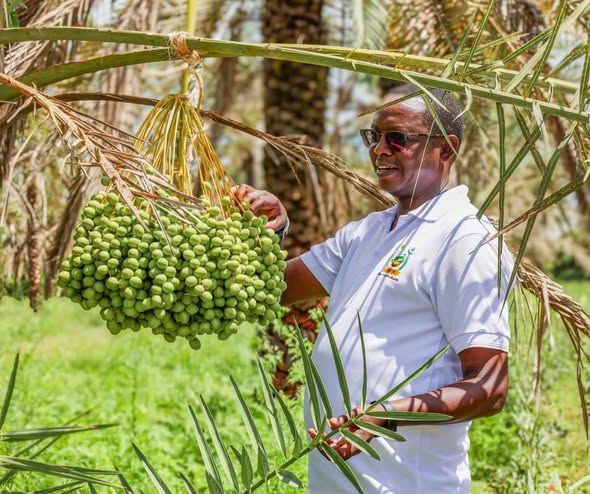
Makueni County, a delegation led by Director General of the Agricultural and Food Authority Dr. Bruno Linyiru, COG Chair and Wajir Governor Ahmed Abdullahi, and technical teams from KEPHIS and KALRO inspected thriving Indian and Israeli date palm varieties. Photo/Courtesy.
By Ruth Sang
Kenya has unveiled an ambitious plan to create a billion-shilling date palm industry across its arid and semi-arid lands, in what has been termed a major step towards commercializing one of the world’s most lucrative dryland crops. The initiative will help transform underutilized regions into high-value agricultural zones while reducing the country’s reliance on imported dates.
During a high-profile tour of Kutch Farm in Kibwezi, Makueni County, a delegation led by Director General of the Agricultural and Food Authority Dr. Bruno Linyiru, COG Chair and Wajir Governor Ahmed Abdullahi, and technical teams from KEPHIS and KALRO inspected thriving Indian and Israeli date palm varieties. The mission was designed to fast-track Kenya’s entry into the global date value chain through benchmarking from successful models of production.
The team saw date palms produce up to 200 kg per tree and observed the entire production chain-from the selection of male and female palms, pollination, irrigation, harvesting, and value addition. Experts from the farm said that under appropriate management, date palms can endure the highest temperature levels, tolerate saline soils, and stay productive for decades, thus being one of the most dependable long-term investments for dryland communities.
The renewed push now comes at a time when climate change is undermining traditional farming systems, relegating ASAL communities to seeking more resilient and profitable alternatives. Globally, dates are a multi-billion-dollar commodity dominated by Egypt, Saudi Arabia, Iran, Iraq, Algeria, and the UAE-regions with strikingly similar climatic conditions to northern Kenya. Yet Kenya produced only 1,100 kilograms of dates in 2023 and spent over KSh 359 million on imports in 2024. According to officials, that gap represents one of Kenya’s most significant untapped agricultural opportunities.
The delegation also reviewed at Kutch Farm an innovative intercropping system, where date palms grow with mangoes, pixies, oranges, okra, and other horticultural crops. The model improves land productivity with many sources of income for farmers.
The counties which will benefit highly if date farming becomes commercial include Wajir, Mandera, Marsabit, Turkana, Garissa, Kitui, Tana River, and Makueni. Dr. Linyiru added that the increase in the production of date palms is now a national priority in line with the Bottom-Up Economic Transformation Agenda and Frontier Counties Development Council.
With premium varieties like Medjool selling for up to KSh 1,200 a kilogram, a well-managed one-hectare date farm can make between KSh 3.4 million and KSh 4.4 million annually once mature. Plans are underway to establish certified nurseries, expand irrigation systems, train farmers, and set up processing hubs. If fully realized, this initiative could raise ASAL regions to become among the leading competitors in the global date industry, with extensive drylands serving as motors for growth in sustainable economies.
About Author