Can a Landlocked Country Claim the Ocean? Museveni’s Remarks Ignite Legal and Diplomatic Storm
He compared East African nations to residents of the same apartment building, suggesting that regional shared “space”—including economic corridors—could not be considered the property of coastal nations alone.
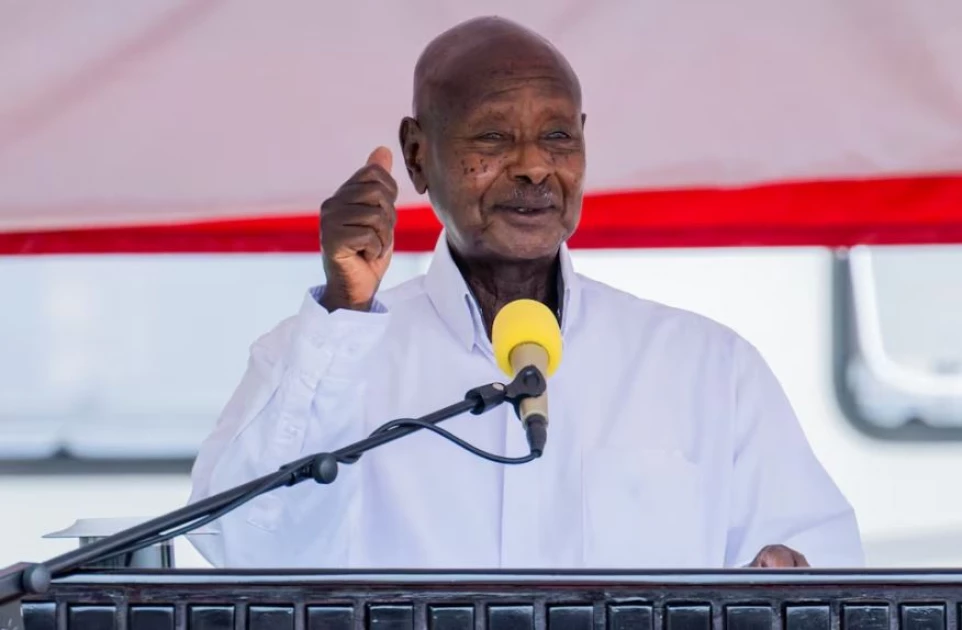
Uganda's President Yoweri Museveni delivers the 2025 State of the Nation Address at Kololo Ceremonial Grounds, in Kampala, Uganda June 5, 2025. Photo/Courtesy
By Ruth Sang
An unexpected regional debate has been stirred by Uganda’s President Yoweri Museveni following his daring statement during a campaign rally that Uganda “owns” the Indian Ocean and would be ready for war over the same in the future in case access is impeded. Unusual even by regional political standards, the remarks rapidly went viral online, stirring confusion, diplomatic unease, and an explosion of humour-particularly among Kenyans, who questioned how a landlocked nation without a coastline or navy could lay claim to an ocean.
It escalated sufficiently to attract the interest of Kenya’s President William Ruto, who intervened not to castigate Museveni but to defend him. Ruto accused the media of distorting Museveni’s statement and called on citizens of both countries to view the statement in the spirit of friendship and regional unity. His intervention was seen as an attempt to defuse rising tension between Nairobi and Kampala, which appeared unsettled for several days following Museveni’s remarks.
Mr. Museveni, who is seeking a fresh term of office, went beyond calls for deeper East African cooperation to make what sounded like a territorial assertion over the Indian Ocean. “I am entitled to that ocean. it belongs to me,” he declared, warning that future wars could emerge if Uganda’s access was ever threatened.
In Kenya, reactions varied from light-hearted jokes on social media to the more-measured statements emanating from government officials. While ruling out any possibility of military conflict, Prime Cabinet Secretary Musalia Mudavadi emphatically restated Kenya’s position as a reliable transit point for landlocked neighbors. He said Kenya was still committed to facilitating Uganda’s use of the Port of Mombasa, describing it as part of the country’s international obligations.
President Ruto emphasized this stance during a public address in Tororo, Uganda, where he stood with Museveni to reassure the public. Ruto insisted that the remarks were blown out of proportion by journalists, assuring Ugandans that access to the sea through Kenya was fully guaranteed. “Uganda and Kenya are brotherly countries,” Ruto said. “There is no question concerning Uganda’s access to the sea through Kenya.”
Museveni later explained that his ocean remarks were figurative. He compared East African nations to residents of the same apartment building, suggesting that regional shared “space”—including economic corridors—could not be considered the property of coastal nations alone. “If you live on the ground floor, that does not mean the compound belongs only to you,” he said.
Beyond the political theatrics, there’s a core legal issue: Can a landlocked state claim part of the ocean?
And what does UNCLOS say about this? A straightforward ‘no’. Under UNCLOS, sovereignty over territorial waters strictly belongs to the coastal states, like Kenya. The landlocked countries such as Uganda do not have any sort of authority over any oceanic territory. However, UNCLOS does grant rights to landlocked states. Article 125 guarantees them access to and from the sea, as well as freedom of transit through neighbouring countries. That means transit states must allow such access and cannot arbitrarily block it. Over the weekend, Museveni softened the tone, clarifying that his comments were intended to call attention to regional security concerns and to push for greater East African political cohesion, not to make a literal claim of ownership over the Indian Ocean.
About Author