Kenya National Civil Society Centre urges government to reintroduce Kazi kwa vijana
By James Gitaka
The Kenya National Civil Society Centre (KNCSC) has called on the government to consider reintroducing the ‘Kazi Kwa Vijana’ programmes to stem the wave of crime bedeviling the country.
“It is the considered opinion of the KNCSC that continued failure by the Kenya Government to provide short and medium-term measures to address the high cost of living is partly to blame for the spate of increasing crime rate in the country “Said Suba Churchil the Executive Director KNCSC
While the government has done a commendable job by taking measures such as making farm inputs like fertilizers more affordable to crop farmers, such medium and long-term measures ought to have been coupled with short-term measures with the potential to immediately put money into the pockets of no-income and low- income earners to meet the most basic of their needs like buying food, energy, transport and healthcare. He added .
The KNCSC has said The government should, therefore, not have dismissed some of the stopgap measures that were deployed by the Jubilee administration such as ‘Kazi Kwa Vijana’ (the labour- intensive public works and social support services through which the government kept the youth positively engaged as they also earned a living).
“Other than providing opportunities for the youth to participate in national and community development processes, studies have confirmed that the ‘Kazi Kwa Vijana’ programme distracted idle youth from criminal tendencies and gave them hope that they would earn some money from lending their labour in the many public works and social service programmes that they had been involved in to meet some of their needs” Churchil arqued.
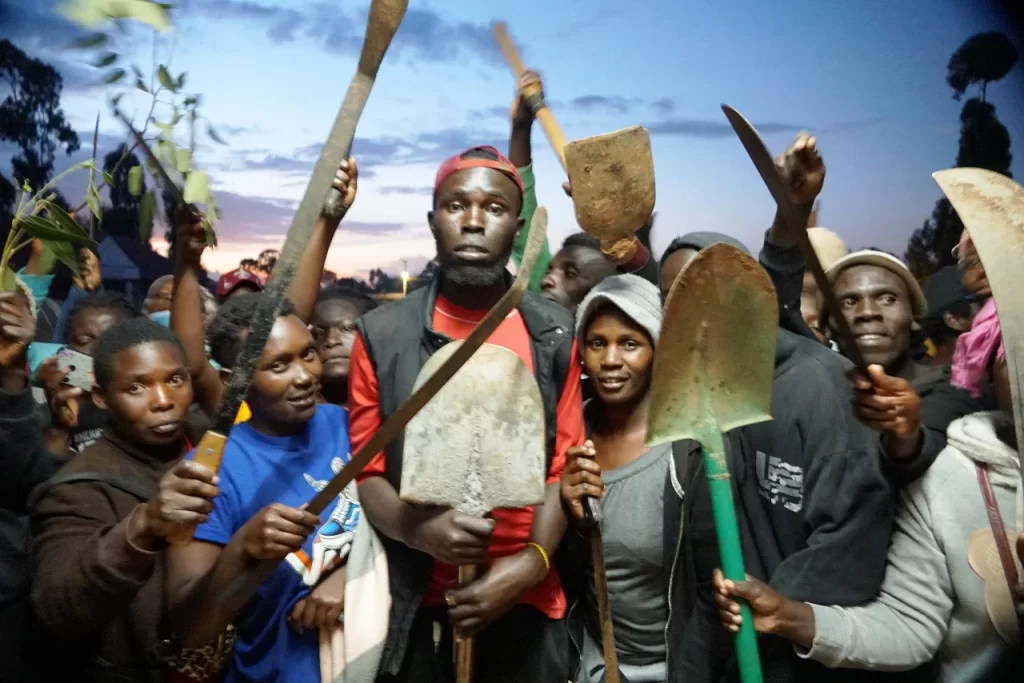
 Kazi kwa vijana/Photo Kenya News Agency
The Kenya National Civil Society Centre, has therefore, considered it ill-advised for the Kenya Kwanza administration to have discontinued the ‘kazi kwa vijana’ programme upon taking over the reins of power merely because it had gained traction during the second term of former President Uhuru Kenyatta.
And despite admission by the Kenya Kwanza Alliance in its manifesto that “there are not enough white-collar managerial jobs in the public service or the small corporate economy to absorb the hundreds of thousands of irrepressible young educated
Kenyans with middle class aspirations” It is the considered view of the KNCSC that the mischaracterization of ‘Kazi kwa Vijana’ in the Kenya Kwanza manifesto that equates the programme to “throwing crumbs at young educated Kenyans” was the starting point to the wave of crime that has hit the country within a month after the August 9, 2022 General Elections, undermining the promise and potential for economic pick-up and growth after the Covid-19 pandemic.
The KNCSC has recalled that in early 2020 when the COVID-19 pandemic struck small and big economies across the world, leading to lockdowns and other restrictive measures that greatly disrupted global supply chains, from factory closures to bottlenecks at maritime ports, it is through such stop-gap programmes such as ‘kazi kwa vijana’ that the government was able to pull the country from the abyss of economic meltdown and public despondency that would have resulted from the massive loss of income at individual, family, corporate and government levels.
Against this backdrop, governments issued stimulus checks and increased unemployment benefits to help blunt the financial impact of these measures on individuals and small businesses. In Kenya where the economy was less able to issue most of such benefits, innovative programmes such as ‘Kazi Kwa Vijana’ came in handy, enabling the government to draw in the energy, enterprise and creativity of the youth into public works and social services that benefit the public as the youth also draw in incomes that enable them to meet some of their pressing needs.
With the Russia-Ukraine conflict continuing unabated, the maritime bottlenecks to movement of grains that Kenya relies on for imports to meet local grain deficits from the two countries still unmitigated, and the ravaging drought depriving communities of their livelihoods, the stoppage of ‘Kazi Kwa Vijana’, and the budget cuts that the government has imposed ostensibly to save for capital intensive investments and to service debts have only served to aggravate the socio-economic situation that the Covid-19 pandemic left in its wake Noted KNCSC Executive director .
“While it is a good thing to save, the government should be reminded that it can only save for the living and not the dead or the dying. The government should, therefore, rethink its strategies in the wake of reports of people collapsing and dying from hunger and dehydration, or resorting to crime to fend for themselves and meet their basic needs “Asserted Suba.
About Author